














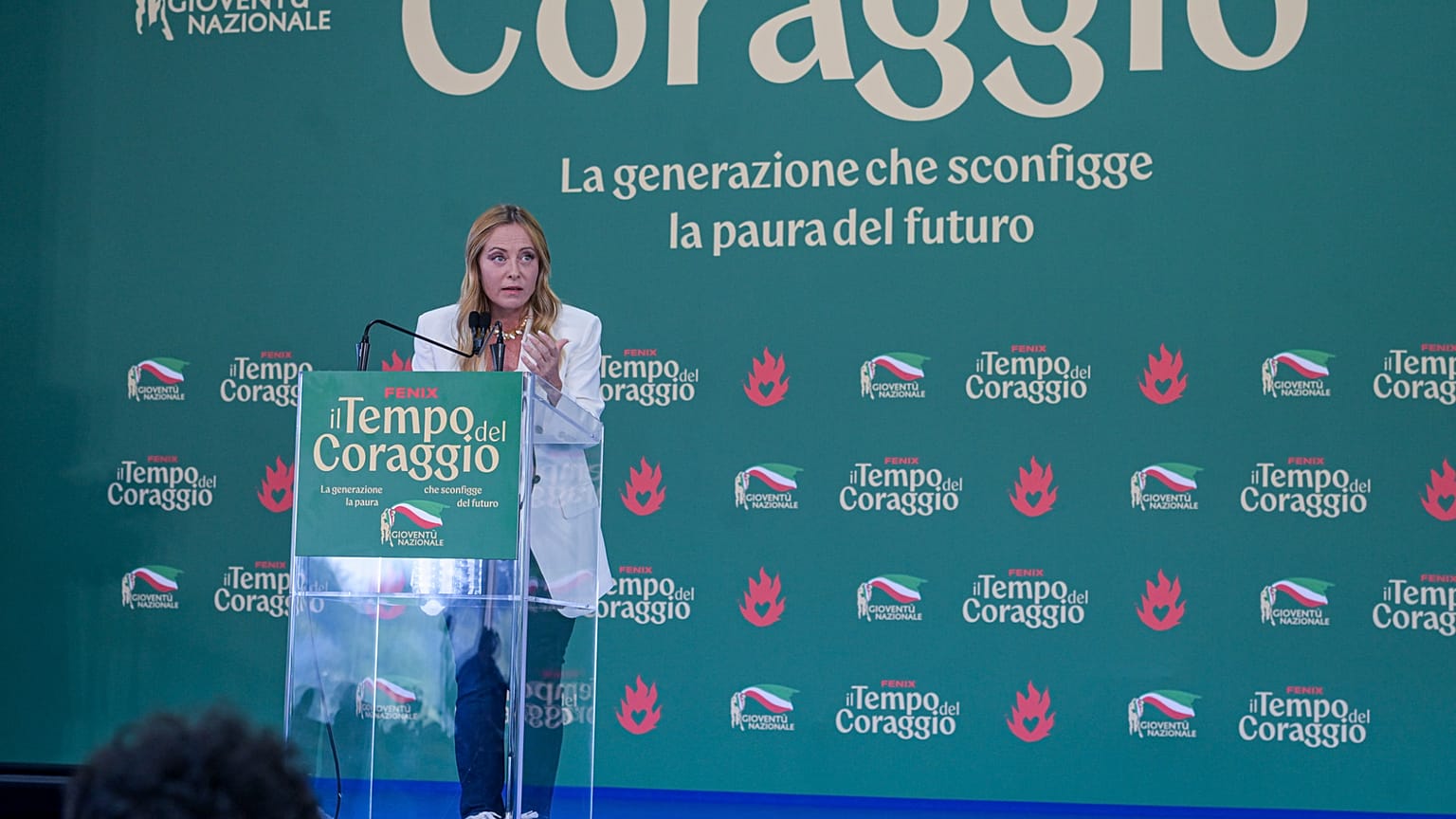













Giorgia Meloni on Sunday announced plans to ban full veils in Italian schools and curb the enrollment of foreign students who do not speak Italian, echoing rules in other EU states. Here's a comparison of other EU countries' rules on this topic.
The Italian prime minister Giorgia Meloni has announced that a bill focused on schools is about to be put before the Council of Ministers, with the aim of introducing bans on wearing burqas and niqabs in the classroom and imposing a limit on the number of foreign students in each class.
 ADVERTISEMENT
ADVERTISEMENT
ADVERTISEMENT
The ban on covering one’s face in public places has previously been introduced in several European countries, including France and Belgium, and more recently, it has also been applied in Austrian schools. In other countries, such as Spain and Poland, freedom of conscience and religion is protected by the constitution.
"A measure is about to go before the Council of Ministers that will set in law the maximum number of foreign students allowed per class, and a measure that will make it compulsory for the parents of foreign students with serious problems of school integration to learn Italian, and that introduces a ban on burqas and niqabs at school," Meloni said during her speech at Fenix, the festival of Gioventù Nazionale, the youth movement of her party Brothers of Italy.
Explaining the initiative, Meloni criticised the way the issue has been handled in the past, saying: "It is unacceptable that in an Italian classroom the children who end up feeling pushed into a corner are Italian children because they have become the minority. That cannot be allowed. Calling all this integration is yet another lie, a convenient lie for those who live off ideology, for those who preach to us from their living rooms and then send their own children to schools where this problem does not exist."
Previous initiatives and legislative proposals
Meloni’s announcement comes against the backdrop of an institutional process already set in motion in previous months.
At the beginning of August, Education and Merit Minister Giuseppe Valditara had floated action on the full-face veil through an amendment to the security bill.
At the end of July, in the Chamber of Deputies, Futuro Nazionale, the party founded by far-right MEP Roberto Vannacci, who has already said he backs the measure announced by Meloni, put forward a resolution against the full-face veil in the Chamber’s Culture Committee, which was approved with centre-right votes after being redrafted at the government’s request.
In March, a bill was tabled in the Senate by the League to amend article 5 of the 1975 "Reale" law, introduced by then justice minister Oronzo Reale during the Years of Lead to ban masking in public places, with the aim of creating a new offence of forcing someone to conceal their face, punishable by one to two years in prison, fines of between 10,000 and 30,000 euros and as a bar to the granting of citizenship.
Definitions and rules on the full-face veil in Europe
In her speech, Meloni spoke of a ban on burqas and niqabs**:** the former is traditionally a full-body garment, usually light blue, that covers the entire body and includes a semi-transparent mesh over the eyes; the latter is a black veil that completely covers the face, leaving only a slit for the eyes. For completeness, the hijab is the traditional headscarf that covers the hair and neck while leaving the face visible.
Across Europe, rules on covering the face in public spaces have been adopted by several states over the years. France introduced an outright ban on concealing one's face in all public places in April 2011, which was later upheld by the European Court of Human Rights.
Belgium approved a total ban on public spaces in July 2011, with fines and prison sentences for violations. Bulgaria has banned the use of the full-face veil in state, administrative and educational institutions since September 2016.
Austria passed an anti-mask law in October 2017 requiring facial features to remain fully visible in public spaces and, from September 2026, girls up to the age of 14 will be prohibited from wearing at school any veil that "covers the head according to Islamic traditions".
Denmark introduced a nationwide ban in August 2018, with escalating financial penalties for repeat offences. The Netherlands opted for a partial ban from August 2019, applied specifically to schools, hospitals, government offices and public transport.
Switzerland has adopted a federal ban in public spaces following a national referendum and subsequent implementing legislation that came into force in 2023. Finally, Portugal completed its legislative process in August 2026 with a law prohibiting the concealment of the face in public spaces and imposing financial penalties.
In Germany, there is no nationwide ban, but federal legislation prohibits public employees, judges, members of the armed forces, and motorists from covering their faces while driving. In addition, several federal states (Länder) impose restrictions banning the full-face veil in schools and universities for both students and teachers. This fragmented approach is based on the principles of state neutrality and road safety and differs from the blanket bans seen in other European countries.
Foreign students in the classroom: a comparison with other European countries
Turning to the rule that would introduce a maximum quota on foreign students per class, Italy would become the first country in Europe to adopt such regulations.
Up to now, in Italy, the 30% limit on non-Italian pupils has been set out in a ministerial circular issued in 2010 by then education minister Mariastella Gelmini, which has often remained unenforced due to local demographic dynamics and a lack of logistical room to manoeuvre in urban outskirts.
Other EU countries prefer different tools. Denmark is the European country with the toughest policies: the government has allowed upper secondary schools to introduce caps of up to 50% for students of "non-Western origin" or from disadvantaged neighbourhoods. Classes are also organised based on parents’ income to force social and ethnic mixing, a model the Italian government is watching with interest.
In France, setting quotas based on origin would be unconstitutional, as the Republic bans the collection of statistics on ethnic or religious grounds. To avoid school ghettos, the country relies on "zoning": municipalities redesign school catchment areas so as to link a working-class neighbourhood with a wealthier one. In areas with a high concentration of migrants, the state also sharply reduces the total number of pupils per class.
Criticism of Meloni’s proposal
Giorgia Meloni’s announcement has sparked favourable reactions from members of the ruling majority, but also criticism from the opposition and some experts. Speaking to the ANSA news agency, Salvatore Curreri, professor of constitutional law at the University of Enna, explained that under article 34 of the Constitution, "school is open to everyone", including the children of foreigners, for whom it is in fact a powerful place and tool for integration.
"If the measure were so restrictive as to uproot minors and their families to other areas, far from where they live, it could prove excessive precisely because it conflicts with the overriding functional aim of integration, with the risk of infringing a right recognised by the constitution," Curreri said.
"Yet again, instead of dealing with schools, she is chasing the neo-fascist right of AfD and Vannacci, who has proposed separate classes for students with disabilities. The truth is that the prime minister is not at all interested in how schools work. Our teachers’ salaries are among the lowest in Europe," said Angelo Bonelli, Avs MP and co-spokesperson for Green Europe.