

















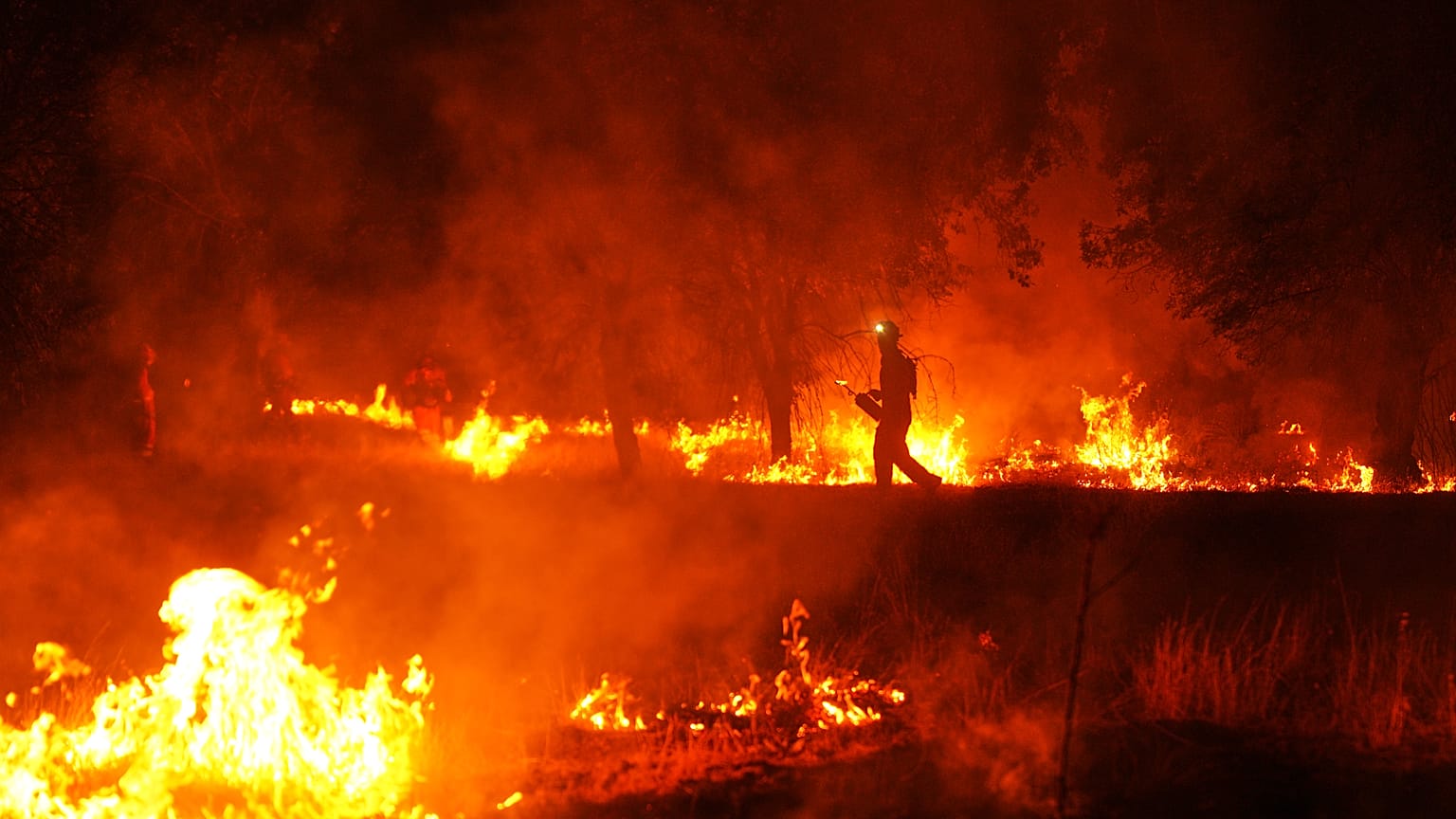













Europe has built advanced systems to detect wildfires and coordinate emergency response. Still, there is no common picture of who starts deliberate fires or why, as arson remains a fragmented national matter.
European authorities are confronting increasingly extreme wildfire seasons as climate change makes each one more destructive. But while the EU has made real progress coordinating its emergency response, the fight against intentional ignition remains fragmented.
 ADVERTISEMENT
ADVERTISEMENT
ADVERTISEMENT
Over the past few years, the EU has significantly strengthened its capacity to respond to wildfires. Through the EU Civil Protection Mechanism, the European Commission coordinates assistance between member states, while the rescEU reserve has expanded Europe's shared pool of firefighting aircraft, equipment and other emergency resources.
But while Europe is getting better at fighting wildfires once they start, it still has little common understanding of one of the first questions investigators ask: how did the fire begin?
Intentional ignition remains largely a national matter, with criminal laws, investigation methods and reporting practices varying widely across the bloc. The result is a blind spot: the EU can map fires from space and coordinate emergency responses across borders, but it has no comparable European picture of who starts deliberate fires, or why.
"Not all these fires are accidents. Some are deliberately set: it is a crime, punishable by 15 years of criminal imprisonment," French Prime Minister Sébastien Lecornu wrote on X during the latest wildfire crisis. "Security forces are fully mobilised to identify arsonists. They will be found, arrested, and held accountable for their actions before the courts."
What is arson?
Wildfire agencies generally classify fires by cause, distinguishing between natural, accidental, intentional and unknown origins.
Natural fires are mostly linked to lightning. Human-caused fires account for the overwhelming majority of ignitions in Europe, but that category spans very different situations: accidental fires caused by machinery, agricultural work, campfires, fireworks or discarded cigarettes, as well as fires set deliberately.
Broadly, arson refers to the deliberate setting of fire to property, forests or land. But the legal consequences vary depending on what burns, the danger created and the damage caused.
A Joint Research Centre (JRC) review of wildfire ignition factors identified several motivations behind intentional fires, including pasture renewal, vandalism, retaliation against private individuals or public authorities, and conflicts over land management.
There is no harmonised EU definition of arson. Criminal law remains a national competence, and countries differ in how they treat forest fires legally, making comparisons difficult.
Spain and Portugal have specific offences for forest fires, reflecting the fact that the damage extends beyond private property to ecosystems, public safety and entire communities.
Germany, by contrast, approaches arson through a broader hierarchy of offences under its criminal code, with the most serious categories tied to the danger posed to human life and protected assets.
Under French law, setting fire to "another person's woods, forests, heathland, scrubland, plantations or reforested areas" is punishable by up to 15 years' imprisonment and a €150,000 fine where the offence is "committed under circumstances likely to expose persons to bodily injury or cause irreversible environmental damage."
Removing economic incentives
Some southern European countries have tried to remove one possible economic incentive for deliberate fires: the prospect that burned land could later become more valuable or easier to develop.
Spain and Portugal introduced restrictions preventing burned forest areas from being rapidly converted to other uses.
In Spain, a reform of the Forest Law introduced a general 30-year restriction on changing the status of burned forest land, except under strict conditions. Portugal introduced a similar framework, with restrictions lasting 10 years in many cases.
The goal was to break a cycle in which land could be deliberately burned and then converted for agriculture, construction or other economic activities.
Researchers caution, however, that land speculation is only one of several possible motivations behind intentional fires.
The role of climate change
The challenge of understanding intentional fires comes at a time when the consequences of every ignition are becoming increasingly severe.
Climate change does not necessarily create more people willing to start fires. But it creates the conditions in which the same ignition is far more likely to become a large-scale disaster.
The European Commission has warned that hotter summers, prolonged droughts and heatwaves dry out vegetation and increase the likelihood that fires spread rapidly.
In its strategy on integrated wildfire risk management, the Commission noted that Europe is facing increasingly extreme wildfire events despite improvements in prevention and preparedness.
In 2025, the Commission said the cumulative burned area in the EU exceeded one million hectares, the highest level recorded in the bloc's wildfire monitoring history and comparable to the size of Cyprus.
What information is available
The EU's Copernicus Earth observation programme has transformed wildfire monitoring.
Through the European Forest Fire Information System (EFFIS), authorities can access fire danger forecasts before fires start, and satellite-based information on fire location, spread and damage during and after events.
Copernicus has significantly improved the information available to civil protection authorities, letting countries coordinate their responses around a common European picture.
However, satellites can show where and when a fire started and how it spread, but they cannot determine whether an ignition was deliberate, identify who was responsible, or establish a motive.
For that, authorities still depend on national police investigations, forensic evidence and local knowledge.
The EU's wildfire database relies on information supplied by national authorities, including their own classifications of fire causes. EFFIS has developed common categories, but the availability and quality of that cause data still vary between countries, limiting comparisons.
A criminal intelligence gap
The gap is particularly stark next to other areas of cross-border crime.
Eurostat produces harmonised statistics for selected criminal offences, including homicide, robbery and sexual violence. There is no comparable EU-wide dataset on deliberate fire-setting, partly because national criminal classifications and reporting practices differ so widely.
Europol has flagged environmental crime as a priority area under the EU's European Multidisciplinary Platform Against Criminal Threats (EMPACT), the framework member states use to coordinate action against serious and organised crime.
But Europol's environmental crime work has focused largely on waste trafficking, pollution and the illegal exploitation of natural resources. Deliberate wildfire-setting remains a comparatively underdeveloped area of European criminal intelligence.
Europe has built one of the world's most advanced systems for detecting wildfires and coordinating emergency responses. It can monitor fires from satellites, mobilise firefighters across borders and estimate the damage within days.
But when it comes to who started the fire, and why, the EU still largely depends on fragmented national investigations.