































Data shows young women, with low education and fixed-term contracts are the most likely to be low-wage earners.
Millions of European workers earn just a fraction of their country's average pay.
 ADVERTISEMENT
ADVERTISEMENT
ADVERTISEMENT
The latest Eurostat data shows nearly 15% of the EU's workforce is made up of low-wage earners.
Low-wage workers are employees who earn two-thirds or less of the median wage in their respective countries.
The report shows a noticeable gender gap: 18.2% among women fall into this category, compared to 12.5% of men.
Young people are particularly affected: one in four low-wage earners is under 30.
The highest shares of low-paid workers were found in Bulgaria (26.8%), Romania (23.9%), Latvia (23.3%) and Greece (21.7%), while, on the flipside, countries like Portugal, Sweden, Finland, Italy and Slovenia show the lowest rates, implying a more homogenous salary distribution.
Food and hospitality workers most likely to be affected
Hospitality and food workers top the list, employing over a third (35.1%) of all EU low-wage earners, closely followed by administrative and support services, at 32%.
Contract type and education also play a major role in defining earnings.
People on fixed-term contracts are more than twice as likely to fall into this category than those on permanent engagements (27.2% vs 12.6%).
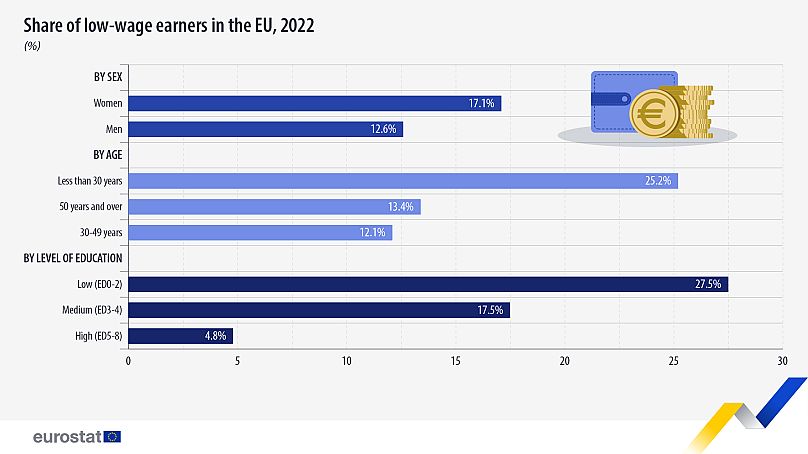
Education makes a huge difference too, as nearly 28% of workers with a low level end up in the low-pay bracket, compared to just 4.8% of those with a so-called higher education and medium education (17.5%).