
















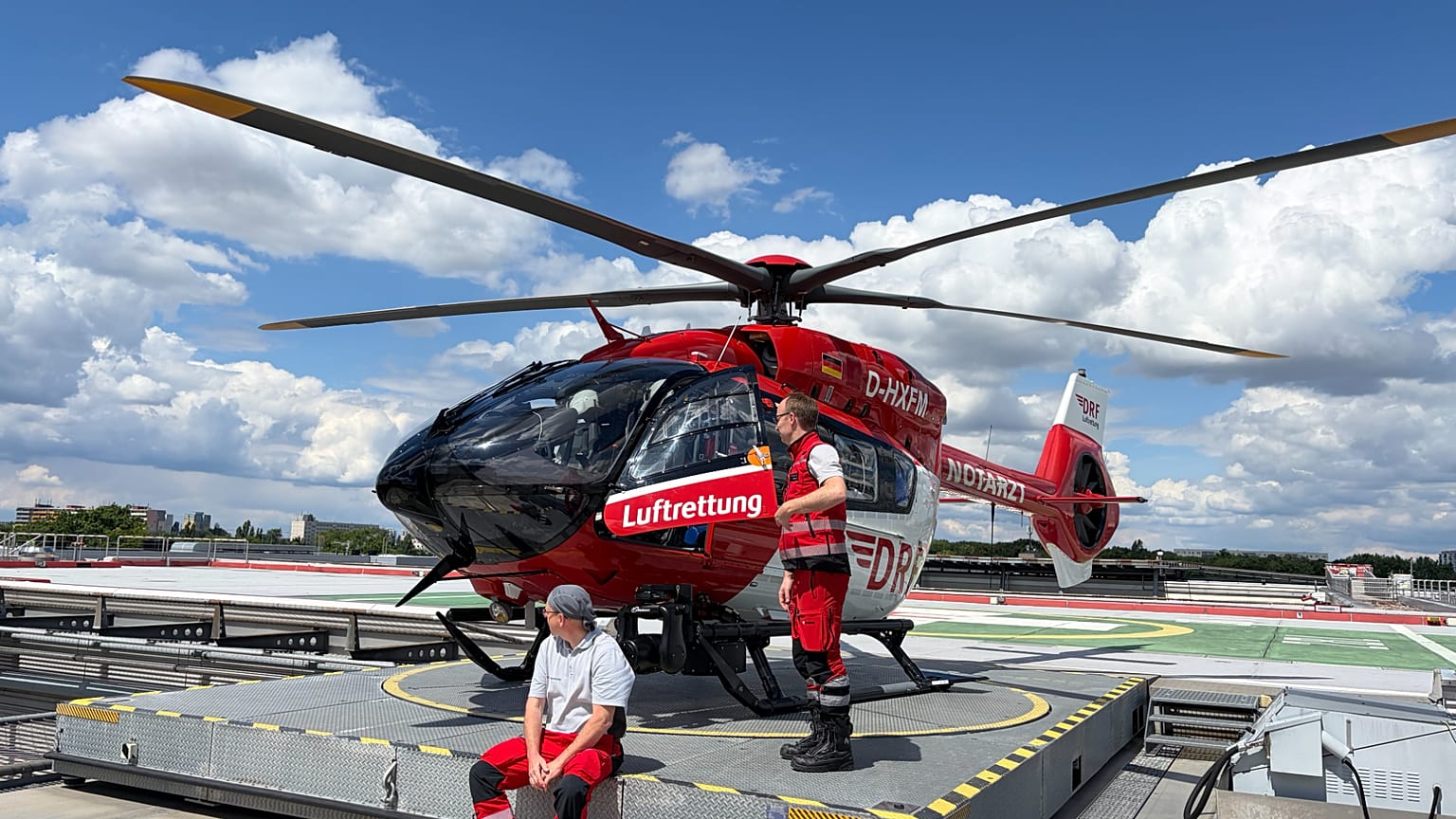













When an emergency call comes in, every minute counts. Air rescue can reach the scene within minutes and supports ground services, but a planned law to curb health insurance costs could put this rapid help from the air under pressure.
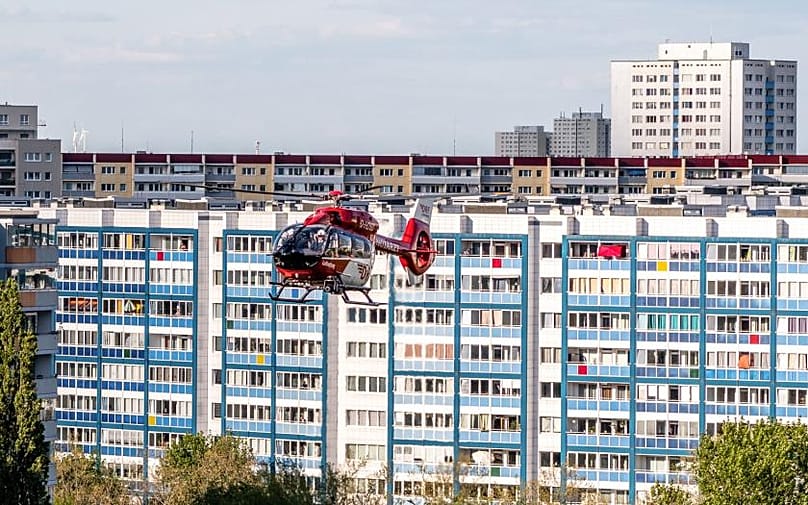
An emergency call comes in. Moments later, an emergency helicopter lifts off from the Berlin Accident Hospital (ukb) in Marzahn. On board are a pilot, an emergency doctor and a paramedic – a well-rehearsed team for missions where routine, precision and time can be critical.
 ADVERTISEMENT
ADVERTISEMENT
ADVERTISEMENT
Their destination is the small town of Lübben in Brandenburg, where a patient with severe burns is waiting. He needs to be taken quickly to the ukb’s specialised burns centre. For the crew, this is a familiar routine.
'When an emergency call comes in, every second counts,' says emergency doctor Jan Martin. 'In particular for heart attack or stroke patients, with every minute without treatment more tissue is lost.' That is why everything has to be prepared at the start of a shift so that the crew can take off immediately. From the alarm to lift-off usually takes no more than two minutes.
Where air rescue is particularly vital
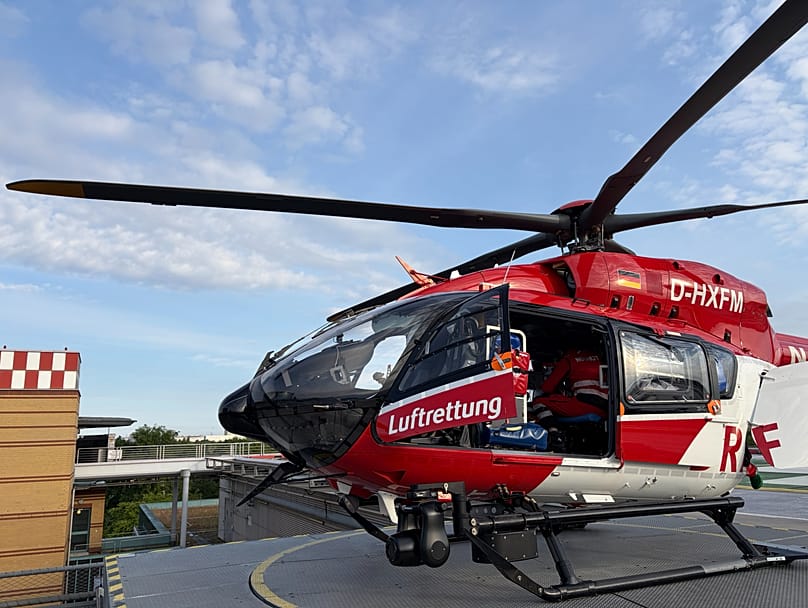
Air rescue does not replace ground emergency services; it complements them. It becomes especially important where distances are long, hospitals are further apart or specialised treatment is only available at a handful of sites. In such cases, the time saved by helicopter can be crucial – both for initial emergency care and for transfers between hospitals.
DRF Luftrettung operates 34 helicopter bases at 32 locations nationwide, three of them in Berlin. The Berlin base is on call around the clock. A helicopter can cover around 70 kilometres in about 17 minutes – a difference that is particularly stark outside densely populated areas.
Classic emergency missions – and patient transfers
What is special about this base is that the intensive care transport helicopter "Christoph Berlin" at the Berlin Accident Hospital carries out two types of missions. Primary missions are classic emergency call-outs directly to the scene – for example after road accidents or in acute internal medical emergencies. Here, speed of medical help is what counts above all.
In addition there are secondary missions, meaning transfers between hospitals. Patients are moved to another hospital because a particular treatment is only available there.
On standby for emergencies 13 hours a day
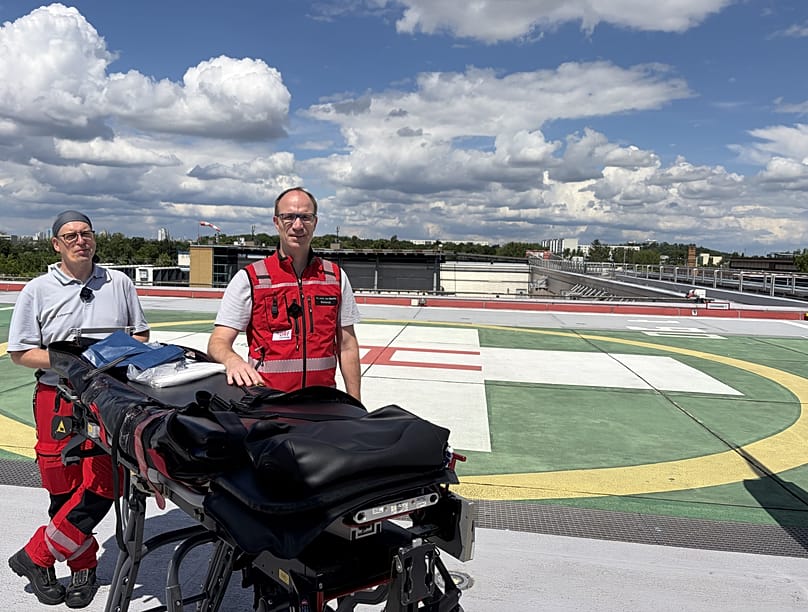
The day shift starts early. At 6.30 am the crew members check the technology, equipment and readiness for deployment. That includes the medical kit, inspection of the helicopter and the weather conditions. The joint briefing takes place over breakfast.
Pilot Sebastian Nothbaum describes how many factors have to be taken into account even before take-off: the weather, airspace closures, exercises, prescribed flight routes. Air rescue therefore means not only flying fast but also precise planning under time pressure.
The crews work 13-hour shifts, which demands sustained concentration – even when there is a long wait for the next call-out. As soon as the alarm sounds, everything has to run like clockwork. On top of that come night flights, changing weather conditions and the emotional strain. The crew sum it up soberly: 'You have to really want to do this job.'
Highly specialised care on board
Modern medical technology is on board. In Berlin-Marzahn, blood and plasma reserves have also been part of the equipment since November 2024. In cases of severe injuries or massive blood loss, life-saving treatment can therefore begin even before the patient reaches hospital.
The personnel are highly specialised as well. Emergency doctors need additional qualifications to work on the helicopter. Many also work in anaesthetics or intensive care medicine to maintain close links with clinical practice. The doctors are not always employed directly by DRF Luftrettung, but often come from partner hospitals.
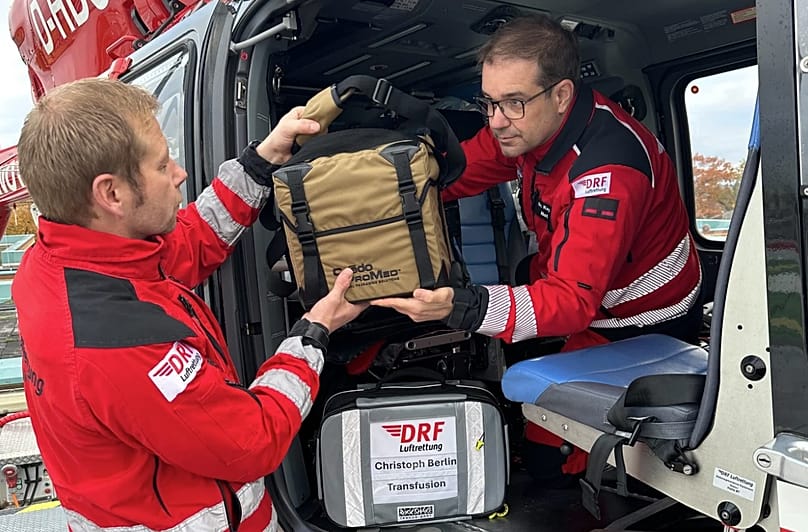
Pilots and paramedics (HEMS-TC) are also subject to special requirements. They have to master both medical and aviation procedures and function as a team under time pressure. This interaction is crucial, especially when landing away from hospital sites.
Once at the scene, the crew carries out what is known as a high reconnaissance: from the air they assess where it is safe to land and how best to reach the patient. Direct access is not always possible, so the exact mode of transport is often decided only on site.
The limits of air rescue
When there is low cloud, thunderstorms, high winds or ground fog, flights may be impossible or only possible to a limited extent. Before every take-off, the crew therefore checks whether the mission can be flown safely, including using information from the German Weather Service.
Conditions at the scene are not always straightforward either. Not every location is suitable as a landing site, and sometimes the crew has to walk some distance to reach the patient after landing. Public cooperation is also essential. If safety distances are not observed or instructions are not understood, this can make landing difficult.
What lies behind every mission
Ensuring that air rescue is available at all times requires complex infrastructure. Helicopters, technology, maintenance, fuel and highly qualified staff all have to be permanently on standby. According to DRF Luftrettung, a helicopter including its equipment costs several million euros, and around 280 litres of kerosene are burned per flight hour.
On top of that, it is not only successful transports that cost money. False alarms or aborted missions also put a strain on the system. Every take-off brings the helicopter closer to its next maintenance check. What is financed, therefore, is not a single flight but a continuous readiness service.
DRF managing director Dr Krystian Pracz explains: 'We bill by flight minute; that is what we have agreed with the health insurers. That covers all services.' In his view, the debate about costs often falls short, because rapid rescue can also help reduce subsequent treatment costs – for example if patients receive care earlier and their recovery time is shortened.
Why the Law to Limit Health Insurance Costs is alarming the sector
With the planned Act to Stabilise Statutory Health Insurance Contribution Rates (GKV-Beitragssatzstabilisierungsgesetz) (source in German), the federal government wants to stabilise the finances of the statutory health insurance system and curb further contribution increases. The plan is to cap increases in remuneration in many areas of the healthcare system. These are to be linked to the basic wage rate, which reflects the average annual percentage change in the contribution-liable income of all members of the statutory health insurance scheme. Alternatively, actual cost increases can serve as the benchmark, depending on which figure is lower.
From the operators’ point of view, this poses a problem for air rescue, because funding does not keep pace with their costs. The non-profit air rescue organisations ADAC, DRF and Johanniter therefore warn of a funding gap. In their view, this would put pressure on a field that is becoming increasingly important in an ever more specialised healthcare system.
Consequences for healthcare provision in rural areas
This debate carries particular weight for rural regions. Where hospitals are further apart, specialist clinics are not close by and journeys by road take longer, air rescue can play a decisive role – both in emergencies and for transfers.
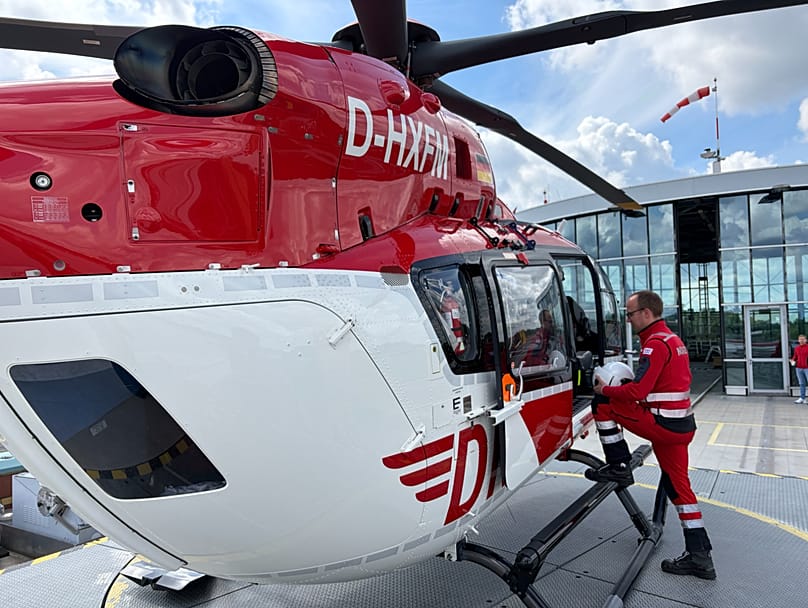
Mathias Buchholz, paramedic and Helicopter Emergency Medical Service Technical Crew Member (HEMS-TC), describes the advantage from day-to-day operations as follows: 'If the patient had been transported by road, an emergency doctor would have been tied up and out of the area for three to four hours. This way it is significantly quicker.' A long ground transport uses up staff and worsens cover elsewhere. For the badly injured man from Lübben, what ultimately counts is the fast route to the specialised burns centre.
Things are quietening down again at the Berlin-Marzahn Accident Hospital. The patient has been handed over, the rotors have fallen silent. For the crew the mission is over, but their shift is far from finished: they remain on standby for several more hours.
Whether this system will remain as reliable in future now also depends on political decisions. The Bundestag is due to vote on the savings package on 10 July. For patients, the price of a flight minute is unlikely to be what matters in the end – but rather that they are flown in time.