






























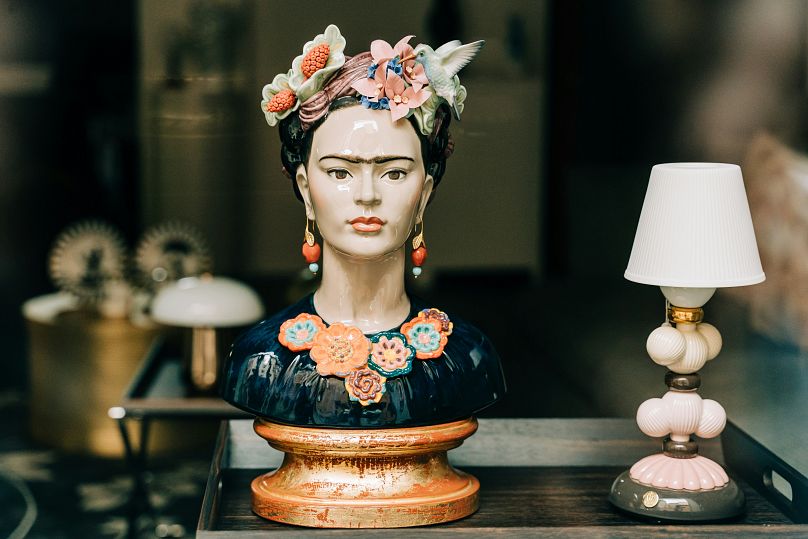
Stylised and simplified, Kahlo’s likeness can now be found on t-shirts, tote bags, eye masks, phone cases, oven mitts and plant pots.
A blockbuster exhibition on Frida Kahlo is about to open at Tate Modern - and it's already a huge success.
 ADVERTISEMENT
ADVERTISEMENT
ADVERTISEMENT
Last week, the London-based gallery reported that more than 41,000 tickets had already sold for 'Frida: The Making of an Icon', which opens on 25 June. This makes it the highest pre-selling exhibition in the entirety of Tate's history - a title previously held by a David Hockney retrospective in 2017.
It also goes to show the hold Kahlo continues to have on the world. Beloved by fans for her ferocious spirit, boundary-breaking art, and profound honesty about the ugliest parts of her life, she also propelled Mexican art into the spotlight.
But still, sometimes it seems like her greatest legacy is the merchantability of her face - and those eyebrows.
Stylised and simplified, Kahlo’s likeness can now be found on t-shirts, tote bags, eye masks, phone cases, oven mitts and plant pots.
This capitalistic evolution is explored at the Tate's new exhibition (examples of which will undoubtedly feature in the gift shop) - but also beg the question: how did Kahlo's appearance become so marketable? And do these items, with their mass-audience appeal, risk losing the try meaning and power of her legacy?
What is Fridamania?
It is not uncommon to find an artist’s self-portrait printed onto an item of clothing, bag or accessory. But with Kahlo, it is not just her psychologically profound autobiographical depictions that decorate gifts and gadgets.
Red lips, black eyes, a monobrow and dark hair studded with flowers and you know instantly it is Kahlo - even in minimalist style. As early as the 1970s, her image was being plastered across billboards and assimilated into fashion design.
Now, beyond Etsy artisans, corporations like Forever 21, Barbie-creator Mattel and Vans have merchandise with her face.
This conflation of her artwork and her real appearance has transformed her into an image of cult-like status. Certainly, her bold, bohemian look of eye-popping colours and floral arrangements lends itself to becoming an eye-catching and reproducible motif.
Her bushy eyebrows and stark, unforgiving representations of herself also chime with current rejections of artificial and conformist beauty standards. To have Kahlo’s face on your tote bag implies you support the non-shaved, all-natural beauty values.
Or perhaps you see her as the figurehead for misfits.
“I used to think I was the strangest person in the world,” she supposedly said. “Read this and know that, yes, it’s true, I’m here, and I’m just as strange as you.”
Frida Kahlo as a cult figure
For the cognoscenti of her life, the choice to wear the artist’s face also suggests support for a figure who is iconic as a standard bearer for women’s courage and bravery in the face of adversity.
At the age of 18, Kahlo experienced a life-changing accident. “She was riding a bus in Mexico City when it was struck by a trolley car. A metal handrail pierced her abdomen; her spinal column was broken in three places. No one thought she would live, nor walk again,” biographer Stephanie Mencimer describes.
But Kahlo didn’t let it stop her from starting to paint, even when encased in a full-body plaster cast.
The life that followed was a series of tragic and traumatic experiences including marital affairs, divorce, and debilitating health conditions.
It has made Kahlo appear as the archetypal troubled, suffering artist and mythologised her into a cult heroine figure.
Some academics like Margaret A. Lindauer have argued that this has distorted the appreciation of her art where there is a “one-to-one association of life events to the meaning of a painting.”
But for her image, it has meant it has become all the more iconic and mass marketable, accruing all kinds of symbolic meaning from emancipation of gender roles to facial hair ambassador.
That said, the commercialisation of her image that now appears on seemingly any kind of mass-produced good has divorced it from its deeper meanings so it exists solely as a stylish and stylised symbol of cool.
As the authors behind the website Messy Nessy see it, she has become “a cookie-cutter-mould of her former self, all the while making a profit for the kind of capitalist corporations in ways that the artist wouldn’t have wanted.”
'Frida: The Making of an Icon' opens at the Tate Modern on 25 June in London, United Kingdom.