





























In Pompeii, the stories of two men who died during the eruption of 79 AD resurface. Between escape, everyday objects and AI, the story of their last moments take shape...
Lifting an earthenware mortar above your head to protect yourself from the rain of fire. It's an instinctive, desperate, almost primordial gesture. It was one of the last acts performed by a man fleeing during the eruption of Vesuvius in 79 AD, now reconstructed thanks to new excavations in the Porta Stabia necropolis in Pompeii. A fragment of life - and death.
 ADVERTISEMENT
ADVERTISEMENT
ADVERTISEMENT
Two victims, two moments
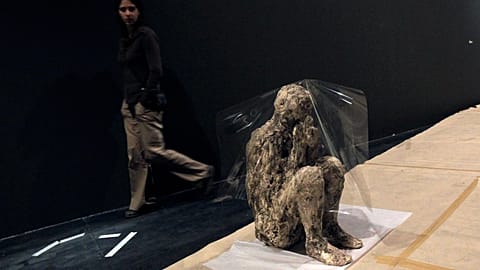
Excavations conducted in the area of the monumental tomb of Numerius Agrestinus Equitius Pulcher have brought to light the remains of two men who died during the catastrophe.
Their positions and the condition of the bodies tell of two different phases of the eruption.The younger one was probably swept away by a pyroclastic current, a searing cloud of gas and ash capable of killing instantly. The second, more adult, died a few hours earlier, under an incessant rain of lapilli (material that falls out of the air during a volcanic eruption), while trying to get away from the city.
Next to the body of the older man, archaeologists found an earthenware mortar with obvious signs of fracture. Everything suggests that he was using it for protection.
Also with him were a ceramic oil lamp, probably for orientation in the darkness caused by the ash, an iron ring on his left little finger,and ten bronze coins. Everyday objects that become precious clues, as they tell of a lucid escape, organised as much as possible, in the chaos of an apocalypse.

There's a surprising echo from ancient sources. Pliny the Younger, an eyewitness to the eruption, described fleeing people who "tied pillows over their heads" to protect themselves from falling debris.
In Pompeii, for the first time, that description goes beyond words.
Artificial intelligence enters the excavations of Pompeii
From the remains also emerges a novelty that looks to the future: the use of artificial intelligence in archaeology.
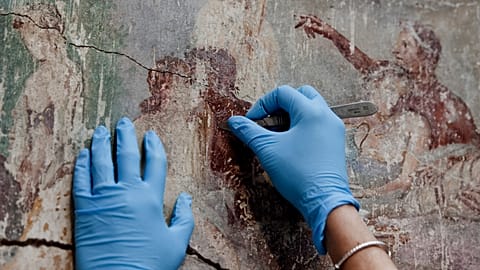
The Archaeological Park of Pompeii, in collaboration with the University of Padua, has created a digital reconstruction of the victim, based on data collected during the excavation. It is an experimental model that combines algorithms and photo-retouching techniques to return a scientifically based image that is accessible to all.

AI: Between innovation and responsibility
"Italy has historically always made classical culture a key ingredient of innovation," said Culture Minister Alessandro Giuli. "In Pompeii, artificial intelligence helps not only in the protection of the immense archaeological heritage, but also in the engaging and accessible narration of ancient life."
Park director Gabriel Zuchtriegel is on the same wavelength: "The vastness of archaeological data is now such that only with the help of artificial intelligence will we be able to adequately protect and enhance them. If used well, AI can contribute to a renewal of classical studies."
Luciano Floridi, founding director of the Digital Ethics Center at Yale, commented on the news: "The man from Pompeii fled with a mortar on his head, an oil lamp in his hand, and ten coins: he carried what he thought was useful for finding his way in the dark. Two thousand years later, AI helps us reconstruct his last moments. The case speaks to all humanities disciplines. AI does not replace the archaeologist. Under its control, it broadens and deepens its potential; and it makes accessible to many what was previously only legible to a few."
Belgian-born French novelist Marguerite Yourcenar, in the notebooks of Hadrian's Memoirs, described her exercise as "one foot in erudition, the other in magic": the magic that consists in transporting oneself with thought into someone else. This is exactly what archaeology has always done: scientifically reconstructing a vanished world from within, and allowing us to imagine it. AI speeds up the rendering of that reconstruction, but the magic remains human.
As for Professor Jacopo Bonetto of the University of Padua, he emphasises that AI is "a technology that can contribute to the production of interpretative models and to the improvement of communication tools, but which requires a controlled and methodologically founded use, always in integration with the work of specialists."
This is precisely where the challenge lies: to use technology without losing rigour, to make the past accessible without betraying it.
In Pompeii, once again, archaeology proves to be a living laboratory, capable of innovation and questioning. That man, with his mortar raised against the ashes, continues to speak to us: not as an abstract symbol, but as a real individual, caught in the most human moment of all - fighting to survive. No matter the odds.