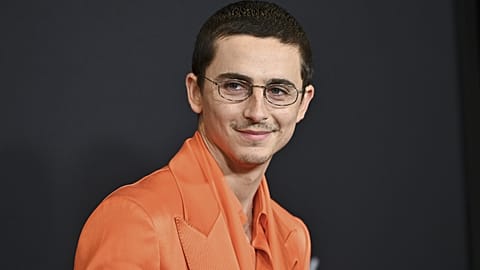




























Does no one really care about La Traviata or The Nutcracker as Timothée Chalamet has suggested? The actor’s comments have sparked a ferocious row but some are defending his remarks saying the real fight is to make these arts more accessible and more representative.
It has now become a global campaign. Major cultural institutions, from Rome to Seattle via Lyon, have reacted to Timothée Chalamet’s comments about opera and ballet, which the actor described as "stuff" that "nobody cares about any more".
 ADVERTISEMENT
ADVERTISEMENT
ADVERTISEMENT
The explosive remark was made during a podcast organised by Variety and CNN featuring the Franco-American actor and his Hollywood colleague Matthew McConaughey at an event at the University of Texas on 24 February.
Just over 50 minutes into the discussion, Timothée Chalamet was asked about cinema attendance and the way audiences’ attention spans are shrinking, with some cinemagoers wanting the action to start in the very first scenes. The Dune star replied that if people really want to see a film, they will come of their own accord, citing Barbie and Oppenheimer as examples.
The actor then digressed, pointing out that some arts now exist mainly within a logic of institutional preservation, even though wider public interest has waned. While insisting that he "admired" those who campaign to "save" cinemas or a particular art form – and that he had done so himself in the past – he nonetheless voiced reservations: "I do not want to work in ballet or opera, or in stuff where people say: 'Hey, keep this going, even though, in reality, nobody really cares about it any more.'"
"With all due respect to people in ballet and opera," he quickly added, anticipating a backlash.
"This is a personal invitation"
The creativity of social media managers at major opera houses, both national and regional, has flooded Instagram and X feeds. Some invited the actor to come and attend a performance, while others seized the opportunity to showcase their seasons, highlighting clips that illustrate their efforts to dust off the classics and demonstrate how vibrant this prestigious art form remains.
At the Paris Opera, the French benchmark with two iconic venues, the Palais Garnier and Bastille, staff revisited Timothée Chalamet’s filmography. He is currently in the running for the Oscars with Josh Safdie’s Marty Supreme, in which he is electrifying as Marty Reisman (1930–2012), a man ready to do anything to become the greatest table-tennis player in history.
"Plot twist: table tennis exists in opera too," the Paris institution quipped on Friday, posting a video of a scene from John Adams’ "Nixon in China", in which we see a game of table tennis, symbolising the rapprochement between the United States and China in the early 1970s, at the height of the Cold War.
"Dear Timothée, […] we just wanted to reassure you: singers, dancers and orchestras are still moving and surprising audiences and, funnily enough, auditoriums are filling up," the Opéra Grand Avignon (source in French) said.
"Apparently, people even come to hear voices without microphones, to watch bodies tell stories without special effects and to cry over music written 200 years ago. Strange times," the venue in the south of France noted.
Vienna State Opera went out into the Austrian capital to ask local residents whether this art form is important to them.
In a series of vox pops posted by the emblematic institution, people can be seen nodding, with some qualifying their answers. "It is very dependent on the generation: older people will of course enjoy it a bit more than we do," says one young man. "Well, I am not really directly interested in it," adds another, "but I find it interesting when you see a bit of what is presented on Instagram or something like that. But I have never actually been myself."
"Consider this your personal invitation to Vienna. Our stage is waiting for you," the opera’s team concluded.
A burst of applause, the curtain falls. La Scala, one of the world’s most famous theatres, opted for brevity, replying with a message in its short video: "Someone does care, you can hear it."
The opera house of Rome chose to play on the actor’s sporting allegiances: "We know you support Roma, but we feel you should broaden your horizons and come and visit us: you will discover other passions," the institution posted on X.
Others, such as the Opéra de Lyon (source in French) – housed in the building refurbished by Jean Nouvel and where the company is currently rehearsing Benjamin Britten’s Billy Budd – highlighted their visitor numbers, with audiences enthusiastically applauding this "comeback".
Gran Teatre del Liceu in Barcelona took the opportunity to announce the digital premiere of Ponchielli’s La Gioconda, which was streamed on Sunday on its LiceuOPERA+ platform.
In Seattle, where Carmen is currently being staged, visitors were offered a 14% discount for the weekend. It was a nod to the 14 cents in box-office takings that Timothée Chalamet reckoned he would lost after his comments about opera and ballet.
"Say bye to that Oscar"
Among the remarks received by Euronews, a Parisian, Luís, referred to a sense of "social responsibility" and regrets that a "young film icon should make remarks that do nothing to help opera, which is already in crisis, quite the opposite".
For fans of the actor who have never been to the opera he said, "it is the perfect excuse!"
While the tone of institutional messages has remained friendly, some comments under the video or on social media are far more blunt. "When no one remembers Timothée Chalamet any more, Mozart and Tchaikovsky will still be working their magic," one user mocked.
Another wrote: "Support your local theatres, man." Some went further: "‘Nobody cares any more’ – says the guy who has just starred in a film about table tennis," or "Yeah, we are definitely going to remember Wonka and Marty Supreme, but not Swan Lake or The Marriage of Figaro."
"La Scala beats Dune I and II when it comes to sold-out shows."
And finally: "Well… you can say bye to that Oscar" – a week before the ceremony at the Dolby Theatre.
"It is absurd to say everyone is moved by opera"
Amid the chorus of criticism and amused jibes, a few voices sound a different note.
Ben Glassberg, head of the Orchestre de l’Opéra Normandie Rouen, addressed his followers in a long video message posted on Instagram. The British conductor, who is almost the same age as Timothée Chalamet, said he did not "agree" with the "defensive" strategy that is rolled out "every time opera comes under attack".
In his view, the Franco-American actor "is not entirely right, but he is not completely wrong either".
"There are a lot of people on Earth who really are not interested in opera, and pretending that it is a 'superior' art form, along the lines of: if you do not get it, that is your problem… well, I think that is a mistake," he insisted.
"It is absurd to say everyone is touched by opera. I wish that were the case," the conductor told Euronews. "A friend put it very well: opera has to be open to everyone, even if it does not necessarily speak to everyone."
"What worries me most is that opera is still an art form reserved for the wealthy," Ben Glassberg added.
The role of professionals in the sector, he explains in his video, is not to exclaim: "Look, we are sold out," but to listen and ask themselves: "Perhaps there are people, many people, whom this does not reach. And why? What can we do to change that?"
It is all a matter of exposure, he explains, citing the example of his children, who started listening to opera "in their mother’s womb".
"What we should be doing, rather than piling on Timothée Chalamet, is going after governments and asking: 'Why are you cutting music funding in schools?' Because in reality, no one will want to come to the opera in future if they have never heard of it. No one will be able to understand it."
The conductor urges his peers to "channel their anger", arguing that Timothée Chalamet "is not the problem" and "can say what he likes in an interview".
"We should direct it at governments that are pulling funding from music and arts education, and also at those within the industry who are not trying to make opera accessible and diverse enough for everyone to feel represented in it," he stressed.
In France, since the upper-secondary school reform that came into force in 2021, access to music has been reduced: pupils can now choose only two optional subjects at most (languages, arts, PE, etc.). The result is that a pupil may stop taking music from the first year of sixth form (seconde, age 15), especially as optional and specialist music courses are not offered in every school and often depend on resources.
Several French opera houses have also seen their subsidies cut in recent years. The Ministry of Culture, in the case of the Paris Opera (2024), or local authorities, as in Lyon (2021), have trimmed budgets to meet other priorities.
"The best publicity opera has had since the start of my career"
In an opinion piece in the New York Times, dance critic Gia Kourlas also argues that the core of the debate is not about challenging the intrinsic value of these art forms, "which are not really part of mainstream culture", but about how people see them and the ability of a live art form to "endure" and reach audiences in the face of competition from films, for example.
In her view, the actor was not trying to say that opera and ballet are "unimportant", but rather that "the world struggles to grasp" their richness.
"Is he wrong?" asks Gia Kourlas, adding that the controversy has been amplified because it was sparked by a film star.
"If a dancer claimed that a film had no impact, it would be like a tree falling in a forest." With no one there to hear it.
It is an essential debate, and solutions will have to come from companies, from society and from policymakers, so that opera and ballet do not remain confined to a niche role and can continue to send shivers down the spine of as many people as possible.
In the end, for Ben Glassberg, the young actor’s throwaway line is "the best publicity opera has had" since the start of his career.
Euronews contacted Timothée Chalamet but received no response at the time of publication.