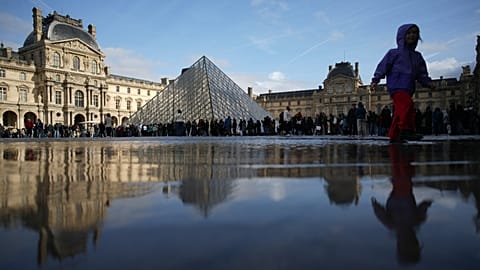
















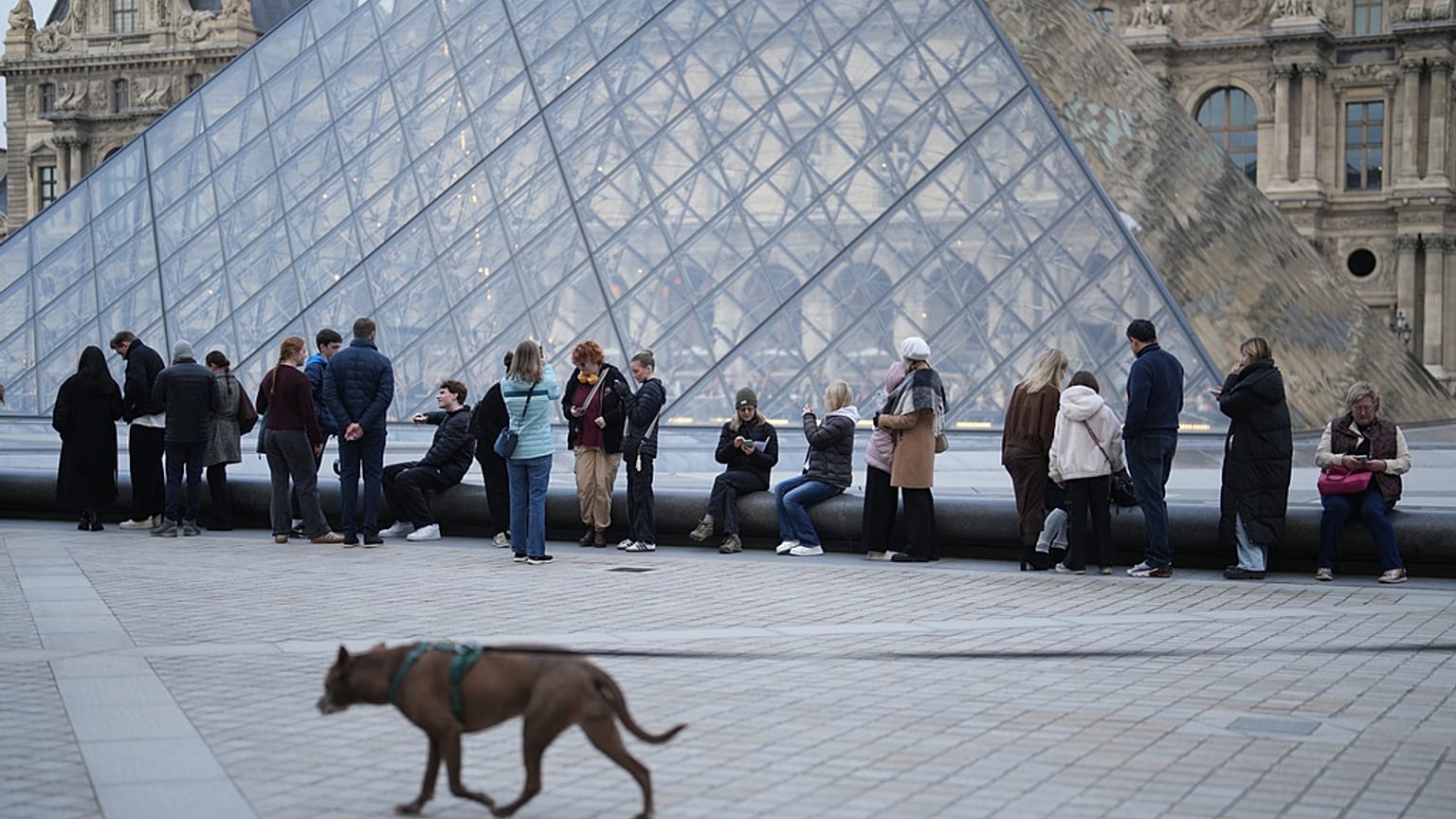














The Paris Louvre has introduced a new €32 (+45%) entrance fee for non-European individual visitors; guided groups will have to pay €28, capped at 20 people per visit to preserve quality, according to museum authorities.
France has introduced a 45% higher entry fee at the Louvre for non-European visitors, a controversial measure aimed at funding the renovation of the struggling Paris landmark.
 ADVERTISEMENT
ADVERTISEMENT
ADVERTISEMENT
The move is one of the boldest in Europe regarding ‘dual pricing’ at museums, which means charging different prices depending on where visitors come from.
Common in many developing countries, the practice has until now been largely absent in Europe and has been criticised as discriminatory, restricting access to the world's most visited museum that houses the Mona Lisa for some low-income foreign visitors.
The museum said the price rise, from €22 ($26) to €32 ($37), is part of a national policy of ‘differentiated pricing’ announced early last year and being rolled out at major cultural sites, including the Palace of Versailles, the Paris Opera and Sainte-Chapelle.
Tourists interviewed by AFP on Wednesday had mixed reactions.
Kevin Flynn, an Australian in his sixties spending a week in Paris with his wife, said the new €32 ($37) fee for non-Europeans was “acceptable”.
“It’s the same price for many things in Italy, many things in Malta… on that scale,” he said.
But others, like Joohwan Tak from South Korea, thought it was “unfair”.
“We are all human beings. There’s a big difference,” he added.
“If I go to India, Indians pay less than foreigners, that’s normal, because they have less money,” added Marcia Branco, a Brazilian. “But as I’m in Paris, supposedly a rich country, I find it unfair.”
Who pays the higher rate?
The change applies to visitors from most non-EU countries, including the United States, which usually account for the largest share of the Louvre’s foreign tourists.
Under the new pricing structure, visitors who are neither citizens nor residents of the EU, or of Iceland, Liechtenstein or Norway, will pay the higher rate, the Louvre said.
The €32 price applies to individual visitors from outside Europe; guided groups will pay €28, with a maximum of 20 people per visit “in order to maintain the quality of the visit”, the museum said.
Some categories remain eligible for free entry, notably visitors under 18.
The last price rise dates back to January 2024, when the standard entry fee went from €17 ($19) to €22 ($24).
The CGT Culture union condemned the policy, arguing that it turns access to culture into a “commercial product” and creates unequal access to the national heritage.
Elsewhere in Europe, the standard entry price for the Colosseum in Rome, as well as the Forum and the Palatine Hill, is €18 ($20), and an adult ticket for the Acropolis in Athens is €30 ($33).
Versailles, Chambord and the Palais Garnier also joining in
Other French state-owned cultural sites are also raising their prices for non-European visitors, including the Palace of Versailles, the Château de Chambord in the Loire area and the Paris National Opera.
At Versailles, the “Passport” ticket will cost €35 in high season for visitors from countries outside the European Union, Iceland, Liechtenstein and Norway, compared with €32 for visitors who are citizens or residents of those countries. At Sainte-Chapelle, the ticket rises to €22 for visitors from outside those countries, compared with €16 for those who are nationals of them, according to heritage officials.
The Louvre said the new rate will help fund investments under its “Louvre – New Renaissance” modernisation project and could bring in an additional €15 to €20 million ($16 to $22 million) a year.
The government has defended the increases on financial grounds, saying that changing the Louvre’s pricing could raise €20 to €30 million a year for the museum, which needs repairs and suffered a major burglary last October.
French museums were already considering raising prices for non-European visitors before the theft of the crown jewels at the Louvre, which investigators estimate to be worth around €88 million ($102 million).
However, the heist, carried out in broad daylight in just a few minutes, was so swift and audacious that it intensified scrutiny of how France protects its most precious cultural treasures.
It also fuelled debate over how major tourist sites should fund their renovations and whether visitors should shoulder a greater share of the costs.
Louvre unions have denounced the policy as “shocking on philosophical, social and human grounds” and cited it among the grievances that triggered recent strikes.
They argue that the museum’s vast collection of around 500,000 works, many originating from Egypt, the Middle East or Africa, has universal value.
While rejecting any discriminatory pricing on principle, they also raise practical concerns, as staff will now have to check visitors’ identities.
Staff went on strike again on Mondayas part of the latest industrial action over pay and working conditions, putting the Louvre’s internal tensions back in the spotlight.
‘France first’ or ‘cultural exception’?
French researcher Patrick Poncet drew a parallel between the French decision and President Donald Trump’s “America First” policy, under which his administration raised the entry fee for foreign tourists in US national parks by $100, effective 1 January.
The French policy is “symptomatic of the return, as elsewhere in the world, of unbridled nationalism”, Poncet wrote in the newspaper Le Monde last month.
It remains to be seen whether the break with European tradition by the continent’s most-visited country will prompt other cultural destinations to follow suit.
Age-based discounts are common in Europe; entry is free for under-18s at sites such as the Acropolis in Athens, the Prado in Madrid or the Colosseum in Rome, to encourage them to visit.
The Louvre remains free for minors from all countries and Europeans under 26.