






























Military spending by European NATO members last year rose faster than at any time since 1953.
European leaders seem to be acting upon their promises to spend more on defence.
 ADVERTISEMENT
ADVERTISEMENT
ADVERTISEMENT
Following US pressure, which saw President Donald Trump lambast NATO allies for not reaching defence spending targets, the continent's investments in 2025 grew by 14% — more than all other continents — to reach €739 billion.
According to the Stockholm International Peace Research Institute (SIPRI), it's the steepest climb since the 1950s and twice the amount as 10 years ago, as many NATO members move to meet the new 5% of GDP spending target set for 2035.
Last year, Berlin invested around €97 billion in defence, a 24% spending spike from 2024.
It means that Germany has now overtaken the UK to become Europe's largest defence investor, and the world's fourth-largest behind the US ($854), China ($336 billion), and Russia ($190 billion).
Bundeswehr to be 'strongest conventional armed force in Europe'
With a package of 153 major projects underway, Germany is aiming to acquire new weapon systems, modernise its equipment and strengthen its infrastructure and cybersecurity, Colonel (ret.) Ralph Thiele, EuroDefense Germany Chairman, told Europe in Motion.
The Bundeswehr, Germany's armed forces, is reinforcing its infantry brigades with more Puma fighting vehicles, as well as a multibillion-euro order for 237 Future Infantryman (Infanterist der Zukunft) systems by 2029.
This is a modular, integrated fighting system designed to provide significant lethality, survivability, mobility, battle command, and training to infantrymen.
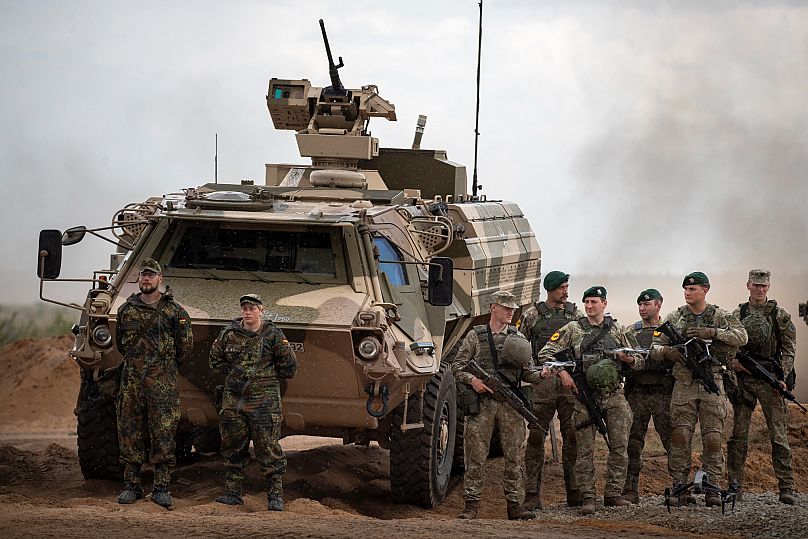
The military is also focusing on closing its air defence gaps, with plans to acquire up to 600 Skyranger 30 anti-aircraft gun tanks, as well as 20 new Eurofighters, alongside significant investment in guided-missile systems, with "major orders for Patriot, IRST and Meteor", he said.
Naval forces are also set for an expansion with plans to procure up to 42 manned vessels integrated with 50 unmanned systems, "including new corvettes and submarines".
"Further strategic priorities lie in military space programmes", Thiele said, with investments in spy satellites, space aircraft and laser-based defence systems in space.
He explained these investments will make Germany's military "the strongest conventional armed force in Europe".
Which other countries are ramping up military spending?
Another major economy which isn’t shying away is Italy, with a 20% increase — now neck and neck with Israel for military spending (€41 billion).
Spain, a habitual NATO underperformer, went even further with a 50% jump, bringing its military spending up to the alliance's former 2% of GDP target for the first time since the early 90s.
Who spends the most compared to GDP?
Looking at defence spending as a share of GDP provides a clearer picture of who treats defence as a national priority.
Ukraine aside (with an estimated 40%), Algeria is the world leader with a significant 8.8%, while in Europe, the top countries all border Russia.
Poland is first, allocating 4.5% of its GDP to weapons and defence infrastructure.
Latvia comes second at 3.6%, followed by Estonia (3.4%) and Norway (3.3%), while Iceland (virtually 0%), Ireland (0.2%), and Switzerland (0.8%) close the bottom of the ranking.
Among the continent's five largest economies, and despite a slight decrease in military spending in 2025, the UK remains the largest investor relative to GDP, with 2.4%, trailed by Germany (2.3%), Spain (2.1%), France (2%) and Italy (1.9%).
How is the war in Ukraine impacting military spending?
The US reported a noticeable drop in total expenditure (-7.5%), but mainly because no new financial military assistance for Ukraine was approved in 2025. This was in sharp contrast to the previous three years, when a total of $127 billion was signed off for Kyiv.
Washington still makes up 33% of the world's total defence expenditure among the 15 top-spending nations, followed by China (12%) and Russia (6.6%).
"Despite ongoing economic pressures and sanctions, Russia has so far managed to increase its military expenditure year-on-year since 2022, albeit with shifting procurement and operational strategies", said SIPRI.
"As its invasion of Ukraine has gradually become a war of attrition, Russia has moved towards procuring high volumes of cheaper weapon systems in an attempt to limit operational costs", it added.