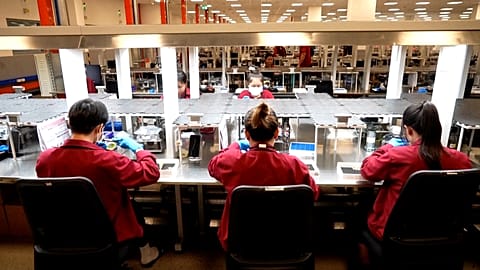
The continent's chocolate industry continues to operate at peak production, reaffirming its position as the undisputed world leader in cocoa processing and exports.
Europe remains the world's largest region for both chocolate production and exports, maintaining a central role in the global supply chain.
 ADVERTISEMENT
ADVERTISEMENT
ADVERTISEMENT
With the industry experiencing significant growth despite rising production costs, a handful of EU member states, led by Germany and Belgium, continue to dominate the global landscape through a sophisticated network of trade and manufacturing hubs.
According to a report published in February by the Dutch Center for the Promotion of Imports (CBI), the European chocolate market was valued at approximately $52 billion (€44.86bn) last year.
The CBI also points to another study by the market research company Mordor Intelligence, which indicates that this figure is projected to grow slightly to $52.38 billion (€45.19bn) in 2026 and to around $65.78 billion (€56.75bn) by 2031, driven by a combination of the "premiumisation" trend and robust seasonal demand.
As the primary manufacturer of chocolate, Europe is the world's largest importer of raw cocoa beans and it also holds the title of largest importer of semi-finished products, including cocoa paste, butter and powder.
The continent also hosts some of the world's most significant trade hubs in the industry, particularly in the North Sea ports, and boasts the highest per-capita chocolate consumption rates globally.
However, this Easter comes with a higher price tag for consumers as chocolate prices have risen across the region due to supply constraints and increased operational costs.
The chocolate heartland: Germany and Belgium
Germany continues to hold the crown as the leading force in the European chocolate industry.
According to Eurostat data from 2025, German sales volume of chocolate and cocoa preparations reached a total value of approximately €9.42 billion.
The country is the primary supplier for the internal EU market, leveraging a massive industrial base that produces everything from mass-market bars to seasonal treats.
German manufacturers have seen persistent and robust demand with the nation exporting over 4 million tonnes of cocoa-based goods annually.
Belgium follows as the continent’s second premium powerhouse, where the industry is more about prestige than volume.
Eurostat data from last year indicates that Belgian exports were valued at roughly €3.04 billion, a figure that underlines the high added value of Belgian pralines and luxury eggs.
While Germany dominates in volume, Belgium is the heart of the "premiumisation" trend, with many of the world’s top chocolatiers based in the country.
The ports of Antwerp and Bruges remain critical gateways for the raw ingredients that fuel this high-end manufacturing, ensuring that Belgian chocolate continues to be a global standard for quality during the Easter season.

Rising stars and trade hubs: Poland and the Netherlands
One of the most striking developments in the European market is the rapid ascent of Poland. Now firmly established as the third-largest exporter by value in the EU, Poland has become a vital manufacturing hub for multinational brands.
According to Eurostat data from 2025, Polish chocolate exports were valued at approximately €2.49 billion, with the country experiencing some of the sharpest price increases in the region at roughly 32%.
Despite these inflationary pressures, Poland's modern production facilities and strategic position in Central Europe have allowed it to outpace more established western competitors in growth.
The Netherlands completes the top four, playing a unique and indispensable role as the logistical spine of the industry. While the value of its finished chocolate exports stood at around €1.21 billion, this figure does not fully capture the country’s influence.
The Netherlands is the world’s largest processor of cocoa beans, and the Port of Amsterdam serves as the primary entry point for cocoa imports to the European market.
As the top importer of raw beans and a leading exporter of cocoa butter and powder, the Dutch industry provides the essential components that German, Belgian and Polish manufacturers rely on to create most of their finished products.
As the global appetite for chocolate continues to grow, Europe’s top four exporters and producers appear well-positioned to maintain their grip on the market.
It seems that in the world of chocolate, Europe has no intention of letting its lead melt away.