




























As US and Israeli stockpiles drain against Iranian drones, the Bruegel think-tank warns Europe faces an even harder fight on its own doorstep
Every Patriot interceptor fired from US defence positions stationed close to the frontline of the Iran war costs $4 million (€3.7m). The Iranian Shahed drone it destroys costs, at most, tens of thousands of euros.
 ADVERTISEMENT
ADVERTISEMENT
ADVERTISEMENT
Somewhere in that gap lie the most crucial lessons Europe needs to absorb as it plans its future defence spending.
According to Bruegel, the defence calculus has fundamentally changed. Precision drones and missiles, once carrying a hefty price tag and limited to a handful of military forces, are now cheap enough to deploy at devastating scale.
"The last two decades have culminated in a strategic environment in which drones and missiles launched by Iran... cost substantially less than the air and missile defence deployed by those countries," Bruegel senior fellow Guntram Wolff and his co-author Alexandr Burilkov argued.
Iranian drones and missiles find their targets with an equally devastating effect, despite Gulf states burning through hundreds of Patriot interceptors to shoot them down and stockpiles are depleting faster than they can be replenished.
"In such a sustained campaign, production capacity is vital," the authors write. "The calculus for the US and Israel is grim."
Yet unlike Israel and the US, Europe's biggest defence risk is not Iran but Russia, which Bruegel's authors argue poses a far more serious threat than Tehran ever could with its rudimentary air force and limited modern air defences.
"Russia has neither of those weaknesses — it fields a substantial air force and a highly sophisticated integrated air and missile defence network," the piece argued.
Any conflict between Europe and Russia, Bruegel warns, "can be expected to play out as a more intense version of the conflict in the Middle East, with large salvoes of Russian drones and missiles saturating and eventually overwhelming European air defences".
The Ukraine blueprint
So who should Europe learn from, if not the US and Israel? Ukraine.
Ukraine has already lived this reality. Russian strikes on Ukrainian cities and energy infrastructure have forced Kyiv to make agonising decisions about when to fire precious interceptors and when to let missiles through.
In turn, European nations supplying Ukraine with air defence systems have felt the strain on their own stockpiles.
The lesson from Kyiv is the same one now being written in the Gulf, namely that defence alone is a losing game if the attacker can produce faster than the defender can intercept.
Bruegel's analysis points to two concrete priorities that European defence planners must act on.
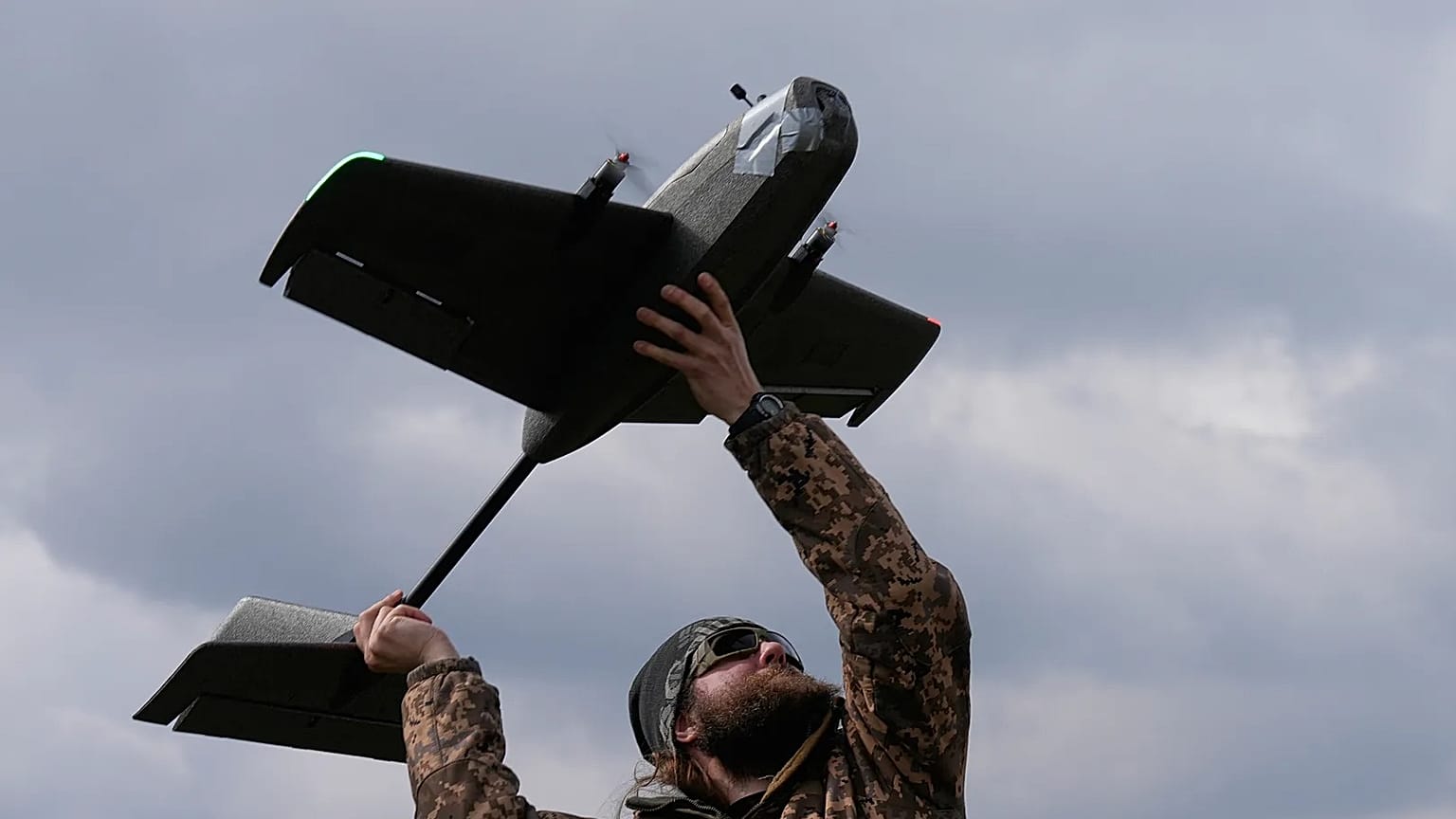
The first is investing at scale in cheap interceptor technology. Ukrainian companies have already developed low-cost interceptor drones now being sought by Gulf states — a telling sign of where battlefield innovation is happening.
"Europe needs to learn from Ukraine in organising air defence cost-effectively," the report says.
"It needs to invest in cheap counter-drone capabilities at large scale that would reduce the massive financial asymmetry between attack and defence."
Continuing to rely on high-end interceptors costing millions per shot, fired at drones worth a fraction of that, is a path to financial exhaustion.
Earlier this month, the UK government convened a meeting of defence companies with ambassadors and defence attachés from Saudi Arabia, Kuwait, Bahrain, Qatar, the UAE, Iraq and Jordan, focused on supplying defensive equipment and technology to counter Iranian drone and missile attacks at speed.
In 2025, European defence tech startups raised $1.8bn (€1.65bn), nearly three times the previous yearly record, according to deal-counting platform Dealroom, with a further $854m (€785m) raised in the first months of 2026 alone.
Companies including Estonia-headquartered Frankenburg Technologies and Ukrainian-UK startup Uforce are both developing low-cost drone and missile interceptors.
Hit the factory, not just the drone?
The second lesson is harder politically but arguably more important militarily: Europe must build deep-strike offensive capability.
Air defences alone cannot win an attritional war against an adversary with Russia's industrial base, according to Bruegel.
"Russia's defence industrial base can produce many more modern drones and missiles than even the highly advanced Ukrainian air defence can intercept," the report warns.
Ukraine's domestically produced long-range drones and missiles have struck refineries, weapons depots and production facilities deep inside Russia — in some cases disrupting months of drone and missile output in a single strike.
That erodes the attacker's capacity at source, rather than chasing projectiles through the sky at ruinous cost.
Cheap, plentiful and fast
The strategic logic Bruegel proposes is to reverse the current asymmetry entirely.
Rather than expending expensive interceptors to knock down cheap drones one by one, Europe should be stockpiling large volumes of affordable air-defence munitions while simultaneously developing offensive strike capabilities to degrade Russian production.
"Rather than a cost calculus in which every Russian missile needs at least two Patriot interceptors, interception needs to be done at low cost, while the enemy's munitions stockpiles and defence industry need to be targeted," Wolff and Burilkov conclude.