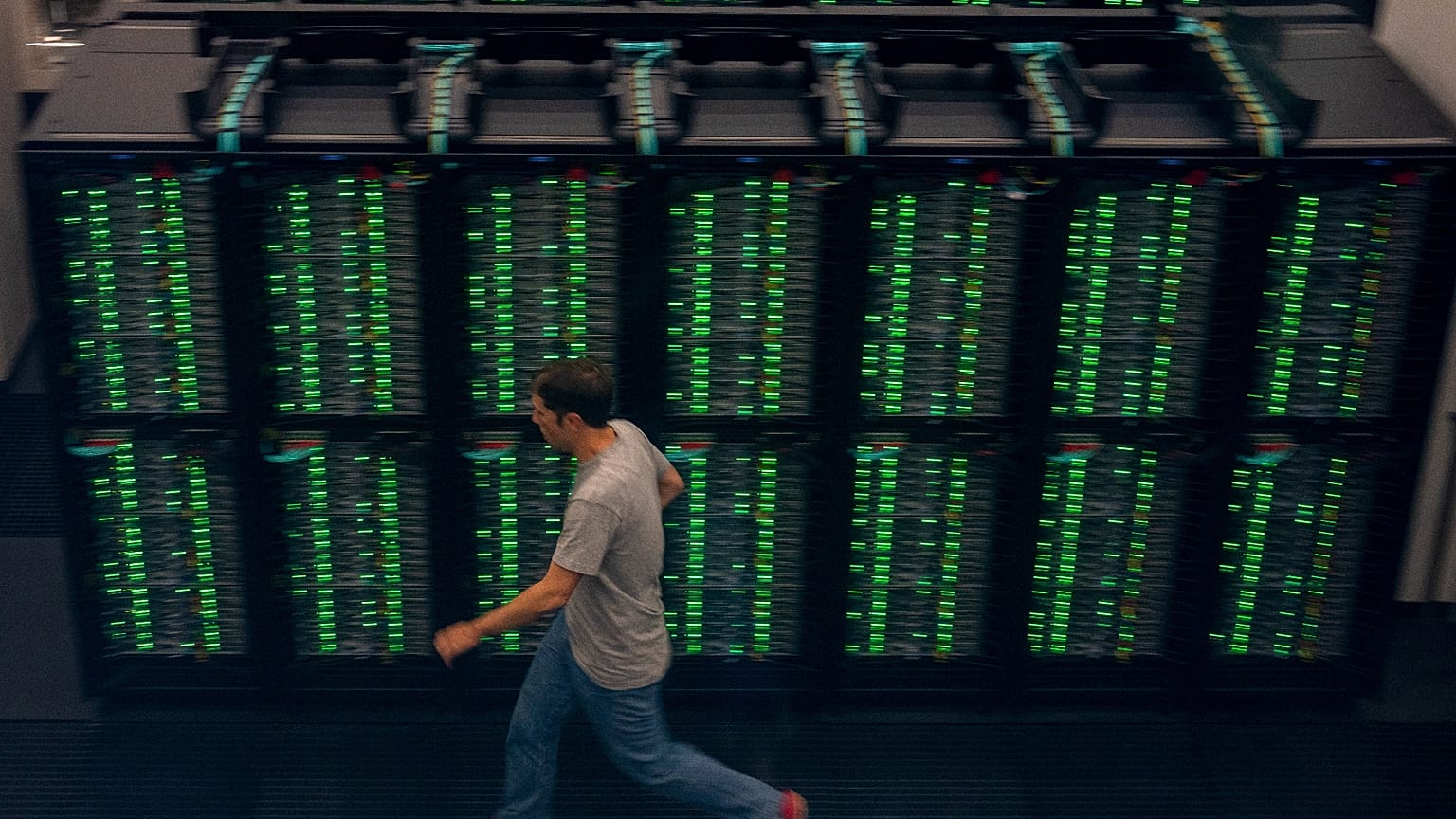













The 500 million DKK (€67 million) investment in Denmark’s AI supercomputer could help create businesses and jobs and enable public institutions to use AI securely, according to Tuesday’s announcement.
Denmark is pouring another 500 million DKK (€66.9 million) into one of the world’s most powerful supercomputers, backed by pharmaceutical giant Novo Nordisk Foundation, under plans announced on Tuesday.
 ADVERTISEMENT
The funding will support its supercomputer Gefion’s infrastructure and operations at the Danish Centre for AI Innovation (DCAI), which runs the machine, according to an announcement from the Export and Investment Fund of Denmark.
Further details of how the funding will be used and when the additional capacity will be available have not been revealed.
Denmark launched its supercomputer Gefion in 2024 with 1,528 Nvidia chips. The centre says it is now nearing full capacity.
The new investment adds to the initial 700 million DKK (€93.8 million) in funding from Denmark’s state investment fund and the Novo Nordisk Foundation, the Danish foundation behind the maker of weight-loss and diabetes drugs such as Ozempic.
‘New solutions, companies and jobs’
The aim is to turn greater access to computing power into economic growth.
“This gives Danish companies and researchers more computing power to translate good ideas into new solutions, companies and jobs,” said Martin Lidegaard, Denmark’s minister for business and competitiveness, in a statement.
“And it also strengthens our competitiveness, while ensuring that ownership of the technology of the future is not left to others,” he added.
Another aim is to help public institutions and businesses use AI while retaining control over sensitive data.
Netcompany, a Danish technology company that builds and operates public-sector IT systems, including for NHS England, is joining the centre’s investors. It will contribute software to manage access, monitoring and security.
What it means for Europe’s push for greater digital control
The announcement comes as European governments race to gain greater control over the infrastructure used to develop AI and the companies building it.
The United Kingdom invested £225 million (€269 million) in a supercomputer dedicated to AI research in 2023.
Meanwhile, Finland hosts a supercomputer, Large Unified Modern Infrastructure (LUMI), jointly funded by the European Union and participating countries at a lifetime cost of more than €200 million.
In July, the European Commission launched a call for up to seven AI gigafactories, larger data centres built to train and run advanced AI models, backed by up to €10 billion in European Union and national funding.
“Europe must be able to do much more itself, and Denmark must contribute to European technological independence — not least so that we can regulate and develop technology based on democratic values,” said Christina Egelund, Denmark’s minister for research, education and digitalisation.