




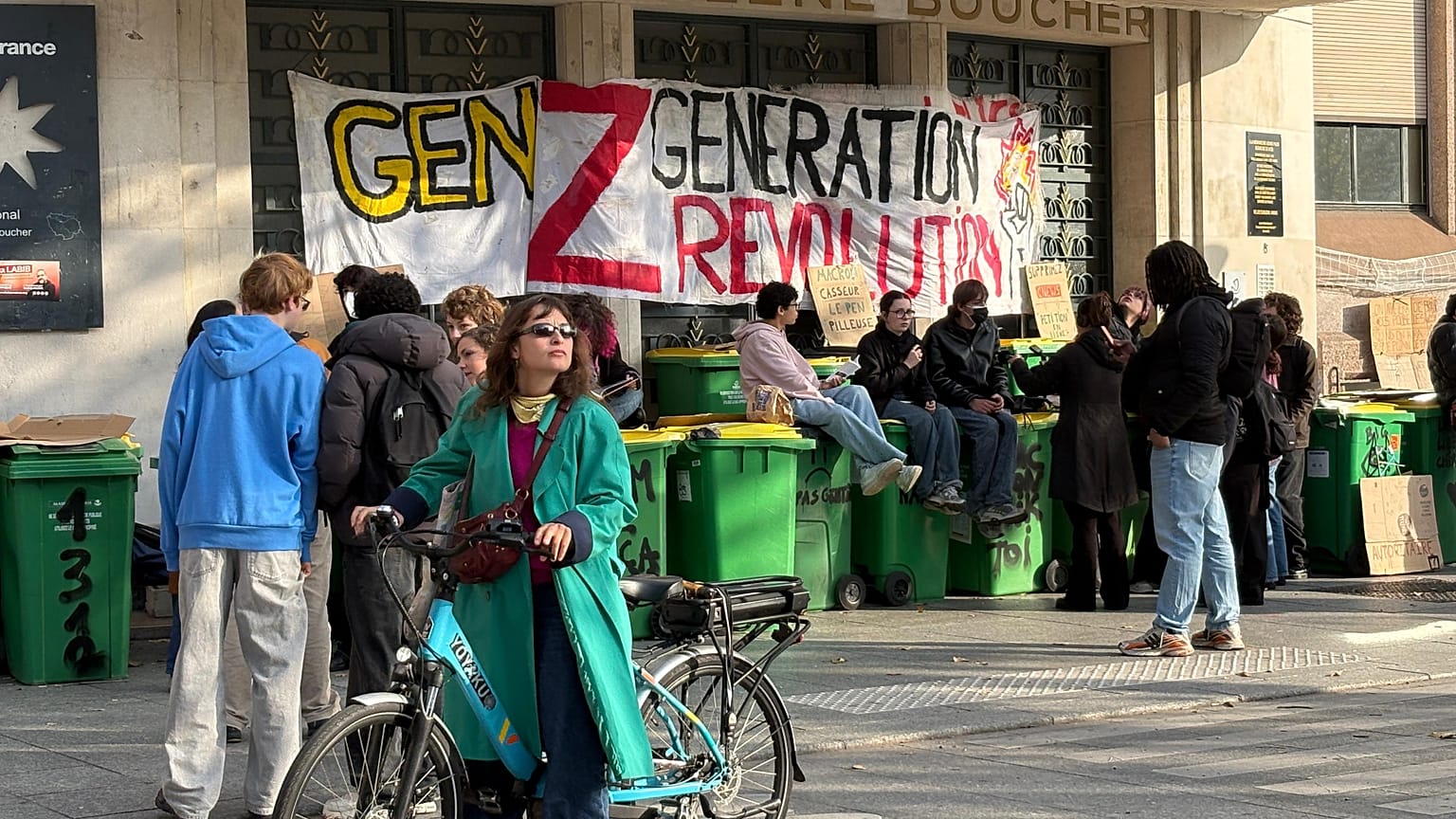













Unions walked out of talks with the prime minister’s office over the presence of the far right, while firework mortars have been set off inside schools as tensions rise.
Secondary school pupils in France are back on the streets on Tuesday. Nearly two months into their protest movement, the government’s concessions have failed to bring it to an end.
 ADVERTISEMENT
A coalition of trade unions and youth organisations has called a nationwide day of strikes and demonstrations. It is the latest escalation in a dispute that has seen sporadic violence at schools across the country.
Two weeks ago, Prime Minister Sébastien Lecornu’s government tried to calm things down. It promised to overhaul Parcoursup, France’s national online platform for allocating university places, from 2027 and to replace it completely in 2028. It also pledged more money for school buildings and extra resources for the most deprived schools.
Protesters were not won over. Relations got worse at a meeting on the Parcoursup reform at the prime minister’s office in Paris. Most of the pupil and student groups, along with education unions, walked out in protest at the presence of far-right and business representatives.
"We are calling on everyone who supports the legitimate demands of young people, but also those of workers, to be out on the streets," said Éloïse Lefebvre-Milon, co-leader of the Union étudiante student union, after leaving the talks.
The coalition includes some of France’s biggest labour unions, such as the CGT and FO, alongside pupil and student organisations. It said in a joint statement that now was the time "to step up the mobilisation by continuing to put pressure on the government".
"Giving fresh momentum to the mobilisation"
Pupil leaders say they have no intention of backing down. "The balance of power is in our favour, we have to keep going," said Ryad Rani, president of the Union syndicale lycéenne, a secondary school pupils’ union.
“We have to stay mobilised. We are not only fighting for ourselves. We are fighting for teachers, for their working conditions,” Rani said.
Sophie Vénétitay heads Snes-FSU, the largest union for secondary school teachers. She said Tuesday’s action would include “supervised and secure marches”, since tensions outside schools are rising.
Youth protests have a long history of putting pressure on French governments. Former president François Hollande faced mass demonstrations against his labour reforms in 2016. At the time, he privately compared a student movement to toothpaste: "You can get it out of the tube, but you cannot get it back in."
Violence reported in several secondary schools
Most of the protests have been peaceful, but there has been a string of violent incidents on the fringes.
On Monday, firework mortars were set off inside two secondary schools in Seine-et-Marne, in theeast of Paris. The regional council said two pupils were hurt at one of them. At the other, nobody was injured, but education officials said pupils were left "in shock".
Police arrested five people after trouble outside schools in Le Havre and Rouen in Normandy, according to France 3 Normandie (source in French). Fireworks were also set off outside a school in Angers in western France (source in French). Further incidents were reported in the north-eastern Meurthe-et-Moselle department, according to Ici (source in French).