

Governments claim to protect public health while failing to tackle fossil fuel dependence, as new research by the Global Climate and Health Alliance exposes a gap between climate rhetoric and action.
The European Union and other major emitters are paying lip service to the health impacts of climate change while failing to match their rhetoric with sufficiently ambitious emissions cuts, according to a recent analysis of 132 countries’ climate commitments by the Global Climate and Health Alliance, a coalition of NGOs.
 ADVERTISEMENT
Unlike most countries, the EU submits a single joint nationally determined contribution (NDC) under the Paris Agreement, covering the bloc and its 27 member states.
The Global Climate and Health Alliance’s Scorecard assesses how well countries integrate health into their national climate plans across eight categories, including climate-related health impacts, air pollution, healthcare sector action, health co-benefits, just transition, governance, financing and implementation.
While the EU, Indonesia, South Africa, Türkiye, Canada and the UAE score higher for health, this is not matched by the emissions reductions needed to protect populations.
“Hypocrisy is a perfect word for that,” Jess Beagley of the Global Climate and Health Alliance told Euronews, arguing that governments cannot claim to prioritise health without addressing the fossil fuel dependence driving global warming and pollution.
“We can’t pay lip service to health unless we are taking action on health,” she said.
The alliance’s 2026 Nationally Determined Contribution (NDC) Scorecard placed the EU 12th, with 19 of the 20 highest-scoring countries coming from low- and middle-income economies. Colombia topped the ranking with 29 points out of 32, followed by Nigeria with 25 and Cambodia with 24.
Among the high-emitting economies receiving mid-range health scores, the EU was the only one whose climate plan included a specific target for reducing air pollution, according to the assessment. This concerns the phase-out of hydrofluorocarbons by 2050.
However, none of the countries in this group included specific targets for black carbon, nitrous oxide or ozone, pollutants that contribute to global warming and can damage human health.
For Beagley, the contradiction is clear: fossil fuels drive climate change while also causing harm through air, water and soil pollution, with consequences ranging from respiratory illnesses to cancer and neurological disorders.
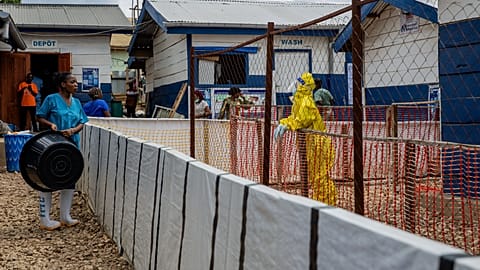
Healthcare systems are left dealing with the consequences of decisions made across the wider economy, she said.
“The healthcare [sector] is really on the front line,” Beagley said. “The burden that falls is the end result of a wider climate action that has been taken or not taken.”
Rich countries under pressure
The health consequences are already being felt worldwide following the recent events.
The figures cited in the report include more than 1,400 deaths and over 6,600 people missing in Nepal, eight million children at risk of hunger in Eastern and Southern Africa and tens of thousands of deaths associated with European heatwaves.
“If this year doesn’t change the way that we’re taking action on climate and health,” she said, “then it’s pure wilful denialism and an abandonment of the populations that government should be protecting.”
Beagley argued that wealthy countries with high historical emissions must cut pollution faster and help finance climate action in developing economies.
“It really should be on the richest and highest emitting countries in the world that have profited from fossil fuel-driven development over decades and decades,” she said. “Those countries should be reducing their emissions furthest and fastest.”
For the EU, that means cutting its own emissions while providing financial support to countries in the Global South to implement their climate commitments under the Paris Agreement.
The alliance also highlighted gaps in policymaking, with Beagley saying health ministries were closely involved in developing national climate plans in only 15% of countries covered by the analysis.
Without their involvement, governments risk overlooking the health consequences of decisions on energy, transport and industry.
COP31, approaching in November, will be a chance to showcase whether the mounting health impacts of extreme weather would finally translate into more ambitious policies.