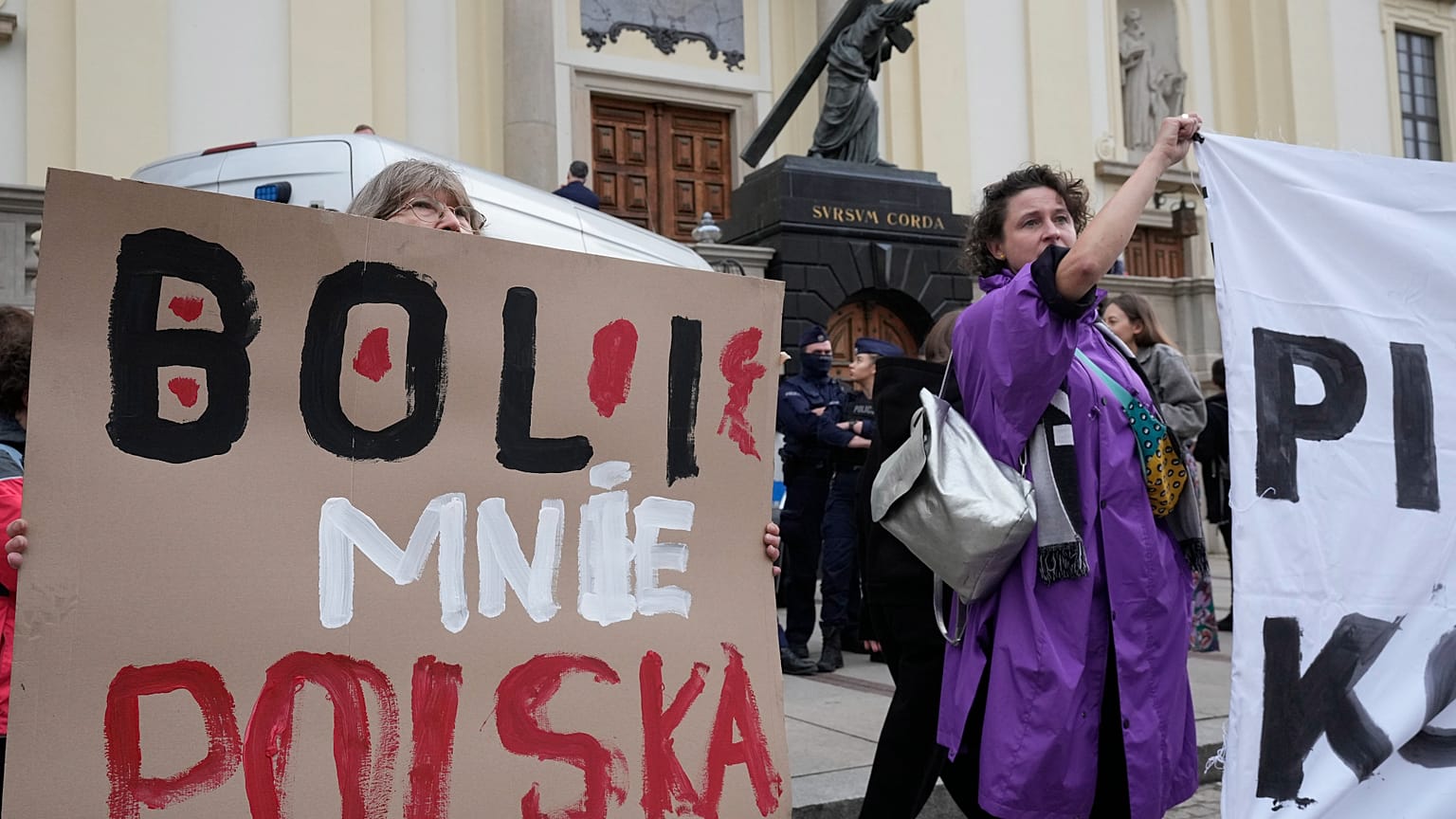


Poland’s parliament, Sejm, has voted to ease some of the country’s abortion restrictions, but the changes would leave its laws among the most restrictive in the European Union — and face an uphill battle to become law.
On Tuesday, 20 October, the Sejm, the lower house of Poland’s parliament, passed amendments to the Criminal Code that would ease some penalties for people helping women access abortion care and restore access to abortion in cases of severe foetal abnormalities.
 ADVERTISEMENT
The vote marks a tentative step towards fulfilling Prime Minister Donald Tusk’s coalition pledge to restore reproductive rights, made nearly three years ago. But even if the legislation survives a likely presidential veto, it would fall well short of the coalition’s promise.
The changes would not introduce abortion on request up to 12 weeks of pregnancy, a pledge made by Tusk’s Civic Coalition during the election campaign. Their passage into law is also uncertain: President Karol Nawrocki, who took office in 2025, has previously said that he would not support legislation easing abortion restrictions.
Under current law, anyone who terminates a pregnancy with a woman’s consent can face up to three years in prison. The same penalty applies to people who assist a woman in obtaining an abortion or encourage her to have one.
The proposed bill, backed by 217 parliamentarians, with 213 voting against and three abstaining, would exempt doctors, nurses and midwives from criminal liability when an abortion results from a medically necessary procedure intended to protect a pregnant woman’s health or life.
“It's time to end the punishment of all those who love, worry, and respect our choices,” Katarzyna Kotula, the government’s equality commissioner and a lawmaker from the Left, said on X.
Another bill, passed with 233 votes in favour, 203 against and one abstention, would again permit abortion in cases of severe and irreversible foetal abnormalities or an incurable condition threatening the foetus’s life.
It would overturn the effect of a 2020 ruling by Poland’s Constitutional Tribunal, which found abortion on the grounds of severe and irreversible foetal abnormalities unconstitutional.
‘Incremental step forward’
Seeing these changes become law remains a challenge. Even if it passes the Senate, it will need Nawrocki’s signature. The president is aligned with the opposition Law and Justice (PiS) party, which oversaw a tightening of abortion restrictions five years ago.
Overriding a presidential veto would require a three-fifths majority in the Sejm, a threshold Tusk’s coalition does not have.
Despite that, such an “incremental step forward” shouldn't be understated “as it's the first time in many years now that there's been movement in the Polish Parliament,” Leah Hoctor, Senior Regional Director for Europe at the Center for Reproductive Rights, told Euronews. A similar attempt was unsuccessful in July 2024, after failing to secure the required majority.
However, even if the amendments become law, Poland would remain one of only two EU countries, alongside Malta, where abortion on request in early pregnancy is not legal.
“The legal changes that these bills represent are so narrow in scope that for most women who need abortion care, that care will remain illegal,” Hoctor said, adding that women would still be forced to travel to access care.
That would leave Poland out of step with much of Europe, where abortion on request in early pregnancy is legal in most countries and several governments have moved to reduce barriers to care and remove criminal penalties.
“Poland is an outlier in the European context,” she said. "Globally, Poland and the US are two of only four countries in the last 30 years to have removed a ground for legal abortion from their laws," she added.
Abortion in Poland is allowed when pregnancy threatens a woman's health or life or results from a criminal act, including rape or incest. Such a near-total abortion ban has been criticised by international human rights bodies.
The European Court of Human Rights has ruled against the country in several cases involving barriers to abortion access, while in 2024, following a three-year inquiry, the United Nations Committee on the Elimination of Discrimination against Women found that Poland’s abortion laws had resulted in grave and systematic violations of women’s rights and called for comprehensive legal reform.