


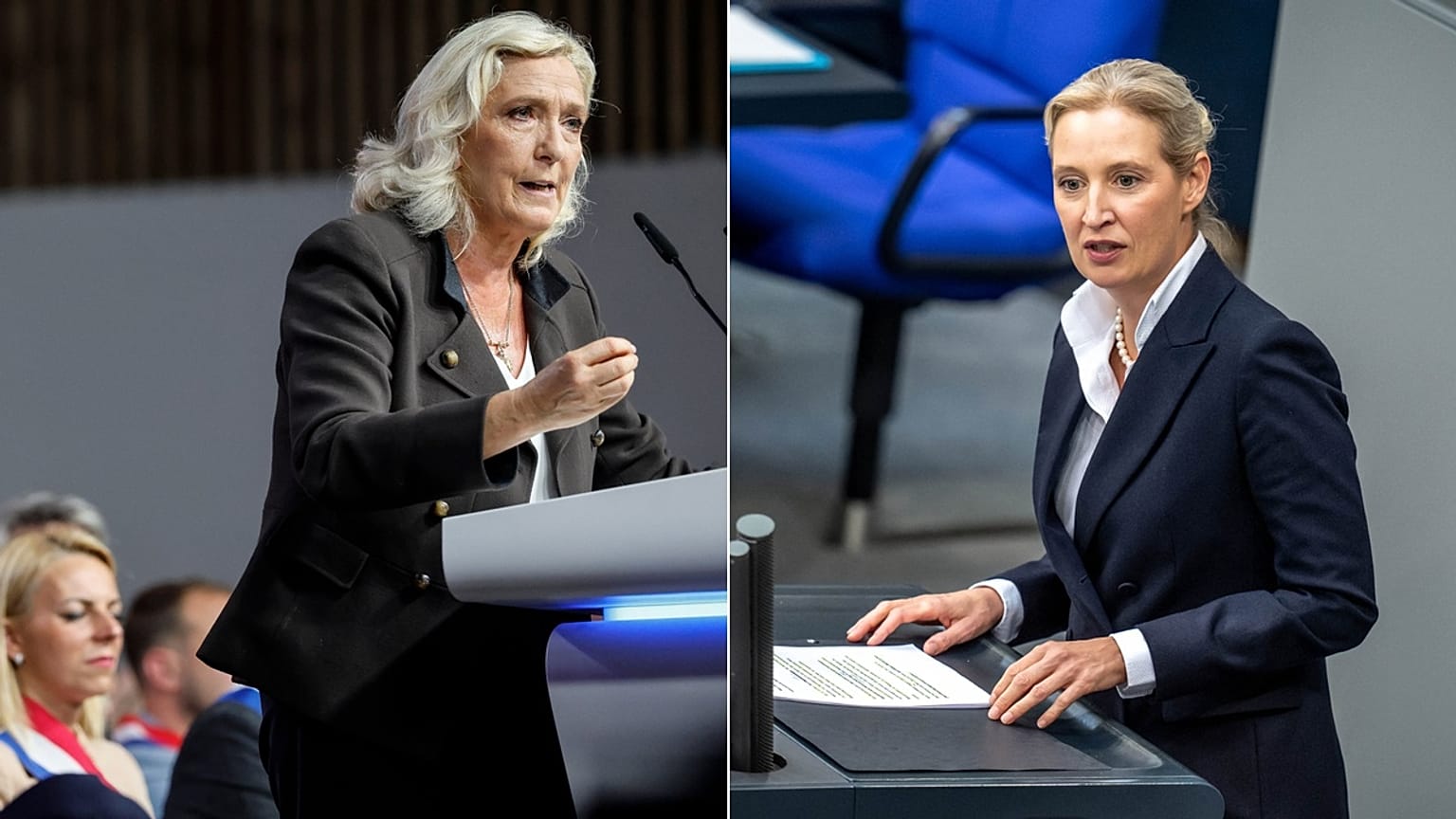


AfD leader Alice Weidel unveiled her EU vision in Strasbourg a week after Marine Le Pen did the same in Brussels. Both parties seek to reshape the bloc around national sovereignty but differ on fiscal policy, energy and the extent of reform.
Neither party now advocates leaving the EU. Instead, both want to reshape it into an alliance of sovereign states, with weaker institutions and reduced powers.
 ADVERTISEMENT
If they come to power, their plans could undermine the Franco-German partnership that has long driven European integration and reshape the future of the EU.
Alternative for Germany (AfD) leader Alice Weidel unveiled her “New Deal for Europe” at a press conference in the European Parliament on Wednesday, a week after France’s Marine Le Pen presented her own vision at the upscale The Hotel in Brussels.
Both leaders are in strong electoral positions. After a major victory in Saxony-Anhalt's regional election last September, Weidel's AFD party is on track to lead a German State for the first time in history, and is currently leading the polls at the national level. "Our aim is to assume government responsibility after the next federal elections", Weidel said in Strasbourg.
In France, a recent Ifop poll puts Le Pen at 34% to 38% of the vote in the first round of France's 2027 presidential election, despite the recent wave of protests across the country.
Both parties oppose continued funding for Ukraine, criticise the EU’s regulatory burden, reject deeper integration and want to curb the powers of EU institutions.
But they differ on fiscal policy, energy and how far their countries should break from common rules. The AfD goes further, proposing opt-outs that would allow Germany to bypass certain EU policies.
Euronews examines the RN and AfD’s plans for Europe, highlighting the key differences and similarities between two of the continent’s leading far-right parties.
No more money to Ukraine
Both leaders agree on ending financial support for Ukraine’s resistance to Russia’s war of aggression.
At her press conference last week, Le Pen argued that France’s strained public finances could no longer sustain aid to Kyiv and called for the lifting of EU sanctions against Russia.
“We obviously agreed to maintain a whole series of mechanisms to train their soldiers, to train their army, to provide them, including aid in terms of equipment, but we can no longer finance Ukraine, so this funding will stop,” she said.
Weidel said on Wednesdayshe wants a peace treaty and called for a “reasonable diplomatic approach,” which takes into account the “security interests of Ukraine and Russia.”
In a recent interview with The Economist, she argued that Ukraine had already lost the war and pledged to end Germany’s support for Kyiv.
Fiscal policy: the sharpest divide
The most significant difference lies in their approach to fiscal policy.
Le Pen wants to harmonise taxes on tobacco, alcohol and large companies at EU level to prevent fiscal dumping across Europe. She also suggested that the European Central Bank (ECB) revise its mandate to give more weight to economic growth, rather than focusing on price stability.
"As I have always believed, the ECB must rethink its course of action. It is essential that it take into account employment, growth, and innovation, given that the monetary easing policies pursued between 2010 and 2022 were not targeted at future investments," she said last week.
The AfD, by contrast, opposes any transfer of fiscal sovereignty to supranational institutions and claims that the ECB must strictly confine itself to its original price-stability mandate.
"There is a ban on the ECB, the European Central Bank, financing state debt. And what is the ECB doing? It's financing state debt", Weidel said.
Both parties, however, firmly oppose common EU debt and want to cut their countries’ contributions to the EU budget. Le Pen aims to cap France’s net contribution at €5 billion a year. Neither Weidel nor the AfD’s New Deal for Europe paper specifies a figure, instead emphasising the need to “end Germany’s role as paymaster.”
Energy: EU carbon border tax vs freedom to use coal
On energy and climate policy, both parties criticise the EU Green Deal and support nuclear power, but differ in their approaches.
Le Pen rejected the “climate-sceptic” label for her party, backed an EU carbon border tax and proposed tying member states’ contributions to the EU budget to their carbon emissions, thereby incentivising the transition to clean energy.
“The further a country deviates from the [Paris agreement] targets, the more it should have to contribute,” she said.
The AfD paper instead stresses total freedom to choose the national energy mix, meaning Germany must be free to use nuclear power, coal, gas and renewable energy according to the needs of its economy.
"Now we rely completely on an ideological energy transition of wind and solar power. We see this development also throughout Europe, through the implementation of the Green Deal, the building energy law, and above all the ban on combustion engines. This is a blatant disruption of the free market economy," she said.
Le Pen targets the Commission; AfD seeks to weaken Parliament too
Both parties want the European Commission to be stripped of powers and reduced to a “secretariat at the service of countries”, as Le Pen put it.
“The Commission wants to be a State, we don’t want it,” she said, rejecting any EU executive ambitions on security, diplomacy and intelligence. She also wants to abolish the European Committee of the Regions and the European Economic and Social Committee, two advisory bodies representing local authorities and social interests.
Weidel has a similar position. "We don't want a Commission that is not elected to intrude and disturb your private life and [Member States] decision making [process]," she said.
The AfD goes a step further, questioning the legitimacy of the European Parliament and advocating a Europe centred on sovereign nation-states.
One of the most far-reaching proposals in the New Deal for Europe states: “The EP should no longer be elected directly, but instead be composed of delegates appointed by national parliaments.”
Different strategies for change
Le Pen envisages reshaping the EU following elections in Spain, France, Italy and Poland, where far-right parties are expected to win or make significant gains.
Poland’s Law and Justice party could return to power, while Spain’s Vox could join the government alongside the Popular Party. In France, Marine Le Pen could become the country’s first far-right president.
**"**This will be our shared undertaking for the years and, the decades to come. [...] It will not simply consist of undoing what has been very badly done over the past 30 years on the European stage," she said, claiming the new "Europe of nations" will feature EU institutions not exercising any authority over the member states.
The AfD, by contrast, identifies 2029 as the pivotal year for EU reform, when the European elections could deliver a “patriotic right-wing majority in the European Parliament.”
The party also floats disruptive national options should its planned reform of the EU fail. These include making extensive use of opt-outs for Germany in areas such as free movement, defence, taxation, social policy and migration.
"If Schengen [system] is over and it doesn't work, we need to get out of Schengen and protect our borders," Weidel said, pointing to challenges to free movement amid episodes such as the large-scale arrival of irregular migrants in Ceuta last July.
The opt-out on migration would mean that Germany "will no longer participate in any European distribution mechanisms [of migrants] or asylum quotas,” disrupting the bloc's Migration Pact. Berlin currently holds the biggest solidarity quota in the EU and is in charge of relocating 4,555 asylum seekers from frontline member states in 2026.
AFD leaves the door open for EU exit
If far-reaching reforms to the EU’s structure prove unattainable, the AfD’s plan states that "the German people should then decide for themselves," a formulation that could be interpreted as an implicit reference to a referendum on EU membership as a last resort, although Weidel did not raise this possibility at her press conference.
Le Pen, once a strong advocate of France leaving the EU, has gradually abandoned the idea, shifting towards a strategy of radically reforming the bloc from within during her 2022 presidential campaign.
Dave Sinardet, a Belgian political scientist who specialises in far-right parties, considers EU withdrawal an unrealistic scenario.
“Most radical right parties have evolved their position towards the EU in the last years,” he told Euronews, adding that after Brexit no political force is seriously considering leaving the Union.
“On this, AfD is really moving in the same direction that RN has already moved in the past. They are abandoning the ideas as Le Pen abandoned Frexit,” he said.