


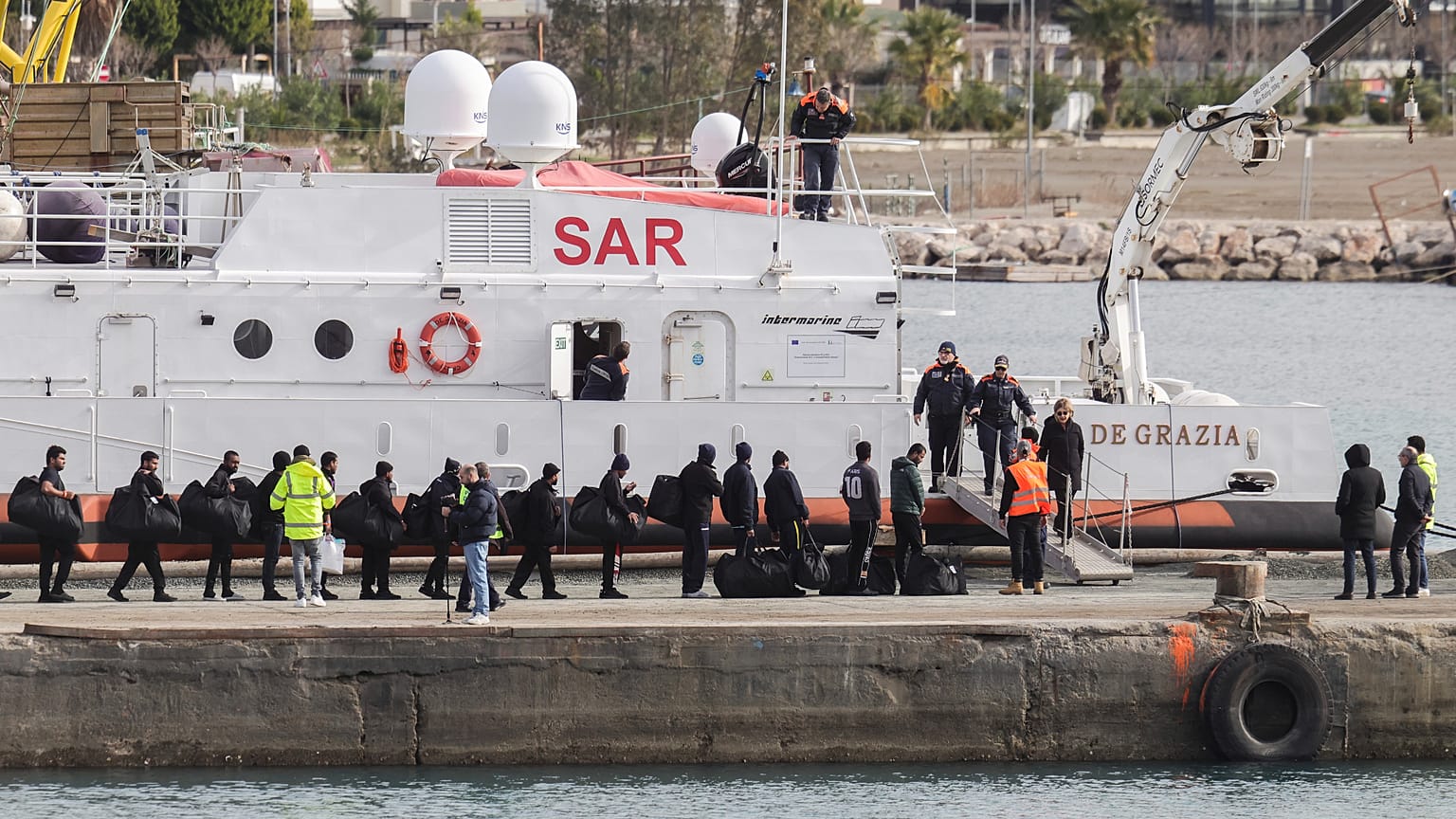


An investigation published by Dutch platform De Correspondent on the controversial Italy-Albania migration deal, now seen as a model for deportation hubs outside the EU, has won the Daphne Caruana Galizia Prize.
An investigation highlighting human rights violations at the controversial migrant centres Italy established in Albania won the European Parliament’s Daphne Caruana Galizia Prize for journalism on Wednesday.
 ADVERTISEMENT
The investigation, published by Dutch outlet De Correspondent in January 2026, explored two centres in Shëngjin and Gjadër built to accommodate asylum seekers rescued at sea while Italian authorities reviewed their applications.
The report is titled "Cuffed, caged, cast away: this is Europe’s ‘innovative solution’ for unwanted migrants". It puts into question the legality of the centres, opened in 2024, which have become a model for European migration policy, as several countries seek to establish return hubs for migrants outside the EU.
Following repeated legal setbacks, Giorgia Meloni’s government repurposed the centres in March 2025 to detain irregular migrants already in Italy ahead of their deportation to their countries of origin.
The report documented violations of fundamental rights and European law in the treatment of migrants and their transfer to the centres, issuing a warning on the new EU policy on migration.
Access denied, FOI requests ignored
Five EU countries seek to establish similar return hubs in Africa by 2027, following the adoption of a controversial EU law that provides a legal framework for such arrangements, legalizing the transfer of irregular migrants to countries they have no connection to.
“The deal is a blueprint for how to erode human rights, undermine the European rule of law, and normalize far-right views on migration,” reads the prize-winning report.
Maite Vermeulen and Giacomo Zandonini, the authors of the report published in January 2026, also estimate that around €259 million was spent on the facilities over their first two years of operation, during which 256 people were detained — equivalent to approximately €1 million per person.
“It is a big PR operation, more than a policy that would actually expedite returns [of migrants],” Vermeulen told Euronews, considering that the Italian approach is neither cheaper nor more effective, and does not deter irregular arrivals.
She argued that other EU countries could not follow the Italian model without breaching human rights. “That is a story we tell ourselves to make [return hubs] acceptable or palatable,” she told Euronews.
The investigation also denounces the “smokescreen” put in place by the Italian authorities to hide the details of the deal. Journalists were denied access, freedom of information requests often went unanswered, staff at the centres signed strict non-disclosure agreements, and contracts were not made public.
The jury for the prize is composed of journalists from all EU member states.