
















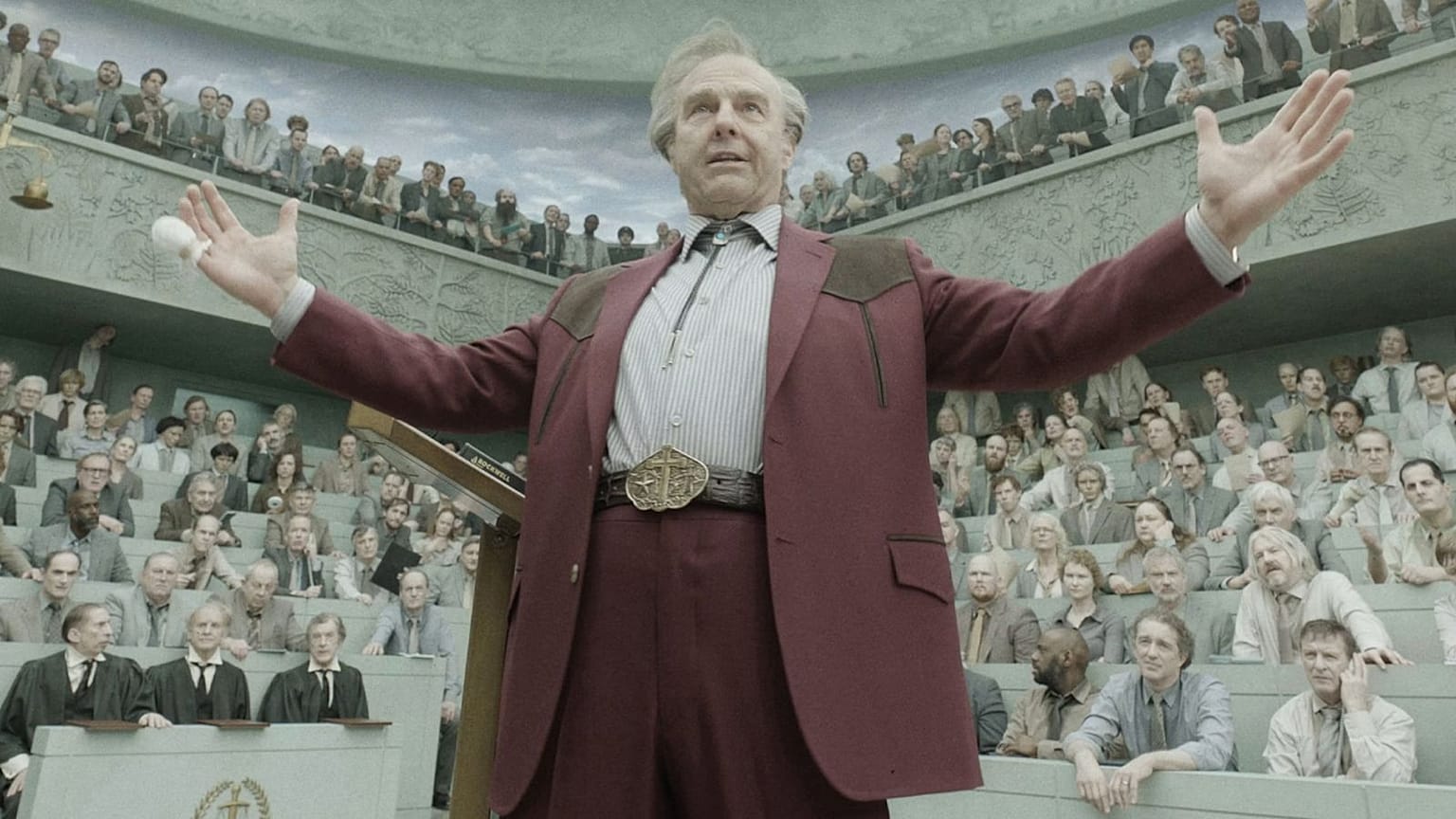














Oscar-winning director Alejandro González Iñárritu teams up with Tom Cruise for 'Digger', one of the boldest and wildest films of 2026. It may also be one of this year's biggest misfires.
NB: Spoiler-free review.
 ADVERTISEMENT
ADVERTISEMENT
ADVERTISEMENT
A billionaire narcissist’s hunger for power and proclivity for manipulating public narrative for personal gain threatens to unleash a worldwide disaster.
If you’re looking for escapism, Digger may not be the way to go. But that’s not the only reason you’ll want to stay away.
Digger Rockwell (Tom Cruise) is an aging oil tycoon whose 38-year-old cat is circling the drain. But poor Maggie, who has somewhere between “two weeks and five minutes” left to live, will have to wait as her master's reckless drilling in Greenland has unleashed methane chaos. This results in a massive explosion and a renegade chunk of Arctic glacier to break free. They quickly name the glacier Judy. She’s five times the size of Washington D.C., and she’s headed straight for Europe.
“Let’s blow that frozen cunt up!” suggests one general to President Compton (John Goodman). But the typical US reaction – launch first ask questions later – won't work with Judy.
“We’re up against the reality of nature,” explains Digger’s top environmental scientist Dr. Ganesh (Riz Ahmed, Digger 's MVP and looking like he just wandered off a Wes Anderson set).
Refusing to accept that the fate of the world (naturally, measured more in terms of infrastructure devastation and monetary loss rather than loss of life) could be in the hands of the wind and ocean currents, President Compton decides that the “great big dildo of a pickle” is down to Digger, who needs to avert Armageddon. And hopefully save Maggie.

Alejandro González Iñárritu (Birdman, The Revenant, Bardo), a polarising filmmaker to begin with, has made both the boldest film of 2026 and this year’s wildest misfire. Digger is certainly his most pretentious film to date and sees him employing his inarguably impressive knack for staging to tell an eco-satire with Dr. Strangelove on the mind.
It kicks off promisingly enough as a heightened farce that pokes fun at bullish American geopolitics and crisis management, the Trump administration (business above all – and the fact the threat comes from American meddling in Greenland couldn’t be timelier), and how arrogant Americans see Europe (“those little boys piss sitting down”). It’s very broad, but it’s never not entertaining... And just when it all seems too exhaustingly cartoonish for comfort comes the metatextual twist to end all metatextual twists.
You can’t fault its boldness and the promise it carries, as the reveal – which shan’t be disclosed here – not only explains the caricatured and largely one-note performances from Cruise, Goodman and Sandra Hüller (reduced to playing Digger’s half-sister Emma as someone who enters rooms and shouts), but harks back to Iñárritu’s Oscar-winning Birdman. The director goes full postmodernist once more and sets the stage for Digger to become a satire about the very concept of satire. More specifically, about the importance of lampooning past calamity, in a sort of Twain-esque “tragedy plus time equals comedy”.
While initially promising, it sadly goes nowhere, with Iñárritu, Alexander Dinelaris, Nicolás Giacobone and Sabina Berman’s screenplay never getting to the heart of the social criticism, distraction, catharsis and yes, possible narrative rewriting, the genre can offer. The script also lacks the laughs to bolster its mordant aspirations and never - excuse us – digs deep enough to engross, relying instead on Cruise’s OTT efforts to entertain.
To his credit, Cruise does pull out all the stops here, dialling it up with his prosthetic belly, terrible comb-over and Foghorn Leghorn delivery. However, this won’t be the vehicle that gets the Best Actor Oscar that has eluded him for so long, as his performances in Digger are both larger-than-life and unrewarding. It’s a shame, as Cruise has proven time and time again that he’s more than Mission: Impossible’s Ethan Hunt; however, he mistakes pantomimic and jowly excess for "serious” acting, and the divisive (by design?) film itself may dissuade Academy voters to give him his fourth acting nomination, following Born on the Fourth of July, Jerry Maguire and Magnolia. As for Iñárritu, it doesn’t look like he’ll be adding a third Best Director Oscar to his shelf, after winning two consecutive awards in a row - Birdman (2015) and The Revenant (2016) - as Digger comes off as far too sanctimonious for its own good.
Then again, when has that stopped the Academy?
Still, should reason prevail, Digger ’s award chances hang on Emmanuel Lubezki’s impressive cinematography and Dennis Gassner’s flawless production design. Both save the day.

It’s hard to write more about Digger without spoiling Iñárritu’s brave but misguided gambit, but safe to say that once he does pull the rug from under the audience, he leaves viewers with a boated folly that’s both hollow and heavy-handed in the way it loudly announces everything via didactic speeches.
It’s still uniquely fascinating in the way it means well as a commentary on complicity, knows where it wants to go while breaking every fourth wall in its way, and understands what it’s trying to say as a cautionary tale; it simply can’t get out of its own finger wagging way. One character (again, no spoilers), played by Jesse Plemons, delivers a monologue towards the end of Digger that may as well have been delivered straight-to-camera, essentially telling the audience that if this all feels too on-the-nose, it’s by design, and that if we’re not in awe at what we’ve just witnessed, it’s because we’re not getting it.
The only thing to get is that high concepts are always to be applauded. But when they end up as empty theatrics that make Adam McKay's Don’t Look Up feel like a masterclass in allegorical subtlety, conceptual bravado just comes off as self-indulgent. Chances are you won’t dig it.
Digger is out in cinemas now.