




























The Russian embassy in South Africa recently shared an AI-generated image of BRICS leaders. It's part of a growing trend of public figures and institutions using AI in their communication, which researchers say can undermine public trust.
The Russian embassy in South Africa has shared a picture that appears to show Russian President Vladimir Putin taking a group selfie with the 10 BRICS world leaders during September's summit.
 ADVERTISEMENT
ADVERTISEMENT
ADVERTISEMENT
The 18th BRICS Summit took place in New Delhi, India, on 12 and 13 September.
The verified X account posted the picture, which garnered more than 2 million views, alongside the caption "BRICS is a superpower".
However, this selfie is not real.
No credible news organisation has published the image as real, and the official website of the summit did not share it either.
The Cube, Euronews' fact-checking team, has also run it through image detectors, which revealed it to be AI-generated.
For instance, after running the image through OpenAI, the tool revealed to have found "a SynthID watermark that originated from OpenAI".
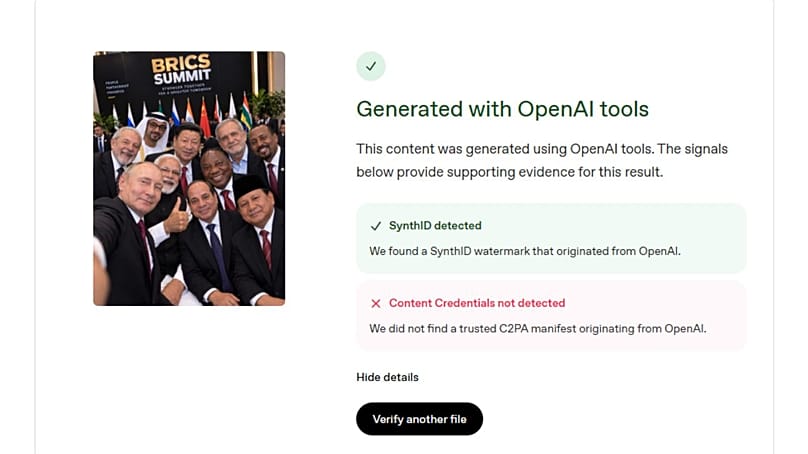
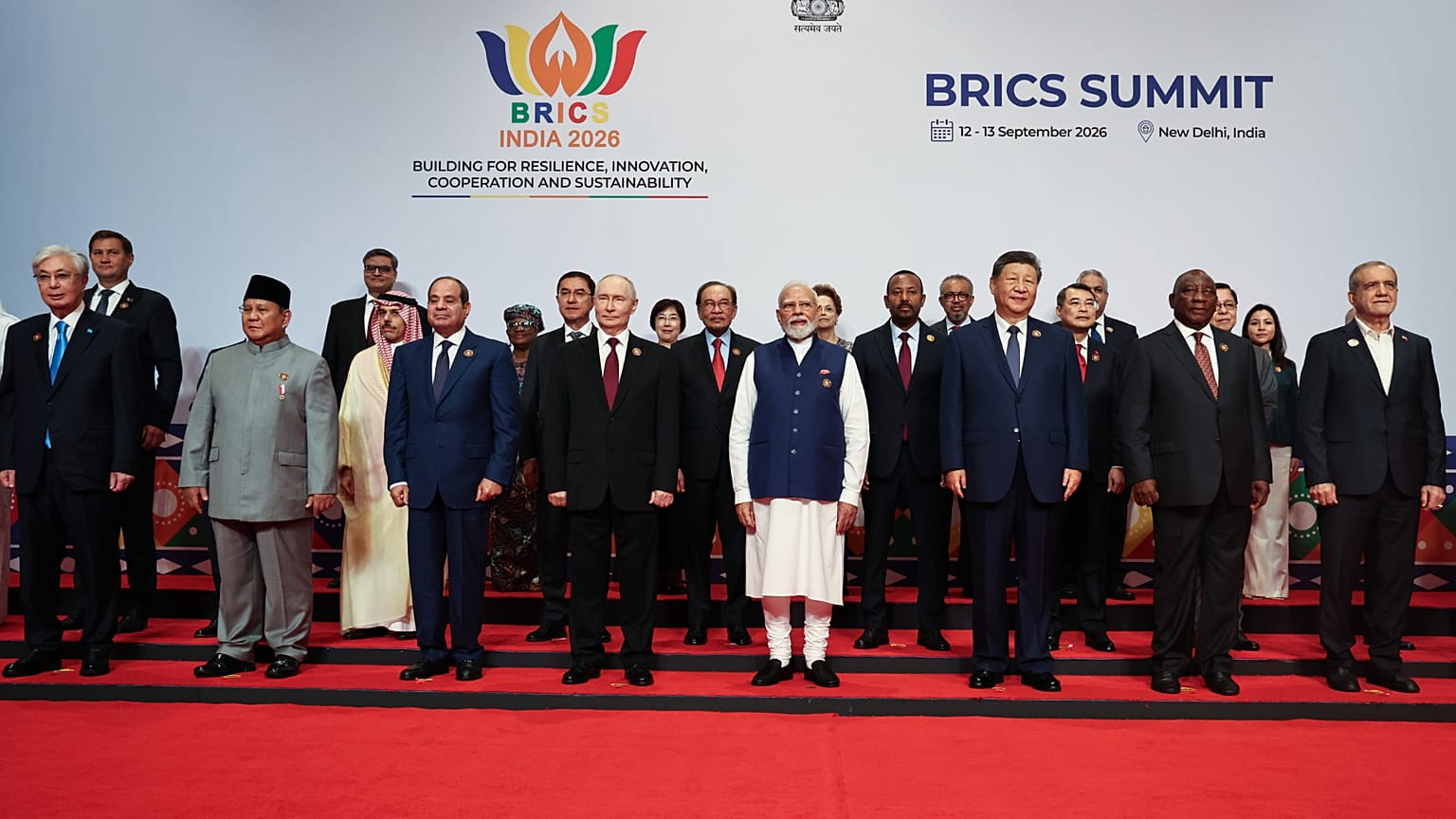
Furthermore, the official logo and slogan of BRICS India 2026 do not match those portrayed in the AI-generated picture.
This summit's theme was "Building for Resilience, Innovation, Cooperation and Sustainability", while the AI-generated picture states "Stronger together for a brighter tomorrow".
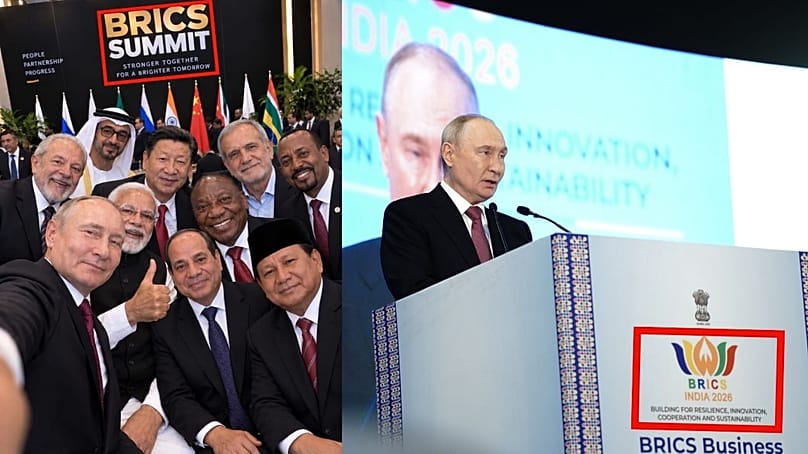
At no moment does the Russian embassy in South Africa disclose that the picture was generated using AI.
A rising phenomenon among politicians
While the image appears harmless, it is becoming increasingly common for European politicians and public institutions to publish AI-generated images without labelling them as such.
Sometimes they are used for disingenuous purposes, and often they can erode trust among the public.
Recently, the leader of the Portuguese far-right Chega party, André Ventura, posted an AI-generated video of a woman with six fingers, seemingly to push an anti-immigration narrative.
The video depicts a hijabi woman supposedly looking up and down at a white, non-hijabi woman wearing a short dress, alongside the caption "if it were the other way around, it'd be racist and xenophobic. They come to our countries... Why do they not get used to respecting our values?"
Despite many comments from users stating the video was clearly AI, Ventura didn't disclose that the video was AI-generated, and it remains active on his profile as of the time of publication.
The phenomenon of politicians using AI-generated content to publicise their policies isn't confined to Europe: high-profile figures such as US President Donald Trump are infamously using more and more AI-generated images and videos in their communications and on their social media channels.
What are the consequences of politicians' AI use?
A 2026 study from the European non-profit AI Forensics showed that AI is being used not only to create photorealistic images "but also for stylised, cartoonish imagery to reinforce key campaign messages, including anti-immigrant narratives".
The research, which focused on the French municipal elections, found that the use of AI remains most pronounced among right and far-right parties, and that the lack of disclosure could put public trust in the electoral process in danger.
Most of the material looked at by researchers carried no explicit AI disclaimer, even when watermarks were present.
Since August of this year, the EU's AI Act has generally required realistic AI-generated or manipulated material to be clearly disclosed as such.
"Providers of generative AI have to ensure that AI-generated content is identifiable," the Act states. "On top of that, certain AI-generated content should be clearly and visibly labelled, namely deepfakes and text published with the purpose to inform the public on matters of public interest."