

















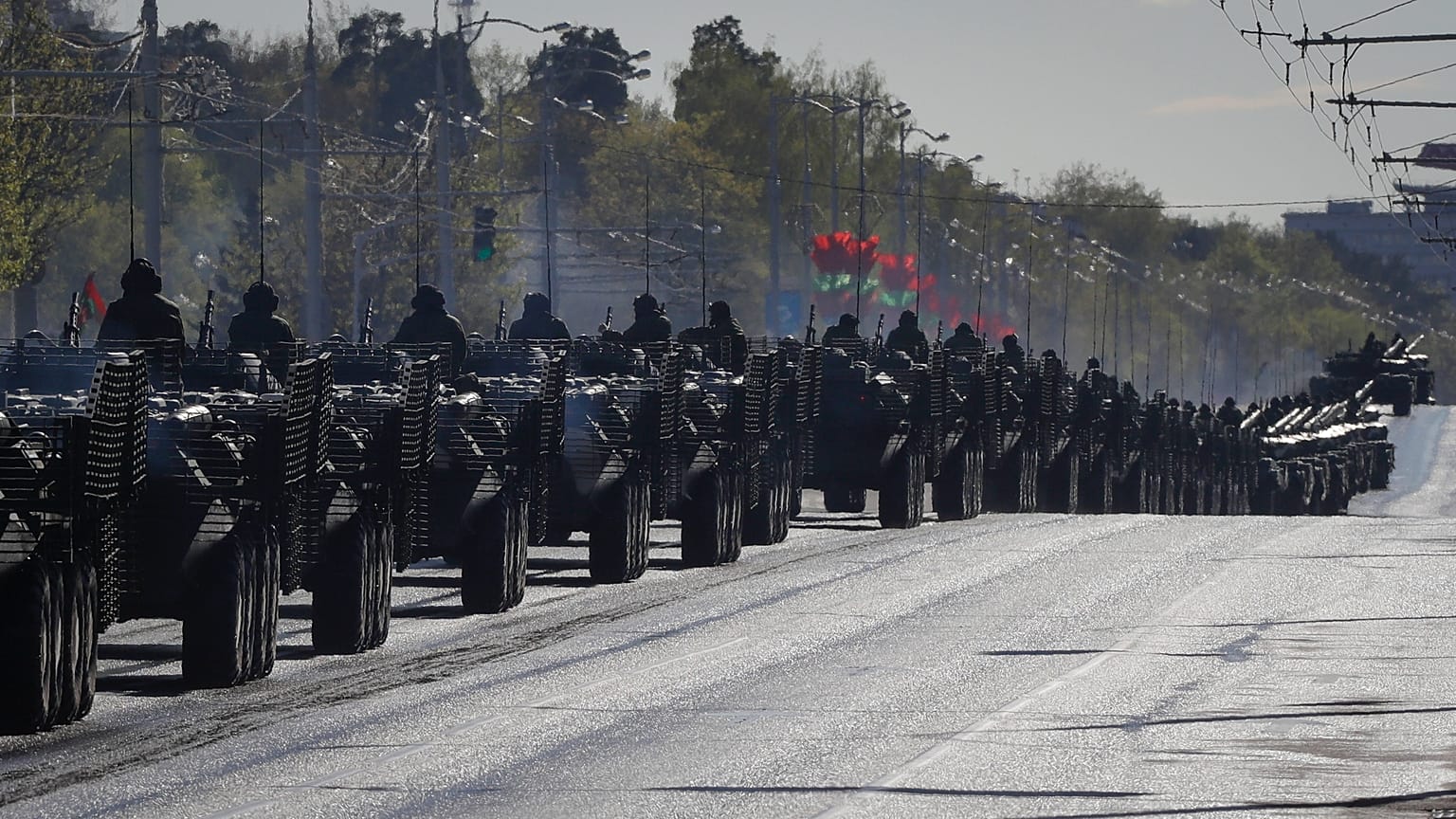














Mechanised and tank battalions are training in border protection and counter-drone operations along the 104-kilometre Polish-Lithuanian corridor, NATO's only land link to the Baltic states.
Belarus has begun four-day military exercises near its borders with Poland and Lithuania, as Ukraine reported that Russia was using Belarusian relay stations to guide drone attacks on targets in western Ukraine.
 ADVERTISEMENT
ADVERTISEMENT
ADVERTISEMENT
The drills involve mechanised and tank battalions training in border protection, "counter-sabotage operations" and defence against drone and light aircraft attacks, the Belarusian defence ministry said, according to Radio Svaboda, the Belarusian service of Radio Free Europe.
The exercises are taking place partly near the Suwałki Gap, a 104-kilometre stretch of the Polish-Lithuanian border that serves as the only land link between the Baltic states and the rest of NATO, and separates Belarus from Russia's Kaliningrad exclave.
Locations include the Hoża training ground on the Lithuanian border and the Brzeski and Różański ranges, approximately 15 and 60 kilometres from the Polish border respectively.
The Belarusian defence ministry described the exercises as "purely defensive" and said the number of troops and equipment involved did not exceed the thresholds set by the 2011 Vienna Document, which would require prior notification of other states. No figure has been given for the number of soldiers taking part.
Belarus' autocrat leader Aliaksandr Lukashenka visited the Obuz-Lesnowski training ground near Baranavichy on 11 September, saying he wanted to assess the state of the entire national security apparatus.
Belarus has held exercises near NATO borders for years, frequently involving Russian forces. The Slavic Brotherhood manoeuvres took place in the Brest area in 2020, followed by the Zapad 21 exercises in 2021.
In February 2022, Minsk allowed Russian forces to use Belarusian territory and infrastructure to launch its full-scale invasion of Ukraine.
Belarusian forces have not taken part in direct combat on Ukrainian territory, and under humanitarian law criteria cited by Radio Svaboda, Belarus is not considered a party to the war.
The logistical and military support it has provided to Russia has drawn sustained international criticism and triggered successive rounds of Western sanctions.
The EU expanded its Belarus sanctions regime in March 2022 specifically in response to Minsk allowing Russian forces to attack Ukraine from its territory, adding trade restrictions affecting 70% of Belarusian import volumes and targeting military sector officials.
Further rounds followed in 2023 and 2024, progressively aligning Belarus sanctions with those imposed on Russia and introducing export bans on sensitive technologies, firearms and aviation equipment. The US and UK imposed parallel measures.
The EU also introduced tariffs on Belarusian agricultural goods and fertilisers, which took effect in July 2025.