





























President Trump’s tariff war and territorial threats have made Ottawa pivot towards Europe. Brussels now wants to seize the political moment and draw Canada deeper into its orbit.
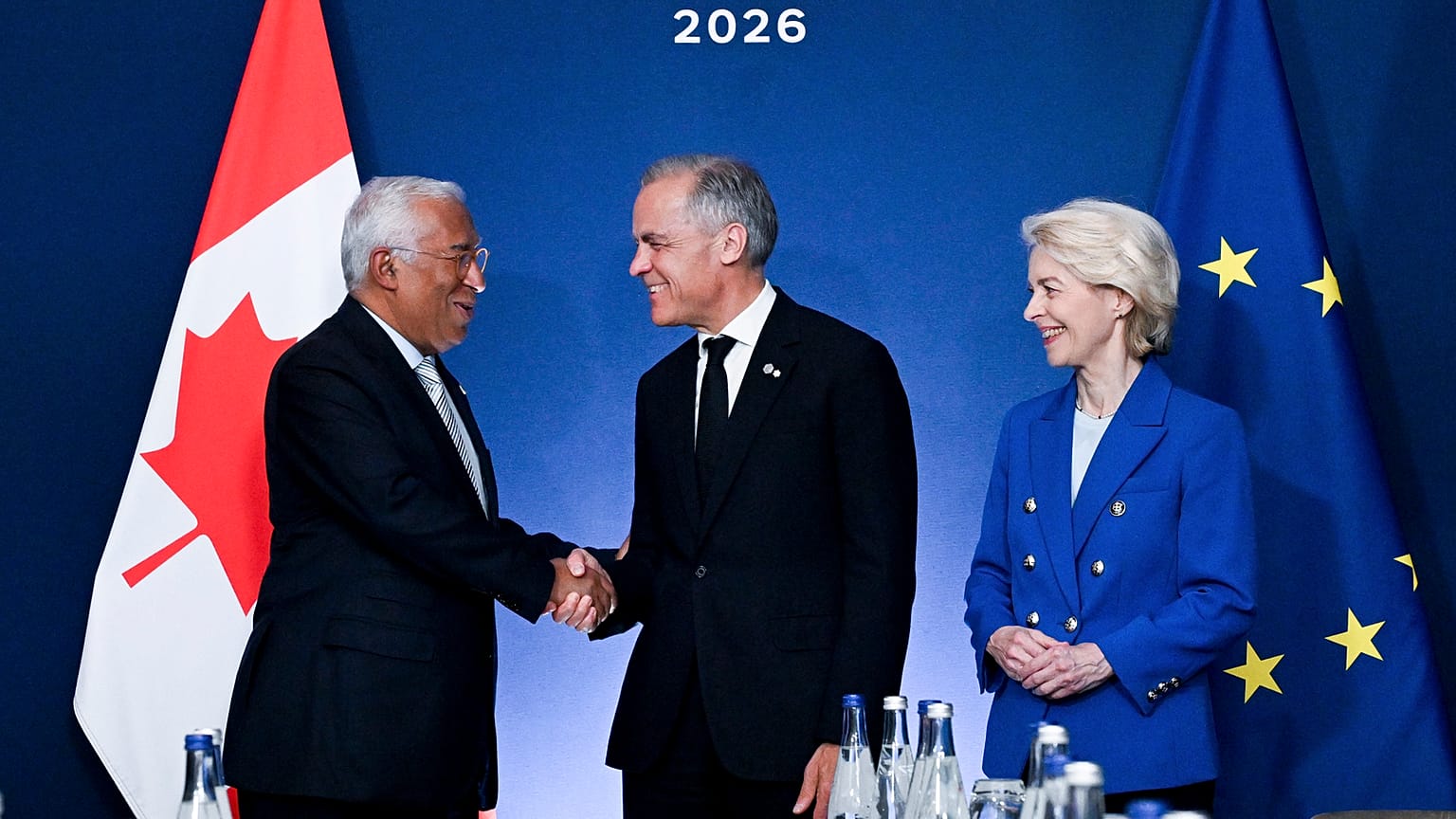
Canadian Prime Minister Mark Carney has seized Europe’s political spotlight this week with his clearest overtures yet towards the European Union (EU), days before he is set to join senior EU officials at a European Parliament plenary in Strasbourg.
 ADVERTISEMENT
ADVERTISEMENT
ADVERTISEMENT
Carney said overnight that he’s seeking a “unique alliance” between Canada and the European Union but not full membership of the bloc, after the Wall Street Journal reported on Sunday that Ottawa was seeking formal talks with Brussels on “associate” EU membership.
The reports come just ahead of Carney’s visit to Strasbourg, where European Commission President Ursula von der Leyen is expected to flesh out the EU’s vision for a deeper relationship with Canada during her annual State of the Union speech on Wednesday, according to EU officials.
It’s the latest in a series of public signs of rapprochement. Carney became the first non-European leader to attend a European Political Community (EPC) summit in May, and Canadian ministers have recently stepped up their participation in EU ministerial meetings.
The shift comes as Canada faces growing economic and political pressure from its southern neighbour. US President Donald Trump’s tariff war has hit $20 billion worth of Canadian products with 50% tariffs, while his repeated threats to make Canada the 51st US state have prompted Ottawa to rethink its security and defence alliances.
European nations have emerged as natural partners as Carney seeks to build what he describes as a coalition of “middle powers” that can spearhead a new rules-based order.
With Carney ruling out full EU membership — despite polling showing broad support for the idea among Canadians — Brussels sees an opportunity to seize on a rare political opening. But what exactly a special EU-Canada “alliance” could look like remains unclear, with no obvious legal or political precedent for such an arrangement.
A European Commission spokesperson confirmed on Monday that the EU’s level of ambition for its strategic partnership with Canada is “even higher” this year ahead of an EU-Canada summit in Montreal in October, describing Canada as a “strategically important partner” and “close friend”.
The head of the European Parliament’s Liberal group has meanwhile called on the Commission to “match Canada’s ambition” by further strengthening trade, economic and security ties.
A ‘symbolic’ upgrade
“This is more about symbolism than anything else,” Dr. Steven Blockmans, deputy director at the International Centre for Defence and Security, told Euronews.
He expects Brussels to dismiss talk of “associate membership” and instead “spin it as an agenda which sees even closer trans-Atlantic cooperation with Canada”.
Reports of Ottawa seeking “associate membership” echo a similar plan floated by German Chancellor Friedrich Merz for Ukraine in May, which was quickly dismissed by most EU countries and Ukraine as a non-starter.
It pitched a seat for Ukraine at the table in summits and ministerial meetings without voting rights, coverage under the bloc's mutual assistance clause, and eligibility for funding under EU programmes.
Ideas of “levels” of EU membership in a pre-accession phase have been gaining traction, but associate membership for a country that is not seeking to become a full member is not likely to gain traction.
“This is a notion that makes no legal sense,” Blockmans explained, but added that it is still possible for Canada to “strengthen its trade relations with the EU in different domains”.
Trade and economics drive rapprochement
Greater access to the EU’s €18 trillion single market is considered a major driver of Ottawa’s agenda, and potentially the biggest prize Brussels could offer Canada in the age of Trump’s tariff war.
Talks between Ottawa and Washington broke down last month, with Trump vowing to impose 50% tariffs on cars and steel from 2027, in a move that has dented hopes of an easing of tensions.
The EU-Canada trade deal, known as CETA, was signed over a decade ago but is yet to be fully ratified across the EU. More privileged access to the single market — potentially moving Canada closer to arrangements enjoyed by countries such as Norway or Switzerland — could help Ottawa diversify away from its traditional reliance on the US.
But Blockmans says it is almost inconceivable that the EU would contemplate such privileged access for a country that has no membership aspirations and follows a “completely different rulebook” in areas such as food and agricultural policy.
“An arrangement such as that of Norway and Switzerland is definitely off the books,” he said, adding that upgrading the current trade deal, known as CETA, is also difficult given the fierce protests the agreement sparked in several parts of Europe.
“This is almost a return to the Brexit situation,” Nicolai von Ondarza, a political scientist and senior fellow at the German Institute for International and Security Affairs, said, recalling the famous "Barnier staircase" used by the EU’s former chief Brexit negotiator, Michel Barnier, to show the trade-offs facing the UK during post-Brexit negotiations.
“If you want to upgrade the trading relations, you get into territory of a European Economic Area (EEA) arrangement,” von Ondarza explained, referring to the model that gives Norway, Iceland and Liechtenstein access to the single market in return for alignment with EU rules.
That level of access would come at a political price for Ottawa. The EU has traditionally demanded close alignment with its laws and judicial framework in exchange for deep participation in its market, conditions that Canada has resisted in its relationship with the US, von Ondarza said, raising questions over whether Ottawa would accept them from Brussels.
“The question is: how prepared is Canada to accept EU rules?”
Interests converge
Experts do see scope to deepen trade ties in areas where Canadian and European interests already converge, including critical raw materials. Talks are ongoing on offering the EU greater access to Canada’s rare metals and minerals, as Brussels seeks to diversify its supply chains and reduce reliance on China.
Canada is also seeking access to the bloc’s “Made in Europe” scheme, designed to shield strategic sectors such as clean energy from unfair competition, mostly from China, by restricting foreign companies’ access to public procurement.
Brussels is open to including partners beyond its member states if they offer reciprocal access to their subsidy programmes.
While Canada and European allies work together on their common security and defence within the NATO alliance, a renewed alliance could also see both sides deepen their defence industry partnerships and work closer together to bolster Ukraine as US support wanes.
Canada became the first non-European country to join the EU's €150 billion SAFE defence procurement programme, and is currently negotiating a contribution to the EU’s €90 billion loan for Ukraine, according to the Financial Times.
But Ottawa could also demand greater political courage from Brussels when geopolitical disputes threaten to fracture Western unity, Nicolai von Ondarza told Euronews.
He pointed to what he described as an imbalance in the relationship: Canada openly backed its European allies when Trump threatened to seize Greenland, while the EU hesitated to side with Ottawa in its trade confrontation with Washington, explaining that Canada “could ask the EU to address this imbalance” in future talks.