













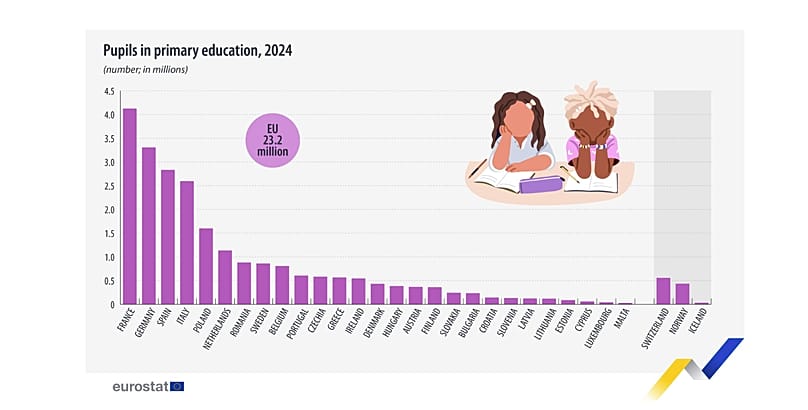
The EU had 23.2 million primary students in 2024, down 0.2% from 2023. Since 2014, numbers have risen by 2.9%, though trends vary widely: Luxembourg and Slovenia grew the most, while Poland, Croatia and Portugal saw major declines.
In 2024, there were 23.2 million primary school students in the European Union, a figure virtually unchanged from the previous year, but the underlying trend has shifted over the past decade: today there are fewer students per teacher than in 2014.
 ADVERTISEMENT
ADVERTISEMENT
ADVERTISEMENT
The latest Eurostat data, released to coincide with International Literacy Day, confirm this and not only set out enrolment numbers but also detail how many teachers are in Europe's classrooms, who they are, and what types of schools they work in.
France remains by far the country with the most primary school children: 4.1 million in 2024. It is followed by Germany (3.3 million), Spain (2.8 million) and Italy (2.6 million). At the other end of the scale, Malta has barely 27,537 students; Luxembourg has 43,020, and Cyprus 60,596, figures that depend both on the size of each country and on the age at which children start primary school, which varies from one member state to another.
Compared with last year, overall primary enrolment in the EU fell by 0.2% (35,153 fewer pupils), a small but real drop.
The picture looks different over a longer period: since 2014, pupil numbers have grown by 2.9% (659,086 more), although the trend is highly uneven across countries. Fifteen member states gained pupils over those ten years, and eleven lost them. Luxembourg (+21.4%) and Slovenia (+18.2%) lead the increases; Poland (-25.7%), Croatia (-10.3%), and Portugal (-10.0%) record the largest declines.
The student-teacher ratio in primary schools has fallen since 2014
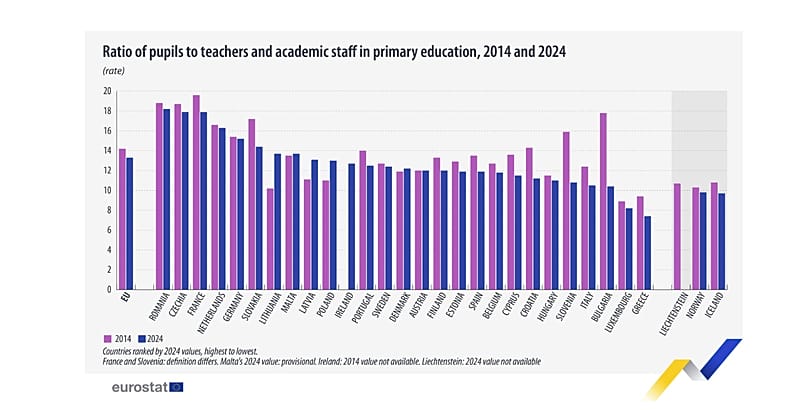
The student-teacher ratio, an indirect measure of teaching resources in an education system, also shows change. In 2024, the EU average was 13.3 pupils per primary teacher, compared with 14.2 a decade earlier. Greece (7.4) and Luxembourg (8.2) are the only countries below 10; at the other end, Germany (15.2), the Netherlands (16.3), Czechia and France (both 17.9) and Romania (18.2) all have more than 15 pupils per teacher.
The downward trend was repeated in 23 of the 27 countries between 2014 and 2024, with Bulgaria (from 17.8 to 10.4) and Slovenia (from 15.9 to 10.8) showing the sharpest drops. Austria is the exception that proves the rule: its ratio did not shift by a single decimal point, stuck at 12.0. The remaining countries saw increases, and Lithuania saw the most marked change, rising from 10.2 to 13.7 pupils per teacher.
Eurostat also sets out, in a broader analysis of the primary phase, how many teachers stand behind those students. In 2024, there were nearly 1.9 million primary teachers in the EU. Germany tops the list with 284,000, followed by Italy (251,000), Spain (248,000) and France (242,000, an incomplete figure as it does not include independent private schools).
Teaching remains an overwhelmingly female profession: 85.6% of primary teachers in the EU are women, compared with 14.4% men. In nine countries, the male share is below 10%; the most extreme case is Lithuania, where only 3.9% of teachers are men. Denmark, at 32.8%, has the highest male presence in primary classrooms, though males remain a minority.
By age, 42.1% of European teachers are between 35 and 49, 38.1% are over 50, and only 19.7% are under 35. Italy (58.2%) and Lithuania (57.3%) have the oldest staff; Malta and Luxembourg, by contrast, have more than double the EU average share of young teachers.