




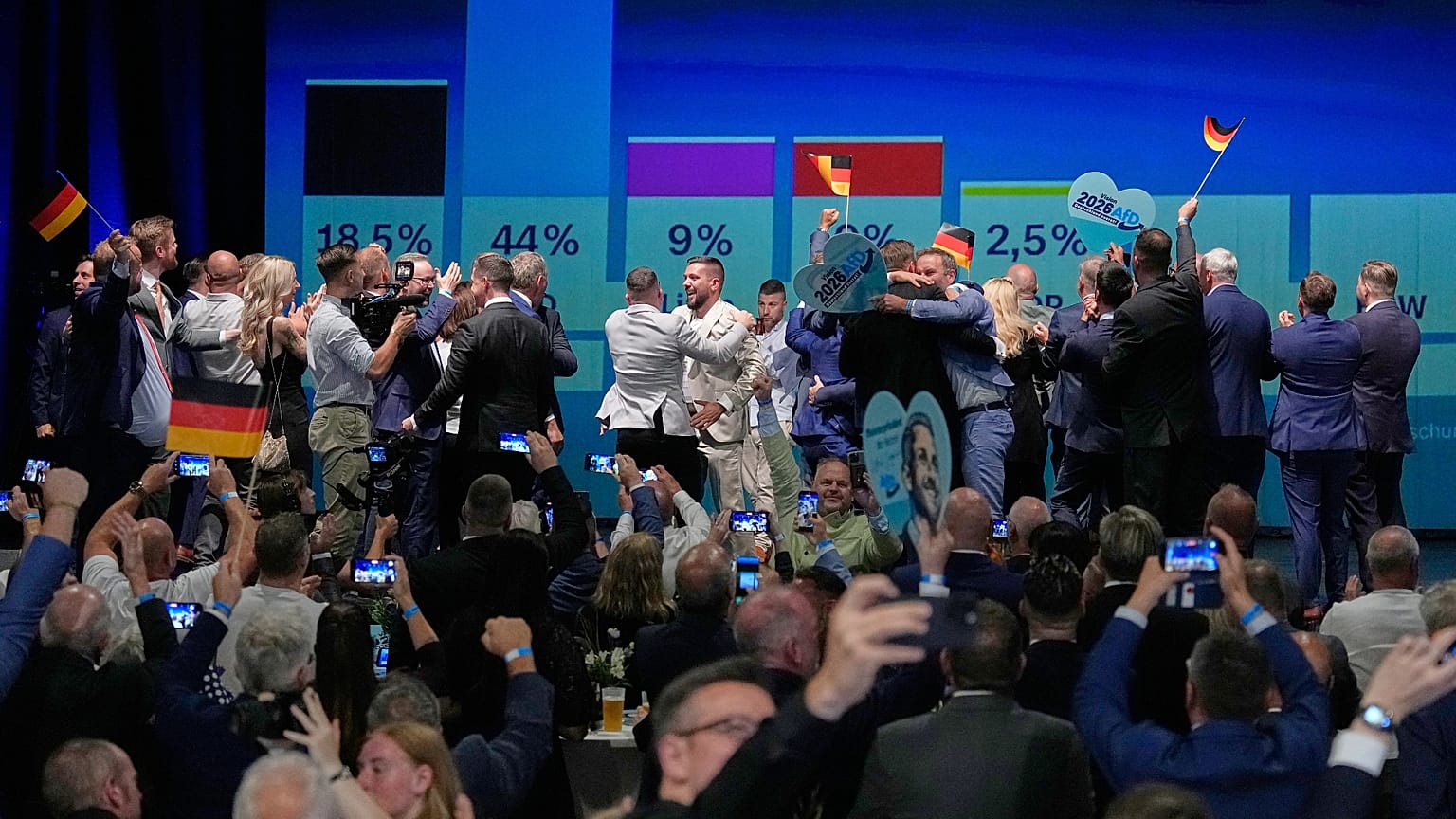













AfD's landslide win in Saxony-Anhalt could be the prelude to far-right forces governing alone across Europe. Germany's 'grand coalition' model, and the centrist alliance underpinning EU politics, are starting to crack.
The radical-right Alternative for Germany's landslide victory in the Saxony-Anhalt region election may be the first real crack in the power structure that has held European politics together since the Second World War.
 ADVERTISEMENT
ADVERTISEMENT
ADVERTISEMENT
On Sunday, Alternative for Germany (AfD) won a resounding victory in the eastern German region, taking 43.8% of the vote. Chancellor Friedrich Merz's Christian Democratic Union (CDU), which leads the governing coalition in Berlin, collapsed to 17.2%, while its junior coalition partner, the Social Democrats (SPD), managed just 9.3%.
For the first time since the Nazi period, a German region could be led by a far-right force, as local leader Ulrich Siegmund could become president if the far-left party BSW decides to support him or to abstain in the election.
Beyond dealing a further blow to an already deeply unpopular government in Berlin, the results drew mixed reactions across Europe, with far-right forces eager to capitalise as key EU states head to the polls next year.
"This result is not an outlier - it is a signal to the rest of Germany and to Europe," René Aust, the head of the AfD delegation to the European Parliament, told Euronews.
"We are on course to become the country's leading governing party, and I am convinced that at the next European elections we will return to the European Parliament with more than twice our current strength," Aust said.
European repercussions
"The region Saxony-Anhalt is a small part of Germany. 1 out of 16 regions," Andreas Schwab (Germany/EPP) said, playing down the impact of the vote. "The [AfD] party has no real power in Berlin, where the great coalition has a clear majority."
For Schwab, the vote's impact in Brussels will likely be limited to reinforcing the EU's simplification agenda — cutting red tape, including for farmers — and pushing for a more nationally oriented EU budget.
Svenja Hahn (Germany/Renew) echoed that view. "We can only hold up a democratic majority in 2029 by finally delivering on economic growth and prosperity and taking the regulatory burden off of people and businesses," she said.
Still, the result is bound to raise alarm bells across Europe, not just for its impact on German domestic politics, butbecause Germany’s grand-coalition tradition provided a foundation for the political consensus at the heart of European integration for much of the postwar era.
The centre-right European People's Party (EPP) and centre-left Socialists and Democrats (S&D) have been the linchpin of Brussels politics since the European Parliament was created, at times with the support of the centrist Renew Europe group.
But the rise of extremist parties and the steady erosion of the political centre is now calling that approach — born in Germany, exported to Brussels — into question. Last month, Europe Elects projected that the three centrist forces would, for the first time, fail to secure an absolute majority if European Parliament elections were held today.
"It is no more about who can speak with whom and how different factions of democratic society can unite. It is about how to get their joint share larger, not by stealing the electorate from one another, but by convincing those who are disappointed by all of us, democrats," MEP Sergey Lagodinsky (Germany/Greens-EFA) told Euronews.
Far-right into power
The AfD's growing electoral gains across Europe have raised the prospect that far-right parties could enter government outright. In Saxony-Anhalt, the AfD fell short of a majority to govern alone but could reach one in coalition with the BSW.
How much power-sharing traditional parties allow has depended on national context, and on whether mainstream forces are willing to ally with the far right.
In Italy, for instance, Giorgia Meloni has steered her coalition government towards the centre, making her European party, the European Conservatives and Reformists (ECR), increasingly mainstream. As a result, she now faces competition from a new far-right force led by Roberto Vannacci (Italy/ESN), a former army general turned MEP.
In Spain, the centre-right Popular Party has partnered with the hard-right Vox to govern several regions, including Andalusia and Castilla y León, a model some would like to see exported to Brussels.
"In each country, it really depends on how radical the far right is and how much there can be any kind of collaboration. But, in general, collaboration with the far right was not good for us. We have stayed weak," MEP Hildegard Bentele (Germany/EPP) told Euronews.
Within the European Parliament, the EPP group led by the Bavarian Manfred Weber has throughout this legislative term kept a flexible approach to forming variable majorities, at times seeking support from hard-right parties over specific files.
While Weber's strategy has strengthened the EPP's negotiating hand and drawn the ire of other centrist forces, moving from case-by-case alignment to a more structural alliance would entail a fundamental reshaping of power-sharing at the EU level.
As of now, Weber has always excluded structured cooperation with far-right forces, while some parties forming the EPP have often wished for it.
Elections loom
In 2027, voters in France, Italy, Poland, Spain, Estonia, Greece, Finland, Malta and Slovenia will all go to the polls in high-stakes national elections. In France, in particular, far-right presidential candidate Marine Le Pen is projected to win against any other candidate in the run-off.
These upcoming elections will reshape Europe's political landscape ahead of the next EU elections in 2029, which, if current trends hold, could be the first not to hand mainstream parties a governing majority.
"[The Saxony-Anhalt election] It's a very strong warning signal, but we have three years ahead of elections, so we have a lot of time to become stronger again. The warning signal is out. We have to work on our own strengths," Bentele said.
Bentele drew two main lessons from the results: the need to mobilise people who had not voted in the last elections — the main driver of the AfD's surge — and the need to choose better-suited candidates.
Meanwhile, Aust noted that only voters over 70 kept the AfD from securing an absolute majority at the regional level, which he considers clear evidence that the future belongs to patriotic forces and that the CDU will soon become "the party of yesterday," as was the case for Democrazia Cristiana in Italy.
For Lagodinsky, the challenge ahead is nothing less than restoring disappointed voters' faith in liberal democracy. "If we don't get our act together on that, our democracy is doomed," he concluded.