

















Good morning, readers. Angela Skujins here holding the pen for this week’s newsletter, where a seismic regional election in Germany’s east has seen the far-right, anti-migration Alternative for Germany (AfD) sweep to power, with the blow ricocheting as far as Berlin.
No alternative: With voters turning out in droves, preliminary end results from Sunday’s Saxony-Anhalt ballot show the AfD securing 43.8% of the vote, representing 39 seats of the 83-member state parliament.
 ADVERTISEMENT
ADVERTISEMENT
ADVERTISEMENT
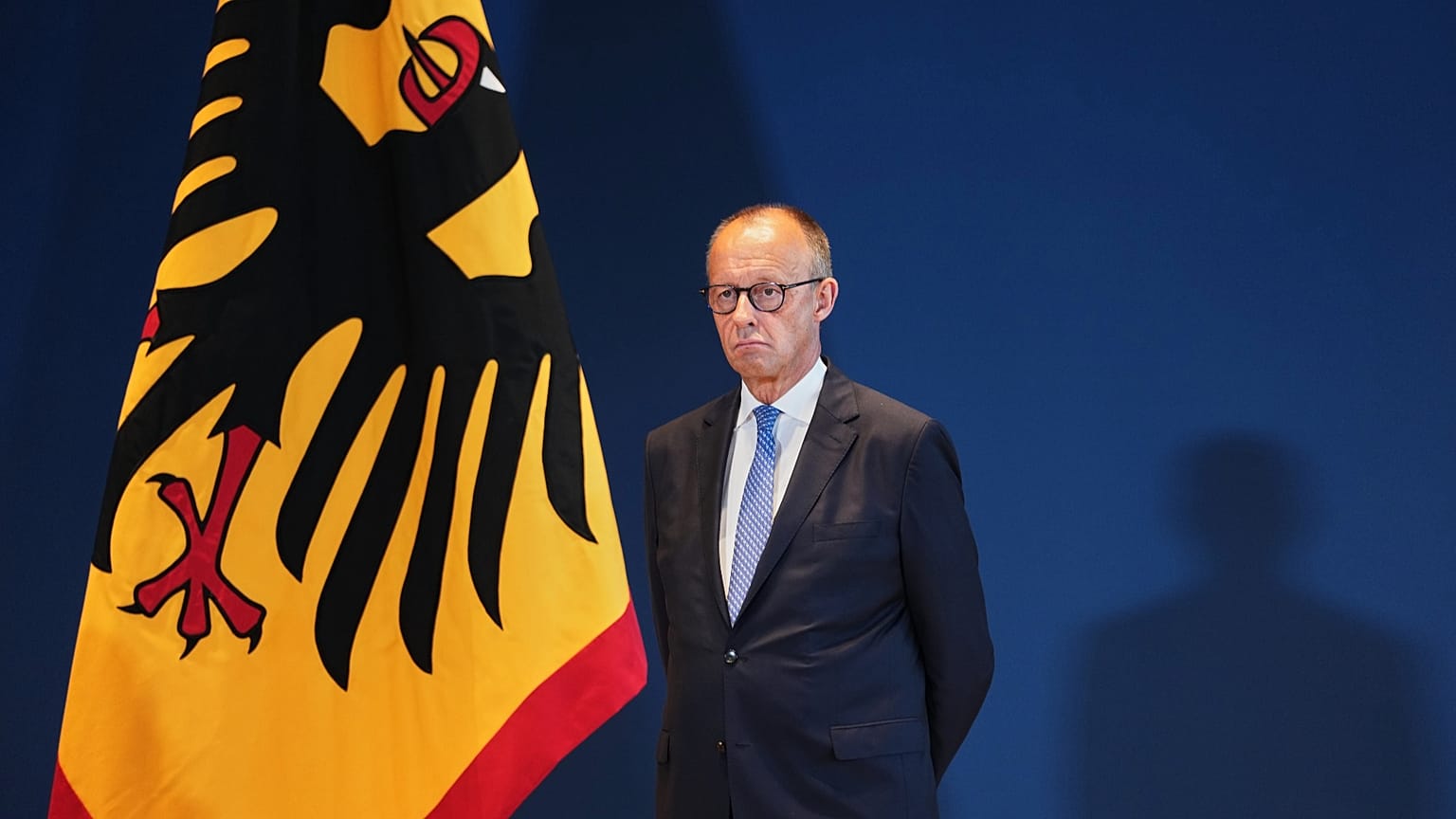
Although this is short of an outright majority, with the official results expected Monday night, it is already being interpreted as a major loss for Merz’ centre-right Christian Democratic Union of Germany (CDU) party. This is a party that has led the region of Saxony-Anhalt for 24 years, but only scraped through 17.2% of the votes.
Nothing short of a disaster: AfD co-chair Alice Weidel told CNN she expects Merz to be out by Christmas. The German chancellor has so far stayed out of the spotlight, but is expected to front-up to his cabinet today in the capital for crisis talks.
CDU member of the German Bundestag Günter Krings just admitted to Europe Today that this was a "devastating result" and "the perception and credibility of our party is a low". Asked about how this impacts the European Union, he said the right would feel "emboldened". "The European Union also should ask, 'What did we contribute to this anger, and what do we have to change?'" Watch.
Interesting to note: European Council President António Costa will be in Berlin on Wednesday and will hold court with Merz. It’s part of Costa’s tour of the capitals — a weeks-long voyage around the member states aiming to collect intel from leaders about their hopes, desires, and gripes with the state of EU affairs. The election results could factor into these talks.
Officially, though, it has to do with the EU’s multi-annual financial framework, aka the long-term budget. As an aside, keep an eye on his Thursday meeting with Spanish Prime Minister Pedro Sánchez, where the Ceuta migration crisis could widen.
Onto Kyiv: The envoys of US President Donald Trump, Steve Witkoff and Jared Kushner, cracked new ground when they visited Ukraine for the first time on Sunday. The aim? Talks with the country’s president, Volodymyr Zelenskyy. As my colleague Sasha Vakulina writes, there was no ostensible breakthrough, but the visit is a clear sign of renewed diplomatic momentum led by Washington.
EU officials will also be talking — albeit virtually — to politicians in Ukraine today. Jorge Liboreiro writes that Ukrainian Prime Minister Serhii Koretskyi will speak with European Commissioner for the Economy Valdis Dombrovskis to discuss the country’s widening budget shortfall.
Money talks: As financial woes for the war-battered country grow, the focus on immobilised Russian state assets held in Europe intensifies. Last year, an ambitious plan to mobilise the funds fell apart because Belgium was concerned about spiralling damages for Euroclear, the depository in central Brussels that holds the bulk of the immobilised assets. But what if the money were moved from Euroclear into an EU-owned custodian?
The idea is gaining traction as a potential solution to break the political deadlock. Jorge envisions what the custodian could look like.
Brussels watches Serbia: The funeral of convicted Bosnian Serb war criminal Ratko Mladić is expected to take place today in Belgrade without state honours or the presence of government officials, despite a Serbian cabinet minister initially vowing to give the “Butcher of Bosnia” a burial with "all military and state honours".
As Mared Gwyn reports, the the optics around Mladić’s funeral have already sparked outrage in Brussels, with the EU’s Commissioner for Enlargement Marta Kos on Friday delaying her planned trip to Serbia, an EU candidate country, saying that the “glorification surrounding his (Mladić’s) death is incompatible with the values on which the EU path is built.”
Mladić died in late August while serving a life sentence in The Hague for genocide, war crimes and crimes against humanity committed in the Bosnian war. His body was returned to Belgrade last Thursday on a government plane, his body draped in the Serbian flag, in the presence of a cabinet minister.
Kos said that the events surrounding his funeral and commemoration would be an “important test” in terms of Belgrade’s alignment with EU values, a key requisite in its bid to join the bloc. “The values that underpin our common future are not negotiable,” she said on social media.
Straying close to the red line: While no state funeral will be held, Serbia’s Justice Minister and the President of Bosnia’s Serb-majority Republika Srpska joined tributes to Mladić over the weekend at the state-owned Army House in Belgrade, according to local media.
A diplomat, speaking on condition of anonymity, told Euronews that any commemoration by Serbian state officials would be completely unacceptable and inevitably weaken the support for the country's EU bid among member states. Brussels had been pushing to open talks on economic growth and competitiveness under Chapter 3 of the accession process.
“Anyone even considering opening Cluster 3 will think twice,” the diplomat told Euronews. “It seems very unlikely that anyone would want to push for that now.”
Hungary, out of the wilderness? The European Parliament is on track to bring Budapest from out of the cold by reversing what is known to be the EU’s “nuclear option”. Article 7 is a legal mechanism that allows the EU to suspend certain rights for a country if deemed necessary. In Hungary’s case, it was triggered in 2018 to assess violations of EU values and alleged democratic backsliding during the government of former prime minister, Viktor Orbán.
With Péter Magyar at the helm, the country is revising several laws from the Orbán era, which is prompting Parliament to reconsider its position. But will this be the good news story Budapest is looking for? Vincenzo Genovese has answers.
Going green: On top of this, we have European Commission President Ursula von der Leyen continuing on her multi-day trip to Greenland. Yours truly wrote an article about how the trip coincides with Brussels reforming its much needed Arctic policy, particularly when it comes to military and economic threats. I have the story below.
EU races to rethink Arctic policy as the global power grab continues
European Commission President Ursula von der Leyen is completing her two-day whistlestop tour of the Greenlandic capital, Nuuk, on Monday to further European Union-Arctic relations — and gather intelligence as the European Union maps out a new Arctic Policy.
When the policy's first iteration was published in 2021, it made little reference to growing security threats. Instead, the then-EU foreign policy chief Josep Borrell emphasised climate change, raw materials and geostrategic influence as central to the document.
But in the years since, the European Commission has admitted the policy needs an urgent revamp to address the changing security and defence environment in the region — a more militarised Russia, for one thing, as well as China's effort to expand its economic footprint as melting ice opens new Arctic Sea routes. Read more.
More from our newsrooms
Ulrich Siegmund: From CDU member to AfD lead candidate
Who is Ulrich Siegmund, the AfD's leading figure in Saxony-Anhalt? He is 35, media-savvy and aiming to be minister-president. Nela Heidner has more.
EU diplomatic service scraps new high-level defence group amid pressure from member states
EU foreign policy chief Kaja Kallas has scrapped a new defence advisory group days after unveiling it, following pushback from member states. Luca Bertuzzi has the latest.
Could NVIDIA's purchase of Hugging Face boost the EU's AI sovereignty?
The deal, marking NVIDIA's increased focus on open-AI models, is likely to draw significant regulatory concern from the EU due to its size and implications for the bloc's digital and AI sovereignty. Read more.
We're also keeping an eye on
- Agriculture ministers meet in Ireland for an informal meeting about agriculture.
- European Commissioner for Trade Maroš Šefčovič receives UK Minister for European Relations Hamish Falconer.
- European Commissioner for the Economy Valdis Dombrovskis holds a virtual meeting with Ukrainian Prime Minister Sergii Koretskyi.
- EU Foreign Policy Chief Kaja Kallas meets the Lithuanian president and prime minister, Gitanas Nausėda and Mindaugas Sinkevičius, respectively.
- European Commissioner for Climate, Net Zero and Clean Growth Wopke Hoekstra meets Japan’s Environment Minister Hirotaka Ishihara.
- European Commissioner for Migration and Internal Affairs Magnus Brunner will speak on the phone with Dutch Minister for Asylum and Migration Bart van der Brink.
That’s it for today. Sasha Vakulina, Jorge Liboreiro, Vincenzo Genovese and Mared Gwyn contributed to this newsletter.