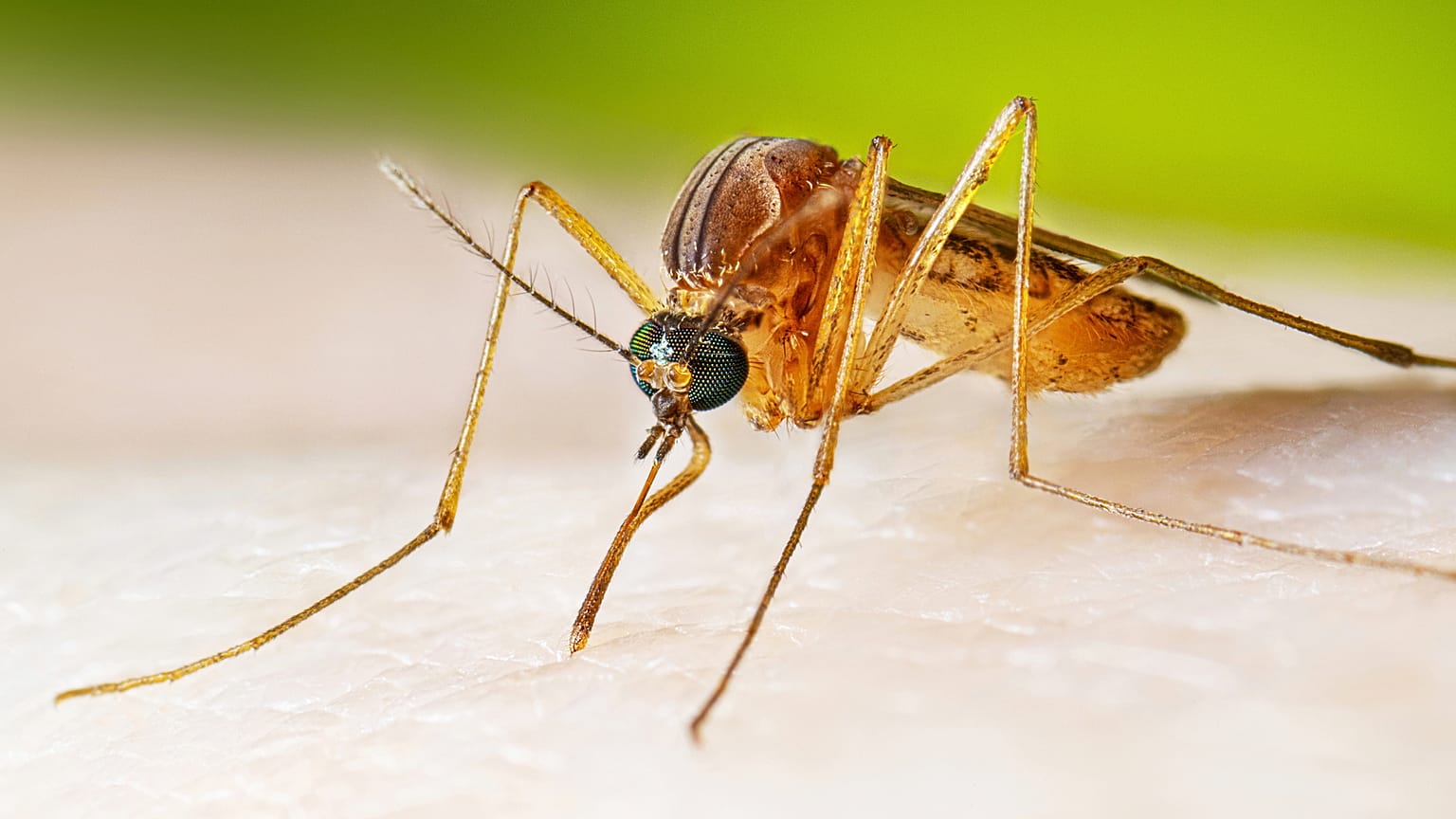













Italy, Spain, Romania and North Macedonia also reported locally acquired cases of West Nile virus infection.
The West Nile virus transmission season is underway in many parts of Europe, with locally transmitted cases reported in Greece, Italy, Spain, Romania and North Macedonia, according to the latest data from the European Centre for Disease Prevention and Control (ECDC).
 ADVERTISEMENT
ADVERTISEMENT
ADVERTISEMENT
In Greece, 21 locally acquired cases of West Nile virus infection have been recorded from the start of the 2026 surveillance season until 22 July, the National Public Health Organisation (EODY) announced.
Of these, 20 patients developed involvement of the central nervous system, such as encephalitis, meningitis or acute flaccid paralysis, while one case presented with mild symptoms. So far, no deaths have been recorded, and 13 patients are hospitalised.
In the past week, 14 new locally acquired cases were reported. In addition, another case was identified with a complex travel history, including a stay in an endemic country abroad. The probable country of exposure has not yet been determined and the case is not included in EODY’s epidemiological analysis.
The situation in the rest of Europe
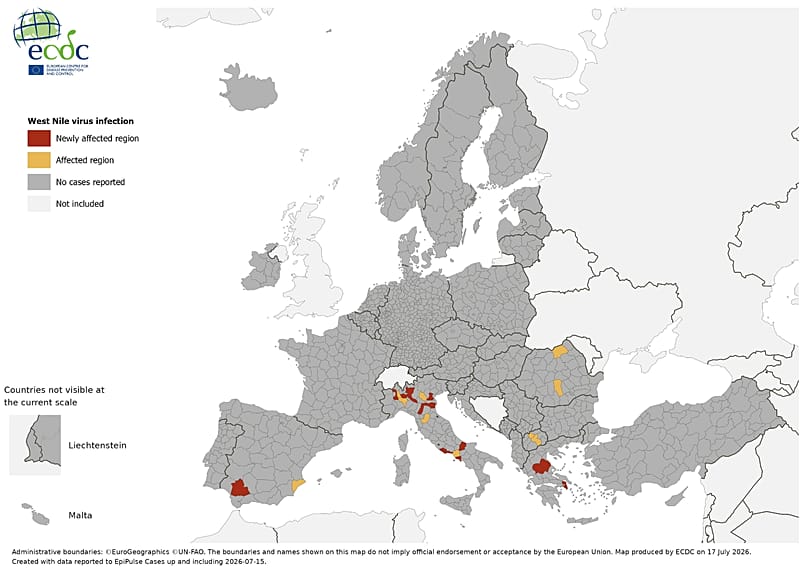
According to data submitted to the ECDC up to 15 July 2026, a total of 33 locally transmitted cases of West Nile virus had been recorded in five countries in Europe and its immediate neighbourhood.
Italy has seen the widest spread, with 20 cases in 16 areas. Most have been reported in Novara, with three cases, and in Cremona and Verona, with two cases each. Cases have also been reported, among other places, in Milan, Florence, Naples, Padua, Modena and Ferrara.
In North Macedonia, two cases have been recorded, in the regions of Skopje and Vardar. Two cases have also been reported in Romania, in the Argeș and Suceava regions, and two in Spain, in Alicante and Seville.
The ECDC map shows the areas where cases have already been reported, as well as those designated as affected for the first time during the latest reporting week. In Italy, 11 of the 16 affected areas were added that week, highlighting the rapid geographical expansion of the virus’s circulation.
Greece: Most infections in Attica
The vast majority of cases have been detected in Attica.
Cases have been recorded in the municipalities of: Spata–Artemida (6), Markopoulo Mesogaias (2), Pallini (2), Agia Paraskevi (2), Vari–Voula–Vouliagmeni (1), Kropia (1), Lavreotiki (1), Nea Ionia (1), Chalandri (1), Athinaion (6th Municipal Community) (1), Glyfada (1).
Outside Attica, one case has been recorded in the Regional Unit of Larissa and one in the Municipality of Palamas.
Although no human cases have yet been reported, EODY has designated as high-risk areas the municipalities of Paiania, Rafina–Pikermi, Marousi, Iraklio Attikis and Filothei–Psychiko.
The decision was based on epidemiological and geomorphological data, as well as on proximity to areas where the virus is already circulating.
EODY points out that the almost yearly occurrence of cases since 2010 indicates that West Nile virus has become established in Greece, as is also the case in several other European countries.
The ECDC now publishes weekly updates during the summer, as virus transmission is affected by weather conditions, mosquito abundance and the movements of wild birds, which are the natural reservoir of the virus.
Health authorities recommend that people take personal protective measures against mosquitoes across the country, as it is not possible to predict with certainty which areas will be affected during this year’s transmission season.