
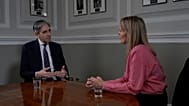













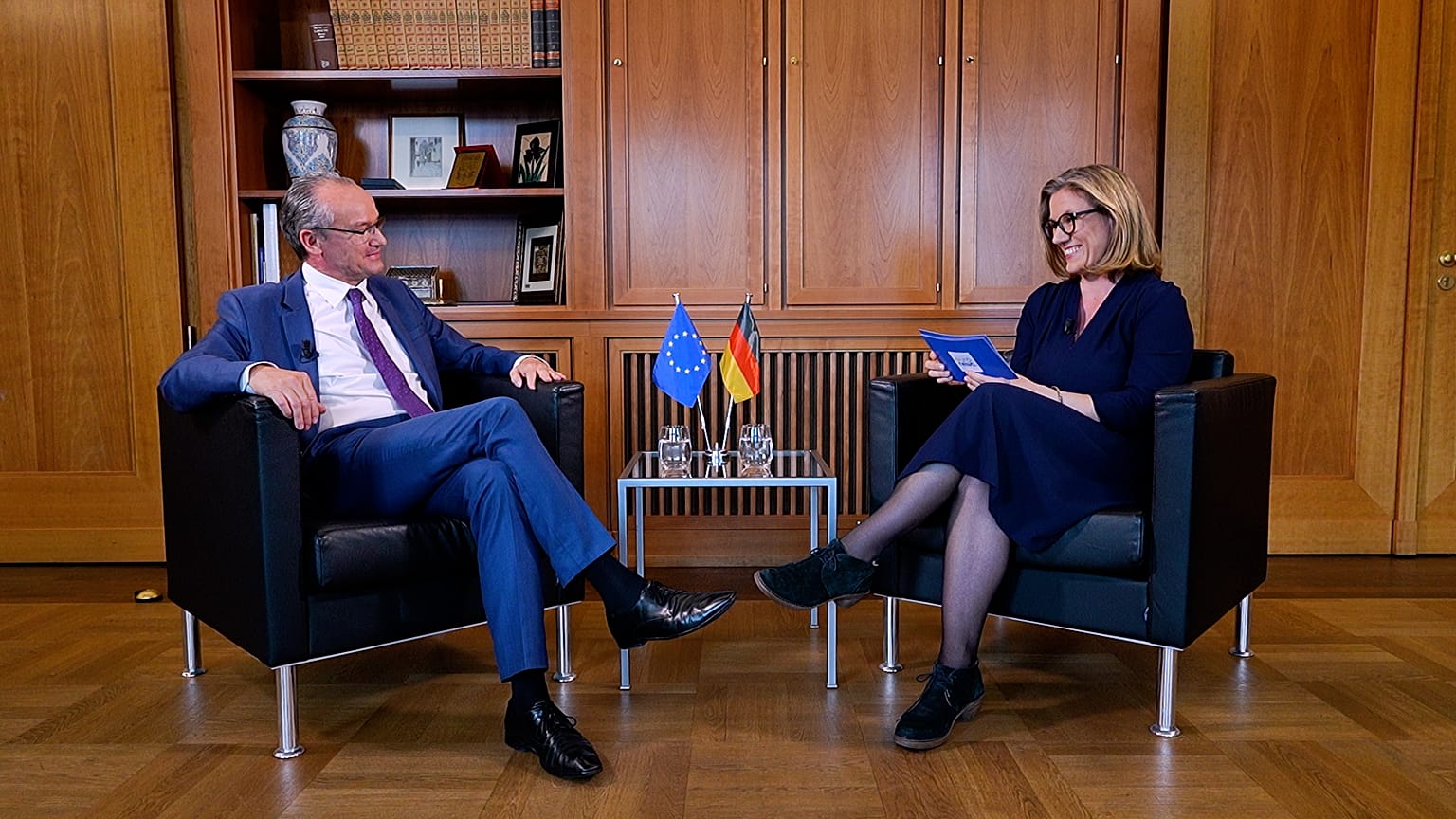














For leading German politician Gunther Krichbaum (CDU), Minister of State for Europe, it is time for the EU to rethink and seek new paths, on enlargement and the budget alike.
The EU is expected to expand again, but there is still no full agreement on how this should happen. Chancellor Friedrich Merz is sticking to his proposal for an associated EU membership status for Ukraine, Moldova and the Western Balkan states, that is Albania, Bosnia and Herzegovina, Kosovo, Montenegro, North Macedonia and Serbia.
 ADVERTISEMENT
ADVERTISEMENT
ADVERTISEMENT
Critics complain this would amount to a kind of waiting room or a second-class membership. Gunther Krichbaum counters that they have evidently not yet understood the model.
For the Minister of State for Europe at the Federal Foreign Office, it is about a clear political commitment. He explains: 'Why should we not give these countries, which would then have the status of associated members, naturally without voting rights, the opportunity to take part in sessions of the European Parliament? That does not cost us a single euro or cent.'
According to Krichbaum, this would also send a clear signal to China, Russia and other countries and show: 'These countries belong to us, to the European Union.'
This would convey to the EU accession candidates that they are already to some extent part of the club, Krichbaum says. It is important, he argues, to bring these states closer and integrate them.
'New tiered system' for EU enlargement
On this he is in line with German Chancellor Friedrich Merz and his French counterpart Emmanuel Macron, who at the EU–Western Balkans summit in Montenegro in early June called for the process to be accelerated.
More speed is also what Krichbaum is calling for, but he believes now is the right moment to take a critical look at the method of accession itself.
There are several aspects of the current model he no longer finds acceptable: 'We organise the accession process like a kind of high jump competition. The bar is set at 1.50 metres, namely the so-called acquis communautaire, all the legal rules, the entire body of law of the European Union at 1.50 metres, and the countries are supposed to jump over it. In reality this acquis communautaire is no longer at 1.50 metres but at 2.10 metres, because all the legal provisions have been tightened over the last ten or twenty years and new rules have been added.'
By way of explanation: the acquis communautaire refers to the entire body of EU law – all binding legislation, rules and obligations that a candidate country must adopt in full.
According to Krichbaum, many new rules have been introduced, for example in consumer protection and environmental protection. The whole framework is no longer comparable with earlier standards. Yet even 1.50 metres is already a major challenge for accession candidates. For him one thing is clear: 'We must move away from this high jump competition.'
He proposes something like a staircase or tiered system, stressing that this would in no way be a dead end: the final destination, the terminus, is and remains full membership of the European Union.
But what about the cost of EU enlargement? Can the EU’s net contributors still shoulder it? Krichbaum considers this manageable, saying it would be financed within the budget and that former recipient countries are today net contributors.
Today’s Poland, for instance, is not comparable with the country it was at the time of its EU accession. 'The Polish economy is booming,' says Krichbaum.
That is not the case for all European countries. For Germany, for example, the growth forecast for 2026 is subdued. This naturally has an impact on its relationship with Brussels. Krichbaum stresses that there are limits to what is possible. The EU member states will feel this in the still very complex negotiations on the multiannual financial framework for 2028–2034.
New priorities for the future EU budget
The countries that are already members of the EU club are indeed currently preoccupied with the next EU budget. The European Commission has proposed spending of 1.7 trillion euros over seven years, Krichbaum explains. Berlin is calling for a drastic cut of 400 billion euros.
For Krichbaum, the key issue is how the money is allocated: where should the priorities lie?
He is calling for a rethink, or rather a fresh start: 'If we were reinventing the European Union today and theoretically had a reset button we could press, we would not start with agricultural policy. That was undoubtedly the right decision in the second half of the last century. But today the focus is on issues such as security, defence, cybersecurity, but also space, artificial intelligence and competitiveness – all areas from which we believe we will draw our prosperity in five, ten, fifteen or twenty years.'
He argues that priorities should be rearranged and proposes merging cohesion policy and agricultural policy into a single heading, a single pillar so to speak.
It would then be up to the member states to decide how they weight the different elements. Agriculture will remain important, but the focus also needs to shift to other areas.
He says speed is just as essential here as it is for EU enlargement. Krichbaum hopes that an agreement on the new EU budget can be reached before the end of the year.
He explains: 'I hope so for many reasons, because we can perhaps still predict what will happen in 2026. But I cannot predict everything that will happen in 2027. And that could make an agreement even more difficult. In other words, it is already complicated enough. I believe we have a strong interest in having the negotiations on the multiannual financial framework truly wrapped up by the end of this year.'