

















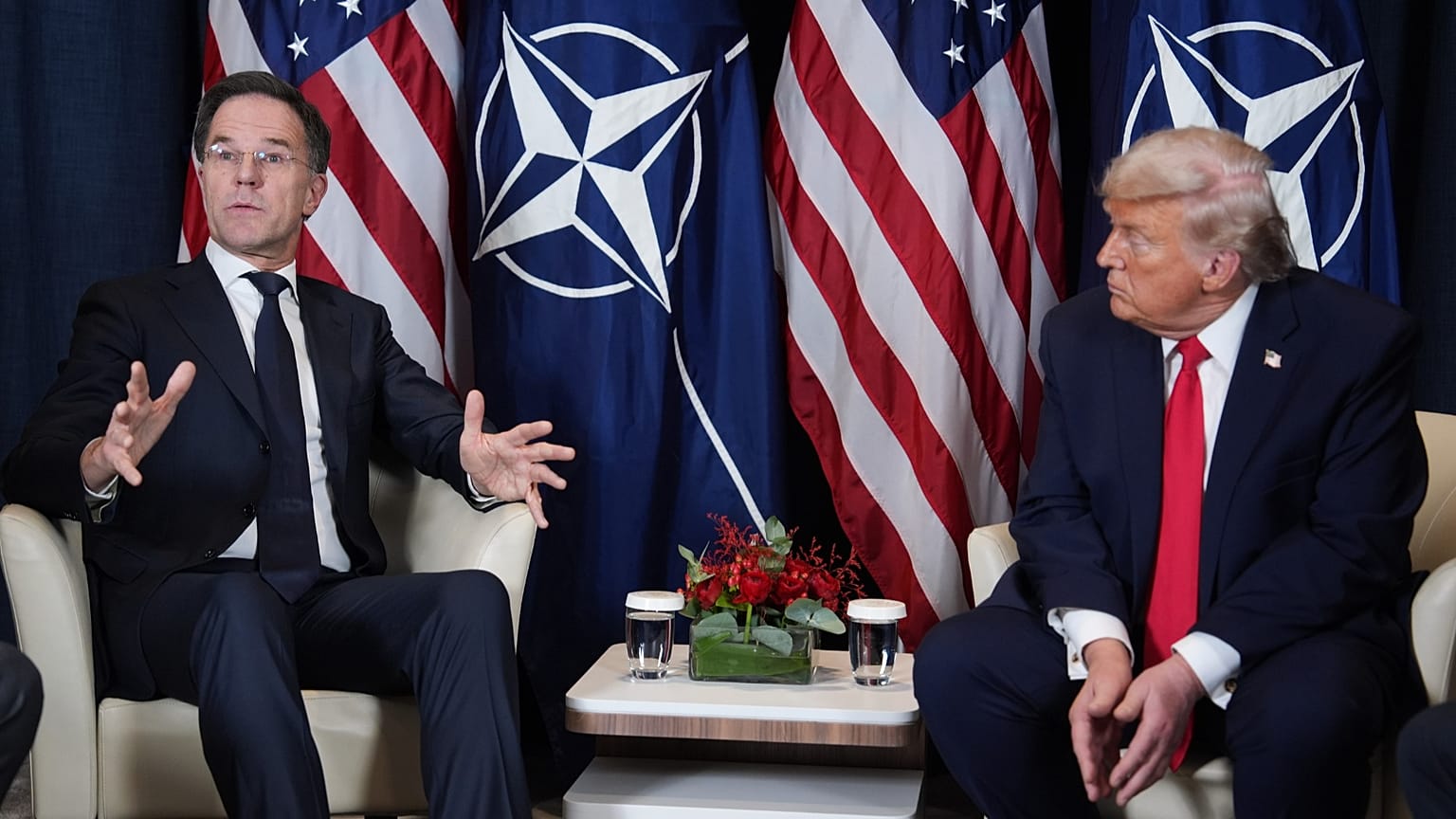













As NATO leaders prepare for their summit in Ankara next week, a document seen by Euronews says all 32 members – including the US – are still committed to the alliance's principle of collective defence.
NATO allies are set to reaffirm their iron-clad commitment to Article 5 of the NATO Treaty and state that Russia poses a "long-term threat to Euro-Atlantic security and stability" in the final declaration of the NATO summit in Ankara next week.
 ADVERTISEMENT
ADVERTISEMENT
ADVERTISEMENT
A copy of the document seen by Euronews carries a declaration that “Iran can never have a nuclear weapon” and commits to €70 billion euros extra support for Ukraine, with "at least equivalent levels" of support to come in 2027.
The declaration is the pre-ordained final text of the summit, negotiated by all 32 allies, including the US. While the document has been agreed at ambassador level, leaders will still need to endorse it at the end of the summit on 8 July.
"The Ankara Declaration will be released once agreed by Allied leaders at the NATO summit on Wednesday," a NATO spokesperson told Euronews.
Of particular importance is Washington’s apparent confirmation that it agrees to the collective defence of the whole alliance. The principle "an attack on one is an attack on all" is at the fundament of NATO's existence, and at times, US President Donald Trump has cast doubt on whether his administration fully supports it.
Trump has previously refused to guarantee that US would come to the aid of European countries which weren't paying their fair share for security and defence.
Next week's summit will see European NATO members try to convince the Trump administration that the burden of responsibility for European security has shifted away from US military, with the alliance now moving towards “NATO 3.0” – a transformed security arrangement with Europe at the helm of its own defences.
But it’s been a particularly volatile six months for NATO, and while the data show a surge in defence spending from Europe and Canada, there are no guarantees Trump is willing to gracefully acknowledge his allies' best efforts.
'They were not there for us'
In January, Trump declined to rule out using military force to “take” Greenland – a semi-autonomous territory of NATO ally Denmark. And on Thursday night, he reiterated his mantra that NATO allies abandoned the US in its offensive against Iran, saying it was “ridiculous” for Washington to keep up its “one-sided” relationship with NATO.
“They were not there for us!!!” Trump wrote on his bespoke online platform Truth Social.
While the US's allies are hoping to turn the page in the short term, their main ambition is to future-proof the defence of the continent through their own investments, given the US has already made clear its intention to withdraw from conventional support for European security.
In May, the US announced it is shrinking the pool of military resources from NATO even in times of war, with various long range bombers, fighter jets, submarines and warships no longer to be made available for European use in wartime.
“Allies were told we would reduce what we are providing for the NATO force model,” US Ambassador to NATO Mathew Whittaker told journalists in a briefing in Brussels Wednesday, saying Europeans “can't be freeriding on American taxpayers”.
Euronews understands NATO Secretary General Mark Rutte will point out that Europe and Canada have upped their core defence spending by 20 percent year-on-year. A source close to the situation told Euronews that the figure for 2025 and 2026 combined comes to some $258 billion (€225 billion) in extra investment.
Rutte will also point to the fact that the allies have spent $1 trillion (€870 billion) on defence since Trump’s first administration. Dubbing it “Trump’s trillion”, he will say the historic spending now needs to be translated into combat-ready capabilities "through transatlantic cooperation".
Rutte will also hammer home that more troops are needed to fulfil the promise of NATO 3.0, and that Europe's defence industry needs to keep pushing hard to expand and increase its production capacities.