




























Ten years to the day since Britain voted to leave the EU, the economic reckoning is neither the collapse its opponents feared nor the renaissance its champions promised, and the anniversary arrives with the country once again leaderless, after Sir Keir Starmer's resignation on Monday.
The vote of 23 June 2016 was meant to settle a question. A decade on, it has settled remarkably little.
 ADVERTISEMENT
ADVERTISEMENT
ADVERTISEMENT
In particular, the economic verdict on Brexit remains one of the most contested in modern Britain, entangled with a pandemic, an energy shock and the steepest monetary tightening in over a generation.
Two detailed assessments published this week, from Allianz Research and Deutsche Bank, reach a strikingly similar judgement: the doom was overstated, but so was the dividend. Allianz captures it in three words: "resilience without revival".
The timing could hardly be sharper. On Monday, the day before the Brexit anniversary, Starmer announced his resignation outside Downing Street, telling supporters he had heard his party's answer on whether he should lead it into the next election and accepted it "with good grace".
Starmer's departure, triggered by a collapse in Labour support and the rapid rise of the hard-right Reform UK, clears the way for what will be Britain's seventh prime minister in ten years, most likely former Greater Manchester mayor Andy Burnham.
Political instability has become one of Brexit's most visible legacies. Allianz notes that the UK has had six prime ministers since the referendum, compared with four during the entire 1997-2016 period, while Deutsche Bank points to the economic costs of the prolonged policy uncertainty that followed the vote.
The forecasts that missed, and the one that didn't
Much of the pre-referendum gloom never materialised.
As British investment firm AJ Bell notes, the UK Treasury's warning of an immediate recession proved wide of the mark: the economy kept growing, and unemployment fell rather than spiking as its "shock" scenarios projected, dropping to around 4% in the two years after the vote.
House prices, which officials feared could fall by up to 18%, instead rose by roughly 7%.
Where the forecasters were vindicated, according to AJ Bell investment director Russ Mould, was on sterling, which dropped sharply, feeding through into higher inflation, and a decade later has never fully recovered against the dollar or the euro.
However, beneath that economic durability and the less-than-bad first two years, both banks identify real and lasting damage over the decade, some of which was forecast by many of Brexit's critics before the referendum.
Deutsche Bank, using a model that compares the UK with a synthetic "doppelganger" built from similar economies, estimates Brexit has left output roughly 4% smaller, employment around 2% lower and consumer prices about 0.7% higher than they would otherwise have been, though it stresses these are milder readings than the wider consensus of a 6% to 8% hit.
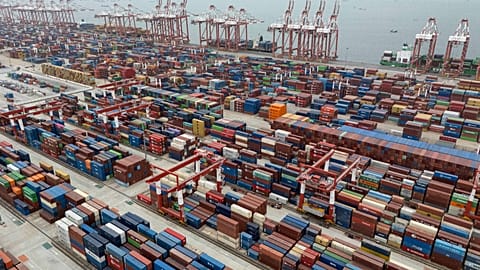
Allianz puts the GDP shortfall at between 2% and 4% and notes the clearest scars are on trade and investment. The report states that goods trade with the EU is around 21% lower than it would have been, while Deutsche Bank documents how business investment stalled for years amid uncertainty, with productivity growth grinding close to a halt.
Yet neither account is one of unrelieved decline.
Both stress that Britain has leaned harder into its services strengths. Allianz notes that ICT exports to the EU have almost doubled, while Britain continues to rank as the world's second-largest exporter of financial services.
London's financial centre has held up better than feared, still handling close to half of global interest-rate derivatives trading. Deutsche Bank points to genuine gains from regulatory autonomy in areas such as life sciences and AI, and to an improved current-account position as contributions to the EU budget fell away.
Looking ahead, Deutsche Bank argues there is meaningful "low-hanging fruit" for improving the existing trade deal, estimating that closer cooperation with the EU on food standards, professional qualifications and youth mobility could lift GDP by 0.4% to 0.8% over the next ten years.
Allianz counters that many of Britain's deepest problems, weak productivity, high energy costs and chronic underinvestment, were exposed by Brexit rather than caused by it.
Both agree the political will to reverse course is constrained: polls may now favour rejoining under the right terms, but no major party has the appetite for it. As a new prime minister prepares to inherit that dilemma, the anniversary lands less as a verdict than as an unfinished argument.