





























Portuguese authorities have earmarked €111 million for coastal restoration and protection.
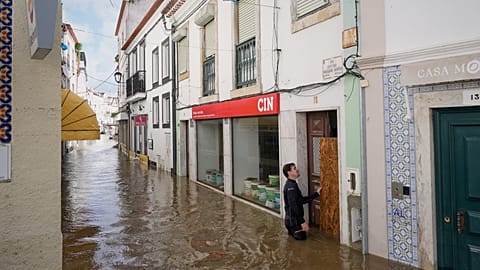
Storms that battered Portugal at the beginning of the year caused hundreds of euros worth of damage nationwide - and the coast was no exception.
 ADVERTISEMENT
ADVERTISEMENT
ADVERTISEMENT
The Portuguese Environment Agency (APA) recorded a total of 749 incidents on the country's shores, including coastline retreat, which in many places was between 10 and 20 metres.
"Almost all of the mainland's beaches recorded a significant reduction in their sediment content," the APA report says.
It also highlighted issues of cliff instability and damage to walls and ramparts.
Storms cause Portugal's beaches to recede
At São João da Caparica beach, in the municipality of Almada, the agency found that the beach receded by up to 14 metres between 20 January and 19 February.
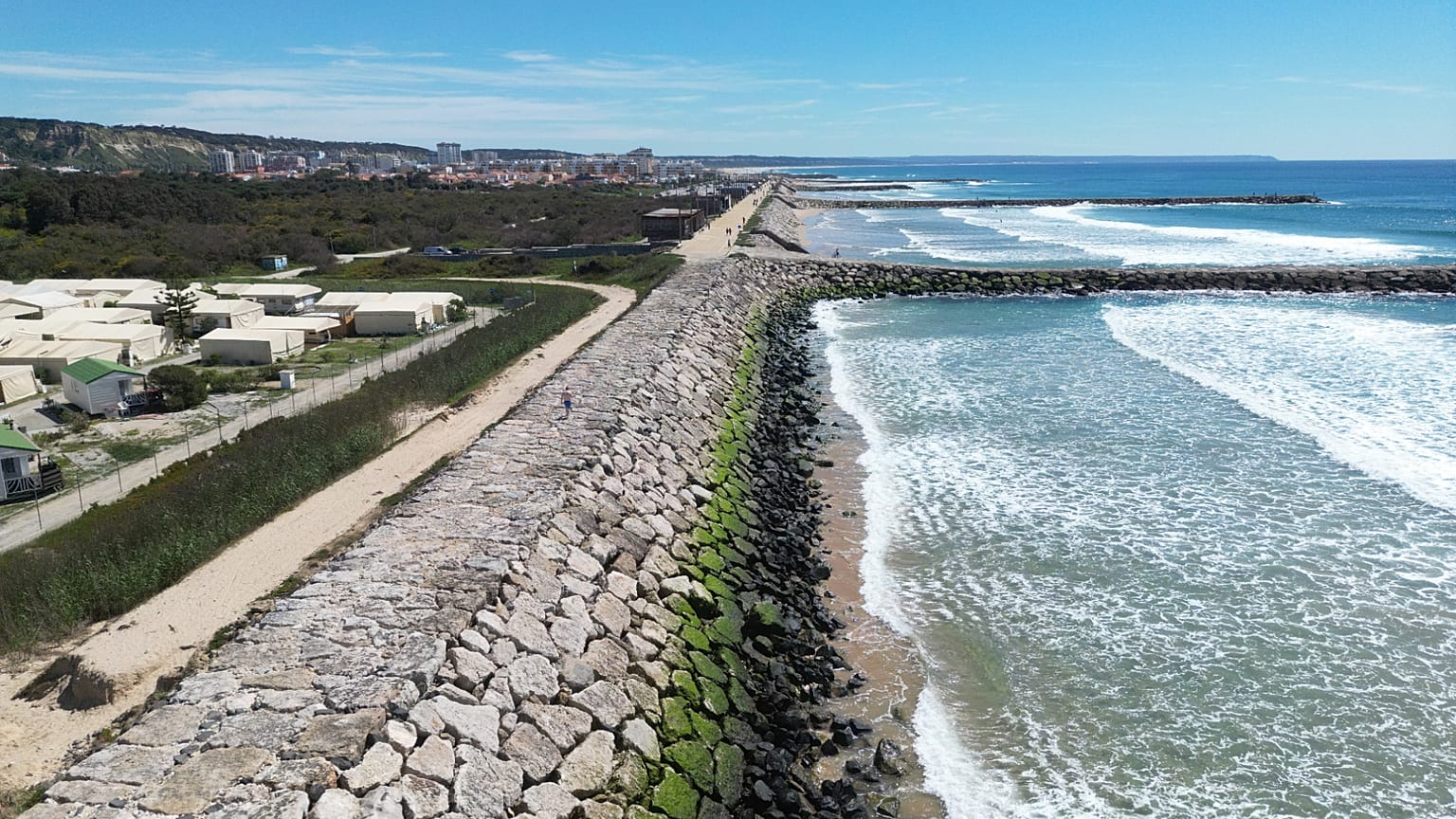
According to the mayor of Almada, the natural dune and the project to preserve it, called 'Reduna', prevented the beach from a worse fate.
"On the Cova do Vapor side, the Reduna project has proved its worth. Where it is in place, the dune has resisted and is still there," says Inês de Medeiros.
"As soon as the Reduna ends, there is one and a half metres of ditch, because all the sand has gone."

A few kilometres further on, at Fonte da Telha, the mayor describes a similar scenario, made worse by the presence of private beach concessions very close to the waterline.
"In some areas, they ended up being very badly affected. But it could have been worse had there not been a dune there that we installed," she tells Euronews.
"This prevented the sea from entering, because, in the past, the sea reached the road."
The municipality is now waiting for the promised sand nourishment which, according to de Medeiros, has been essential for preserving not only the beaches, but also the urban area.
"These successive sand fillings, despite everything, have safeguarded the coastline," she says.
"Apart from the urban beach area, where the APA is already going to replenish the sand, our coastline hasn't shrunk much and we're hopeful that now the sea will bring sand again."
According to the mayor, the APA has promised to replenish the sand starting in April, in a job that she says is "absolutely necessary".
"People don't really understand because they think that throwing sand into the sea is throwing money into the street, but it's not, because all these fillings have allowed for greater sedimentation on the seabed and this is what is safeguarding the coast," explains the mayor.
She emphasises that many people live or spend time by the sea and that protection measures are therefore necessary.
"In the case of beaches, engineering isn't going to solve it, but in the case of protecting populations, it is," explains de Medeiros. "It will probably be necessary to raise the seawall to protect the urban area and with that, immediately, the chance of flooding decreases a lot."
€111 million to upgrade the Portuguese coast
To compensate for the effect of the storms on the coastline, the APA has announced an investment programme.
It has earmarked €15 million until the end of May - the start of the bathing season - for emergency interventions to repair damage to the coastline and €12 million until December.
These figures are part of a total €111 million investment in the coastal zone to "recover and strengthen the protection of the Portuguese coastline", confirmed APA's Executive.
"The plan includes a series of priority works aimed at restoring infrastructure, reinforcing coastal protection and restoring conditions of safety and enjoyment of the beaches," the government said in a statement.
"The interventions include rebuilding beach accesses, reinforcing dune strands, stabilising cliffs, recovering walkways and artificial beach nourishment operations."

Beach retreat: A natural process helped by humans
Beach retreat is not a problem unique to the Portuguese coast, nor is it exclusively caused by bad weather.
"This is a process that has been happening for decades, which is linked to a number of different factors," João Joanaz de Melo, a university professor and land-use planning expert, tells Euronews.
These include an accelerated rise in sea levels in recent years and increasingly frequent extreme weather, which de Melo says has been occurring for decades.
Human interventions have also contributed to a structural deficit of sand on the Portuguese coast.
"This has mainly been caused by the construction of dams since the 1950s," explains the professor. "Large reservoirs retain sediment, which would otherwise reach our coast in much greater quantities."
It is also caused by the extraction of sand from estuaries and bars and the degradation of dunes, which de Melo says "give the coastline resilience".
Rigid constructions such as sea walls protect urban areas but increase erosion in other areas by reflecting wave energy.
"When the sea hits the rock, instead of the energy dissipating, as it does in a dune in good condition, that energy is reflected and increases erosion in other areas," says the expert.
De Melo explains that it is normal for winter storms to cause beaches to retreat, while in the spring and summer, most of that sand eroded returns.
However, he adds that as there is a lack of sand in the system, "from year to year, if nothing is done, the amount of sand on the beach will decrease".
'There are no magic solutions'
Mitigation measures include strengthening natural resilience and reducing risk exposure.
Replenishing sand through dredging helps to temporarily recover beaches, but it doesn't solve the structural sediment deficit. Instead, land-use planning is crucial: avoiding building in high-risk areas and only allowing compatible structures, such as tourist facilities, as long as they are protected.
"In many cases, it's a matter of complying with the law, and in other cases, it's a matter of correcting these municipal plans so that they comply with good planning practices," says de Melo.
These protection and construction measures must be adapted to the physical, social and economic characteristics of each area, he emphasises.
"Costa Caparica is originally a community of fishermen and farmers, so they're used to dealing with occasional storms and floods, like many other communities across the country that know what it's like to deal with these phenomena," says the professor.
"But there have to be protective measures, which don't depend on individuals but on planning, safeguarding the territory and organising resources that are in the hands of local authorities or companies," he explains.
He adds that there are no "magic solutions" that work everywhere because the conditions up and down the coastline are different.
"Geographical conditions, people's preparedness for dealing with these phenomena and economic activities are different. Therefore, solutions have to be adapted to the circumstances in each case."