
















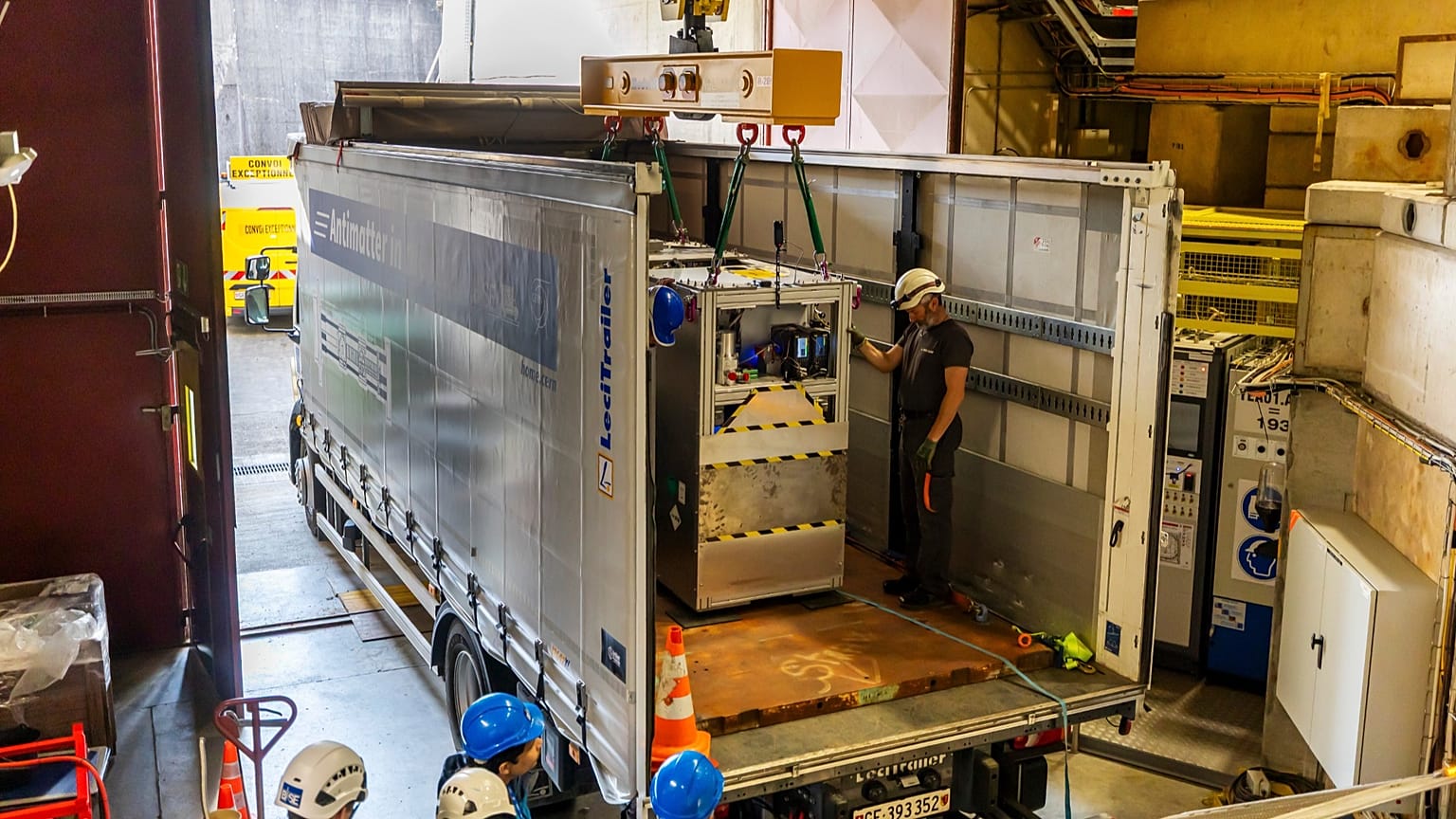














Housed in a high-tech, super-cooled container, the fragile particles survived a short truck journey without touching normal matter, which would have made them vanish in a flash of energy.
One short truck ride, one giant leap for particle physics.
 ADVERTISEMENT
ADVERTISEMENT
ADVERTISEMENT
Scientists have taken antimatter, some of the universe’s rarest particles, out of the lab and onto the road for the first time - in a carefully controlled truck experiment that could transform how it is studied.
At the CERN Antimatter Factory near Geneva, researchers carefully transported around 100 antiprotons by truck in a specially designed container, in a four-hour experiment aimed at proving they can be moved safely.
Antimatter is notoriously fragile. If antiprotons come into contact with normal matter - even for a fraction of a second - they annihilate, releasing energy.
To prevent this, the antiprotons have been encased in a roughly 1-metre-cube box, known as a “transportable antiproton trap,” that uses special magnets cooled to -269 degrees Celsius (-452 Fahrenheit) and allows the antiprotons to be suspended in a vacuum – not touch the inner walls, which are made of... matter.
The half-hour drive tested whether the particles could remain contained outside the controlled lab environment.
Why is it important to be able to move antimatter?
So why all the fuss over antimatter? It holds answers to one of science’s biggest mysteries: why the universe exists in its current form, said particle physicist Professor Tara Shears from the University of Liverpool, who is not involved in the project,
"Antimatter is one of the biggest mysteries that we have in science. It's very rare to start with, so we haven't been able to study it very much.
"But it holds the keys to our understanding of what literally why the universe is like it is because the whole issue for us is that when the universe is started out life, half of it was made of antimatter," said Shears.
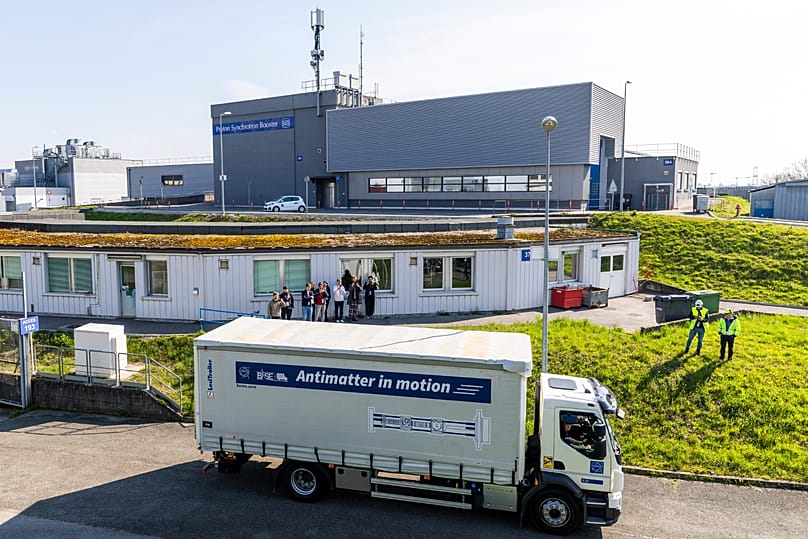
The experiment is a first step toward transporting antiprotons to specialised labs elsewhere in Europe - such as Heinrich Heine University in Düsseldorf, which is about eight hours away in normal driving conditions - for precise measurements. But doing this is no easy feat.
'The moment these antimatter protons come into contact with normal matter, they annihilate each other. They just vanish in a puff of light," said professor Alan Barr, from the University of Oxford.
He said the key challenge in this experiment is stopping that from happening.
"The technology traps antimatter protons in an ultra-cold vacuum, suspended by powerful electric and magnetic fields. It literally keeps them from touching the sides of the container. This transport is a proof of principle. It shows that, in the future, we can do these moves routinely and study antimatter in detail," Barr said.
He said in pushing yourself to do these very hard things, "you’re forced to invent technologies that end up being used elsewhere. That’s not why we’re doing this, but it’s what happens as a side effect."
What breakthroughs could come from this development?
Shears said CERN has begun a long journey to scientific discovery and we can't imagine now what benefits it could unfold for humanity in future.
"I am sure that had (will have) applications elsewhere. I just can't tell you what it is at the moment because we haven't thought about it yet. But we will," she said.
Heinrich Heine University is seen as a better place to study antiprotons in-depth, because CERN - with all its other activities - generates a lot of magnetic interference that can skew the study of antimatter.
But to get them there, those antiprotons will have to avoid touching anything on the way.
Work remains: The trap has a maximum of four hours of autonomy now, and the drive to Düsseldorf is twice that.