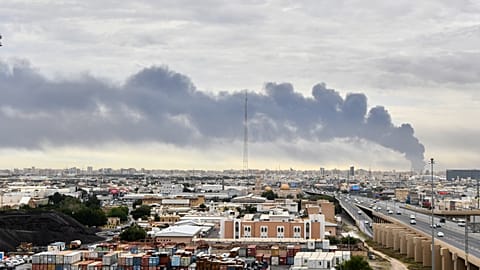






























US stocks opened slightly lower on Tuesday while oil prices climbed higher, reflecting persistent uncertainty over the Iran war even after US President Donald Trump signalled progress in talks.
At the opening bell on Tuesday, the S&P 500 and the Dow Jones Industrial Average fell around 0.65% and 0.8% respectively, while Nasdaq also dropped 0.8%.
 ADVERTISEMENT
ADVERTISEMENT
ADVERTISEMENT
The tempo of the Iran war remains high even a day after President Trump delayed his self-imposed deadline for Iran to reopen the Strait of Hormuz.
Tehran’s closure of the vital waterway continues to disrupt energy markets and international shipping, threatening the global economy.
There are also reports that Iran is now effectively charging some commercial vessels transit fees to pass through the maritime chokepoint, with some payments reaching as much as $2mn (€1.7mn) per voyage.
At the time of writing, Benchmark US crude is trading at $92 a barrel while Brent crude, the international standard, is around $103.
Markets had staged a rebound on Monday, with oil prices dropping almost 20%, after President Trump posted on social media that the US and Iran had held productive talks “regarding a complete and total resolution of our hostilities in the Middle East.”
Iran rejected the assertion outright with Iranian parliament speaker Mohammad Bagher Ghalibaf writing on X that “fake news are used to manipulate the financial and oil markets,” which sent crude prices almost 10% higher shortly after.
Despite the volatility, some analysts nevertheless see a tentative first step to wind down the conflict and there are reports that talks between the US and Iran will potentially be held in Pakistan later this week.
However, Citigroup, one of the largest American investment banks, just released a report stating that they expect things to get worse from here predicting that Brent crude will rise to at least $120 per barrel over the coming month.
Additionally, that in a scenario where there is a prolonged disruption through the end of June, oil prices could "skyrocket to some $200 per barrel".
Citigroup derives the number from the standard relationship between inventory and price, given the world is now without 13.5 million barrels per day, taking out around 400 million barrels per month.
European and Asian markets
European benchmarks traded higher in early Tuesday trading but have all turned red in the afternoon.
The Euro Stoxx 50 and the pan-European Stoxx 600 index are down 1.35% and 0.20% respectively, at the time of writing.
Britain’s FTSE 100 has dropped roughly 1%, Germany’s DAX fell almost 2% and France’s CAC 40 is down around 1%.
However, European natural gas prices also lowered, with the Dutch TTF benchmark falling almost 5% and trading at around €54.
As for Asian markets, reactions were mixed with Chinese and South Korean equities rising while Japanese and Australian stocks dropped.
Japan’s Nikkei 225 declined about 1.5% and Australia’s ASX 200 fell roughly 1.75%.
On the other hand, South Korea’s Kospi climbed 2.7%, Hong Kong’s Hang Seng jumped 2.8% and the Shanghai Composite advanced 1.8%.