





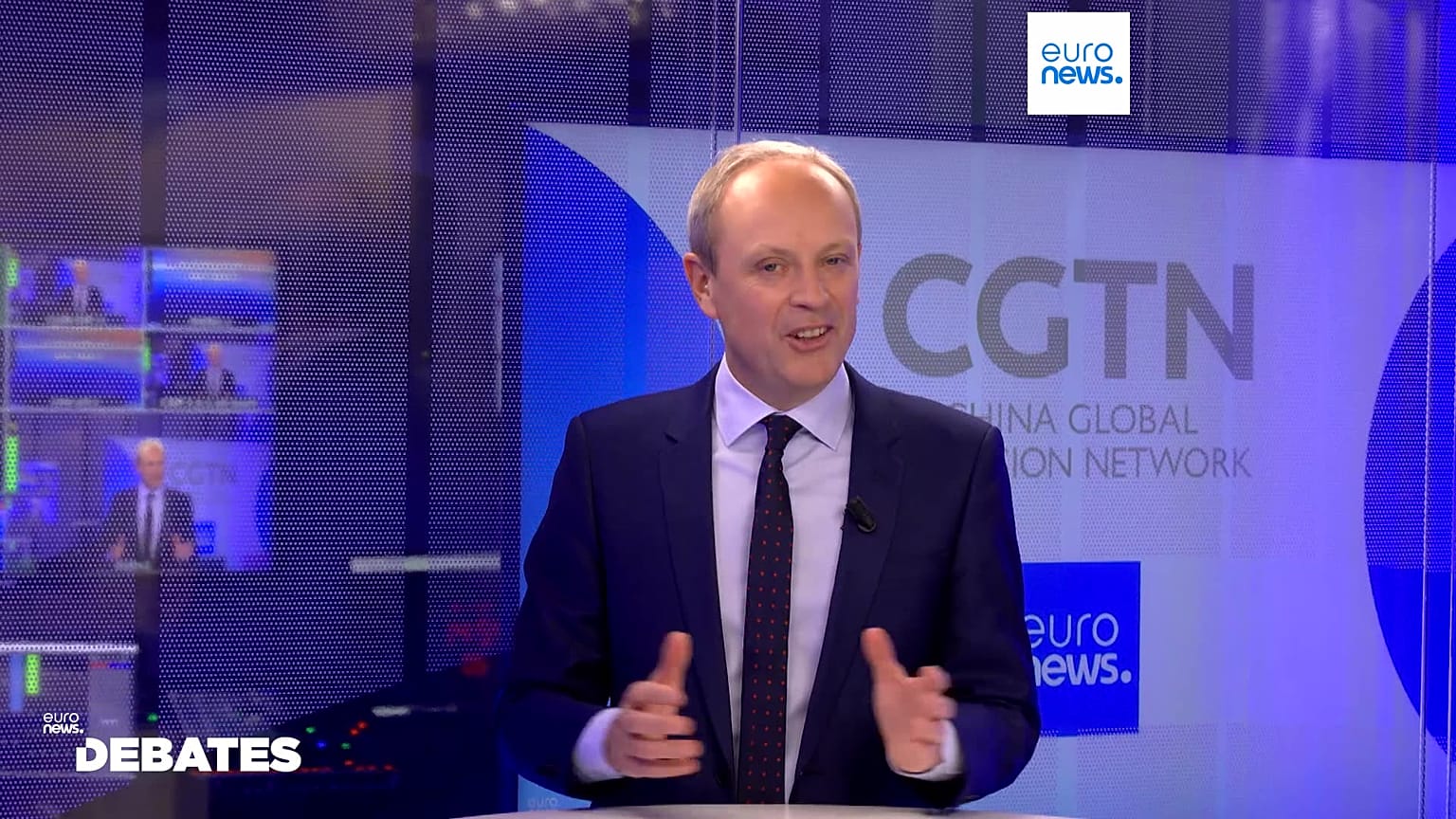














Keeping the global temperature increase below 1.5 degrees will have its challenges, but it is possible, say a number of experts from China and the EU, who discussed the future of green growth at a special Euronews and CGTN debate.
Though the global COP 30 summit in Belen, Brazil, was widely panned as a failure, due partly to a lack of agreement on fossil fuel reduction, deforestation laws and meaningful financial commitments, there is still hope for the future of green technologies.
 ADVERTISEMENT
ADVERTISEMENT
ADVERTISEMENT
Some of the leading voices in Europe and China believe that the right mix of technologies, legislation, cooperation and competition can still produce the required results to speed up green growth and reduce harmful emissions.
During a co-produced Euronews and CGNT debate, four prominent members of the industry shared their thoughts on who would be leading the charge for renewable energy, what the barriers are to success and the role AI has to play in it all.
Speaking were Karine Vernier, CEO of InnoEnergy in France; Professor Wu Changhua, President of Global Climate Academy and Chair of the Governing Council of Asia Pacific Water Forum; Doctor Ma Jung, Director of the Institute of Public and Environmental Affairs and Ben Honan, Investment Lead for the Climate Kick, an EU community working on climate innovation.
Here’s what they had to say.
Green growth won’t be led by one nation
Karine Vernier, doesn’t believe one country will spearhead the move towards a greener future. Instead, she outlined four parameters she believes could be major factors in making progress: innovation, gigascale, alliances and demand.
Imperative to making these things work however would be cooperation. “You cannot see one single geography; nobody can manage in total autocracy, and so the world must cooperate,” Vernier explained. “And even if it has been a weak COP, I would say it has been a COP, and this is the place where we have to all cooperate.”
Professor Wu Changhua agreed that no one country would emerge as a climate leader. Instead, progress would be made with teamwork.
“I do see China, Europe and the US – as well as many other South developing countries – really coming together,” Wu said.
However, Wu was keen to highlight the significant role she believes China is playing in the future of green energy. “China has its own strength in terms of scaling, in terms of pace, in terms of affordability, driving down costs and industrial capability.” The EU’s strengths, she said, lie in “investing, innovation, regulation, standards, [and its] market.”
Affecting change will be challenging
Doctor Ma Jung agreed that China had made a step in the right direction towards lowering emissions following the country’s first ever commitment to reducing all carbon emissions, not just carbon dioxide. Achieving this, however, is not a foregone conclusion.
“For a country with 1.4 billion people, it’s not easy,” he shared. “China is still going through massive industrialization and urbanisation, so this energy and social economic transition is not easy.” However, should China hit its targets, it will bring “the single biggest reduction over the next 10 years globally.”
As the largest contributor of CO2 emissions in the world, this kind of reduction would be a major achievement in the fight against global warming. “We all need to recognise that the NDCs (Nationally Determined Contribution) submitted by more than 110 countries [at COP] put together are not enough to limit temperature below 1.5 degrees,” Ma went on.
Geopolitical tensions will be a barrier to success, with Wu asserting that international governments’ lack of trust is a major problem. “If we do not address the trust issue and continue to let the geopolitical saga interrupt everything, we know for sure that even though we have technologies today to address climate change, we wouldn't be able to achieve it because we wouldn't be able to get to the scale or the pace that's needed to do so. That’s the harsh reality we're living in.”
Vernier agrees that the importance of global collaboration cannot be underestimated. “If we are able to share [green technologies] between China and Europe,” she said, “We’ll be able to co-develop new platforms and factories, accelerate the launch of new large projects in terms of industry, and then decarbonize the industry and the world.”
– Karine Vernier
Unsurprisingly, the role of digital tools such as using artificial intelligence (AI) for smart grids, digitalization of industries and green fintech played a large part of the conversation.
Vernier believes the digital economy will play an increasingly important role in our journey towards a sustainable future. “With digitalisation and artificial intelligence we are able to create leaner, more efficient, lower energy production systems,” she explained.
Ben Honan was particularly enthusiastic about the prospect of AI. “I would like more people to be looking at AI in the sense of how we can use it for experimentation in industrial processes like nitrogen fixing or energy production,” he said. “How can we use it for biomedical processes and to optimise our food and fibre systems?”
It seems indisputable that AI could hold the answers to many of the issues holding green growth back. “There are a lot of different very technical processes that I think applied AI is really very interesting for finding some breakthrough solutions,” Honan went on. “That's what I would like the conversation to shift towards, a little bit less about solar panels and unicorns and a bit more about how we get into these deep tech industrial processes.”
How can we accelerate the deployment of green technologies?
The answer, pretty unanimously, was ‘cooperation’. Vernier emphasised that while learning how to use AI, reduce raw materials and increase recycling was important, progress was vastly dependent on ‘well balanced cooperation’. Focusing on what was working, not what wasn’t, and remembering that ‘we’re not doing politics’, would be key to success.
Professor Wu restated how important fixing the ‘trust infrastructure’ of international governments would be to progress. “If we do not manage to address that,” she said, “All the aspirations, targets and commitments we have on the table wouldn't be delivered.”
Honan concurred, saying that changing the way countries choose to work together could create a “really significant shift in accelerating the clean transition.”
Motivation was also an important factor too, and something Ma Jun proffered could be achieved by competition. “Competition is not a problem,” he enthused, “Market competition actually motivates change and enhances efficiency and creates values. We should not just set ambitious targets; it’s not enough. We need to tap into the technologies – AI and renewable and all this – and try to create really good solutions.”