

















Democrats look all but certain to take the US House. The real fight is for the Senate, where a handful of races in states Republicans never expected to defend will decide who controls Washington.
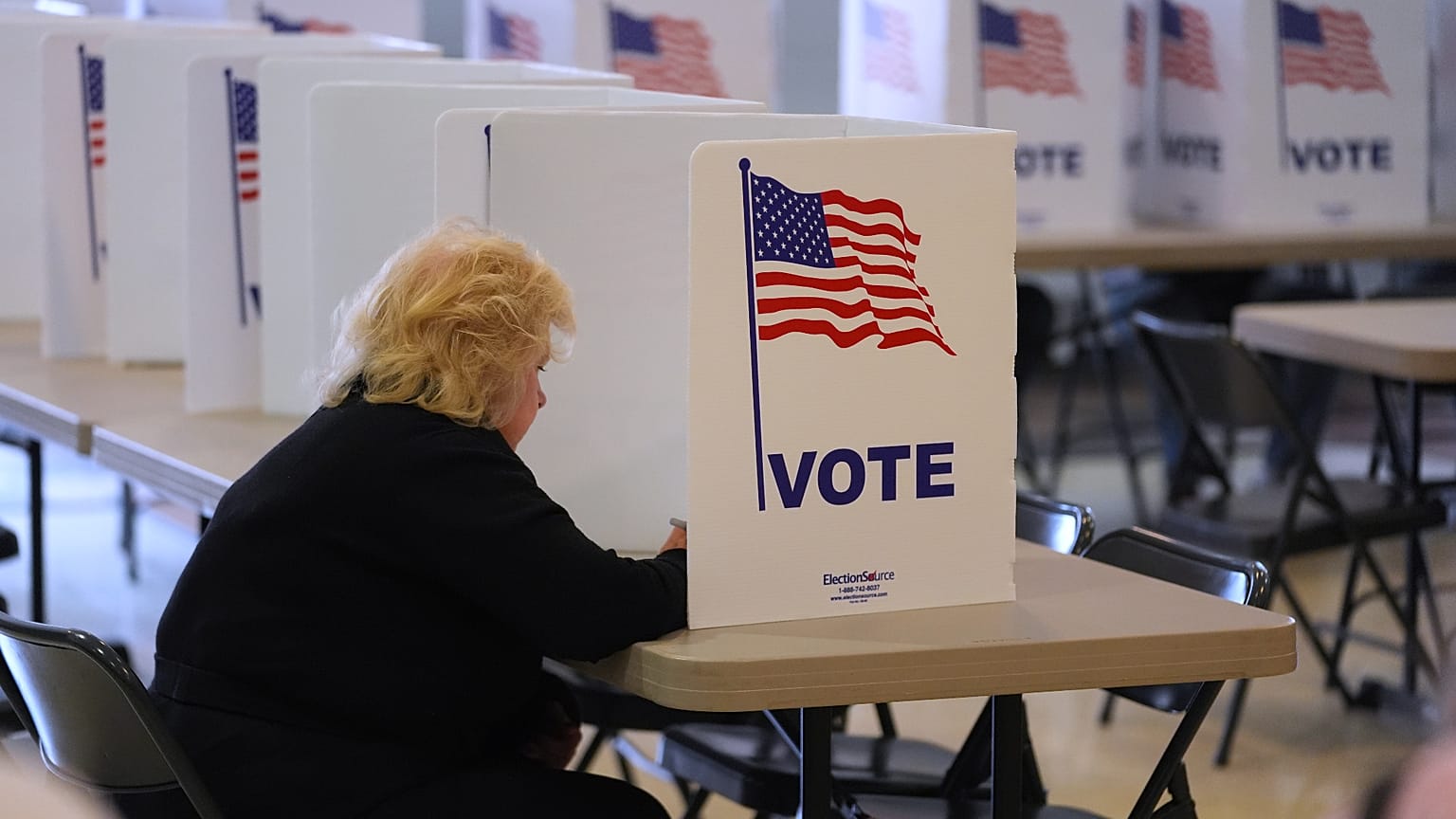
Polling stations are opening across the United States in a midterm election that, a year ago, Republicans expected to survive with their Senate majority intact. That expectation has been reduced to a hope.
 ADVERTISEMENT
Start with the House of Representatives, where the question is no longer whether Democrats win, but by how much. Prediction markets give them a 95% chance of taking control. The Cook Political Report now rates 222 seats as at least leaning Democratic, four more than the 218 needed for a majority, against 195 for Republicans, with 18 pure toss-ups. A good night for Democrats could see them controlling as many as 230 seats. A great night means the Senate and a blue wave.
The magic number
Republicans hold 53 of the Senate's 100 seats. To take control, Democrats need a net gain of four. Three is not enough: in a 50-50 Senate, Vice President JD Vance casts the tie-breaking vote, just as Kamala Harris did a record 33 times as vice president; however, Senator John Fetterman, the Democrat from Pennsylvania, could muddle certain partisan votes in a 50-50 Senate.
Prediction markets now give Democrats roughly a three-in-four chance of winning the Senate. Cook rates six races as toss-ups, all of them held by Republicans.
The battleground covers 12 seats. Democrats are defending three: Michigan, Minnesota and New Hampshire. Republicans are defending nine: Alaska, Iowa, Kansas, Maine, Nebraska, North Carolina, Ohio, South Carolina and Texas.
Two of the three Democratic seats look safe. In Minnesota, Peggy Flanagan leads Michele Tafoya by 5.2 points in the RealClearPolitics average. In New Hampshire, Chris Pappas leads former Senator John E. Sununu by eight points in the same average. Michigan is another matter, but we will come back to it.
North Carolina: Abandoned
North Carolina is a swing state, but it leans Republican: it has voted for the Republican presidential candidate in every election since 1980 bar one. With Senator Thom Tillis retiring, it should have been a fair fight.
Instead, national Republicans all but walked away. The Senate Leadership Fund, the party's main Senate super PAC, had planned to spend $71 million backing its candidate, Michael Whatley. It cancelled its remaining ads in early October, after spending more than $30 million. Former Governor Roy Cooper now leads Whatley by eight points in polls from both Quantus Insights and Trafalgar Group, two Republican-leaning pollsters.
Barring an upset, North Carolina will be the Democrats' first flip. That leaves three more to find.
Ohio and Texas: The big prizes
Democrats placed one of their biggest bets in Ohio. Sherrod Brown, who lost his seat two years ago, is running against Republican Jon Husted, who was appointed to JD Vance's old Senate seat in 2025. Brown leads by 2.8 points in the RealClearPolitics average, in a state Trump won by double digits.
Texas would be the bigger upset. The state has not elected a Democrat to the Senate since 1988. Yet Democrat James Talarico leads Republican Ken Paxton 49% to 47% in the latest Texas Southern University poll—in line with other recent surveys. Still, this is within the margin of error and is effectively a tie. Texas probably isn’t turning blue. Republicans lead every other statewide race in the University of Houston's Hobby School poll, from governor down to railroad commissioner. What Talarico could benefit from is ticket-splitting: voters backing a Republican for governor, attorney general or Congress, then crossing over to the Democrat for the Senate. Republican Governor Greg Abbott wins 93% of Republicans in the Hobby poll. Paxton wins 88%.
Part of the problem for Paxton is Talarico, a disciplined young candidate who has run a strong campaign. The other part of the problem is Paxton. The embattled attorney general, impeached by his own party in the Texas House in 2023 and acquitted by the state Senate, is viewed unfavourably by 57% of likely voters and favourably by just 42%, according to Texas Southern University. Trump backed him over four-term Senator John Cornyn in the primary. If Paxton loses, it will be a wound Republicans partly inflicted on themselves.
The curious case of Alaska
Alaska votes Republican for president, but it has a long independent streak. It sent Democrat Mary Peltola to the House in 2022. This time, Peltola is challenging Senator Dan Sullivan, and she leads 48% to 46% in the latest New York Times/Siena poll. Again, within the margin of error.
Then came the other Dan Sullivan. The New York Times reported last week that Democratic operatives, including senior Peltola aides and officials at the Democratic Senatorial Campaign Committee, recruited Daniel J. Sullivan, a retired teacher, to run as a spoiler and confuse voters. Ballot-stacking is generally legal, but the optics are terrible. Peltola denies involvement. Governor Mike Dunleavy has ordered a criminal investigation and the Justice Department sued, unsuccessfully, to stop Alaska certifying the result if Sullivan loses.
A trick meant to take votes from Sullivan could end up costing Peltola the race, or the legitimacy of her win. Expect President Trump to aggressively attack the result should Peltola win.
Kansas: A pastor in the pulpit
Kansas has not elected a Democrat to the Senate since 1932. This year, the Democrats are running Adam Hamilton, the senior pastor of the largest Methodist congregation in the country, against Senator Roger Marshall. Hamilton leads by 4.1 points in the RealClearPolitics average.
Even the Washington Post's pollsters, whose own survey had Hamilton 10 points ahead, caution that Democrats were far more eager to respond than Republicans. But in a state Trump won by double digits, a single-digit race is a warning.
The rest of the map In Maine, Troy Jackson leads Senator Susan Collins by 3.6 points in the RealClearPolitics average—but never underestimate Senator Collins, who has a history of pulling off electoral upsets. Iowa is a coin flip, with Josh Turek at 48% and Ashley Hinson at 47% in the New York Times/Siena poll. In South Carolina, Senator Darline Graham, appointed in July after the death of her brother Lindsey, leads Democrat Annie Andrews by 2.6 points in the RealClearPolitics average. Nebraska offers Republicans the most breathing room, with Senator Pete Ricketts leading independent Dan Osborn by six points in the latest Times/Siena poll.
Michigan: The Republican lifeline?
If Republicans are to hold the Senate, Michigan may be where they do it. It is the only Democratic-held seat in RealClearPolitics' toss-up column, in a state that voted Trump, Biden, Trump. With Senator Gary Peters retiring, a Republican win would force Democrats to find five flips.
The Democratic nominee is Abdul El-Sayed, a progressive former public health official backed by Bernie Sanders and Alexandria Ocasio-Cortez, whom Republicans tie to the Democratic Socialists of America. A staunch critic of Israel, he has pledged to oppose further US aid to the country. His platform still includes Medicare for All and abolishing ICE, but on the stump, he has traded the left-wing agenda for a populist pitch.
Some in his own party have been harsher. On Sunday, Congresswoman Haley Stevens, whom El-Sayed narrowly beat in the Democratic primary, endorsed Mike Rogers, the Republican candidate, after being disinvited from a joint campaign event. Senate Democratic leader Chuck Schumer called it "a despicable betrayal". Senator John Fetterman, a fellow Democrat, took Stevens' side, saying El-Sayed has "the worst case of little man syndrome I've ever seen". El-Sayed still leads by 5.3 points in the RealClearPolitics average, but data from Trafalgar Group has him just one point ahead. A Republican win in Michigan would be a major upset, but the path to it is narrower than El-Sayed's.
It comes down to turnout
This should have been a year in which Republicans kept the Senate. Instead, dissatisfaction with Washington, the economy and Trump has turned it into a close race that could break either way.
By most metrics, Democrats hold the enthusiasm advantage. Polls have favoured the Democrats nationally, but we have seen that mistake before. The question is which model holds. In 2022, pollsters underestimated Democrats. In 2024, Republicans exceeded most pollsters' expectations.
Both models come down to the same thing: whether that enthusiasm becomes votes. Republicans hope to hold the blue wave at bay. Turnout will turn the tide, one way or the other.