





























The General Information Press Alliance (Apig) is asking France's competition authority to compel Google to "respect the commitments made in 2022" under a compensation agreement with French news publishers.
A French David taking on an American Goliath? Let us hope for the same outcome.
 ADVERTISEMENT
ADVERTISEMENT
ADVERTISEMENT
A federation representing nearly 300 French newspapers announced on Tuesday that it has lodged a complaint with the Competition Authority over Google’s new AI-generated search result summaries.
This is the latest move by media companies against the way the US tech giant uses their articles and other content, at a time when they are facing a decline in advertising revenue.
At the end of July, Google rolled out its "AI Overviews" in France, AI-generated summaries that appear above the usual links to search results and bring together information from a wide range of sources.
Media outlets fear the feature will discourage internet users from clicking on their links, as they will already have an answer to their question thanks to the US company’s AI, depriving publishers of their usual traffic and the associated advertising income.
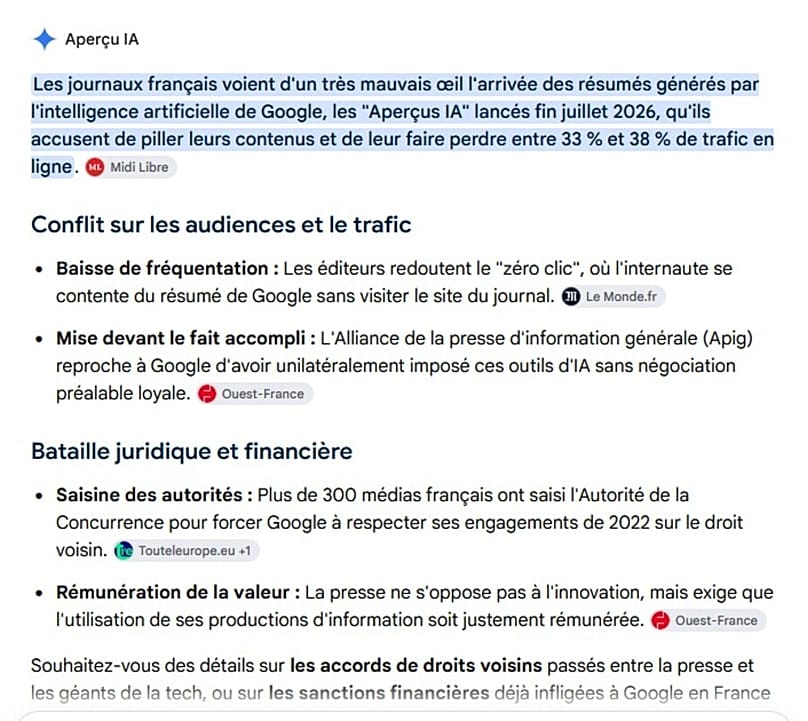
However, the APIG (Alliance de la presse d’information générale) wants (source in French) the French competition regulator to ensure "Google honours the commitments made in 2022" under a compensation agreement with French media groups, because "the unilateral rollout of new uses of press content, without prior authorisation or dedicated remuneration, breaches those commitments".
Google’s initial response
The US giant issued an initial response, saying it had reassessed its system for paying the press "so as properly to take into account the display of protected content within AI Overviews and AI Mode".
Google also told Franceinfo that "website publishers can choose whether or not to appear in these AI features".
"Between 33% and 38% traffic loss"
France’s audiovisual and digital regulator, Arcom, has estimated "between 33% and 38% traffic loss attributable to AI-generated summaries", APIG points out.
Information "has considerable value", said Marc Feuillée, president of APIG and chief executive of Le Figaro, in a statement.
"Publishers are not asking for innovation to be halted. They are asking for that value to be shared and for the use of their work to be paid for, as required by law," the association said in its statement.
"Publishers are ready to feed and support these new uses, within a balanced framework based on negotiated authorisation and remuneration commensurate with the value their content helps to generate," APIG added.
It said Google had introduced these new AI summaries without their consent, which would amount to a breach of the 2022 agreement.
In France, Google reached agreements in 2022 with 450 news publishers over "neighbouring rights" under copyright law, which allow newspapers, magazines and news agencies to be paid when their content is used by digital giants.
In 2024 the Competition Authority had already fined Google 250 million euros (290 million dollars) for failing to comply with parts of that deal.
Press revenues in free fall
Many media groups have seen their income slump over the past two decades as advertising has shifted online, a market in which tech companies capture a large share of the profits.
Critics argue that AI summaries make matters worse by cutting web traffic to news articles, with many users no longer clicking through to consult the original source of the information.
Google, for its part, insists these tools allow users to ask more complex questions and discover new content, while saying it gives publishers ways to control how their material is managed.
The EU announced in December 2025 that it was opening an investigation to determine whether Google had breached competition rules by using content put online by media outlets and other publishers to train and provide AI services without paying appropriate compensation.