




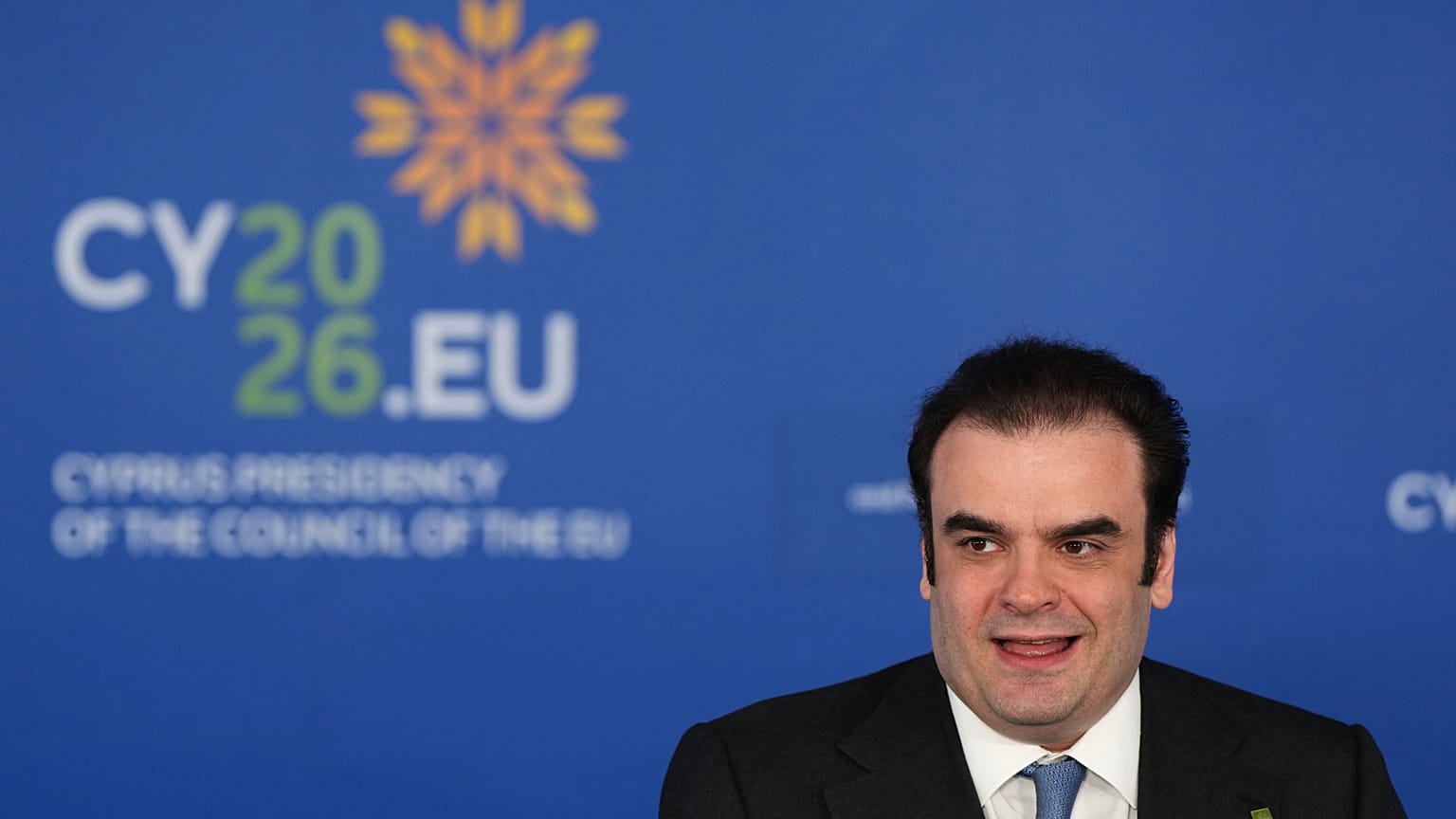













Pierrakakis tells Euronews fiscal policy must not contradict the ECB's efforts to tame inflation as the central bank prepares to raise interest rates. Rome is calling for more flexibility pegged to rising energy costs as a result of war.
Eurogroup President Kyriakos Pierrakakis told Euronews that fiscal policy across the euro area must complement the efforts of the European Central Bank to contain inflation, after the conflict in the Middle East triggered an increase in energy prices across the bloc.
 ADVERTISEMENT
ADVERTISEMENT
ADVERTISEMENT
The ECB is widely expected to raise its key interest rate by 25 basis points to 2.25% on Thursday, as part of the monetary policy overseen by ECB President Christine Lagarde.
Speaking on Euronews' flagship morning programme, Europe Today, Pierrakakis said finance ministers must strike a balance between providing fiscal support and implementing targeted measures that do not fuel broader inflationary pressures.
"While we do not comment on monetary policy, we trust the ECB to fulfil its role in anchoring inflation expectations," Pierrakakis told Euronews' Europe Editor Maria Tadeo on the sidelines of a Eurogroup meeting in Luxembourg.
Finance ministers "should implement policies that do not run counter to monetary policy", Pierrakakis said, as euro area governments consider measures to cushion the impact of higher energy costs without resorting to broad-based subsidies.
Both the European Commission and the International Monetary Fund have urged governments to adopt support measures that are "targeted and tailored" to those most affected. Still, Italy's government has called for further support.
Last month, Giorgia Meloni sent a letter to the Commission suggesting that Brussels should treat the energy crisis triggered by the closure of the Strait of Hormuz, carrying one fifth of all global supply, as an emergency equal to defense in measure.
Meloni and her finance minister, Giancarlo Giorgetti, called on the Commission to relax fiscal rules for energy, exempting them from debt and deficit calculations. Under EU rules, all member states must keep their deficit as a percentage of GDP below 3%.
In response, the Commission has added flexibility, allowing energy-related investments up to 0.3% of GDP for the period 2026, 2027 and 2028 to be included.
Talks will now begin on the next European common budget. Pierrakakis acknowledged the divisions among member states, telling Euronews that "there are different viewpoints around the table" and that his role as Eurogroup president is to help forge a "consensus".
With operation Epic Fury, the US administration has upped the pressure on Tehran militarity and economically, but the regime has not yielded and maintains the strait shut. Overnight, Iran and the US exchanged fire as President Trump Donald Trump vowed to make the regime a "pay the price" for not cutting a deal.
Pierrakakis told Euronews that Europe must invest more in its own energy infrastructure and projects, arguing that doing so is essential to the continent's "economic independence", just as defence investment is key to safeguarding "Europe's freedom".
"We know that the best social policy is to lower energy prices over the long term, rather than relying on short-term fixes," he said.
"What the Commission is proposing — additional flexibility to support investment in energy projects — is a very targeted and fair approach, and that is what we will be discussing."