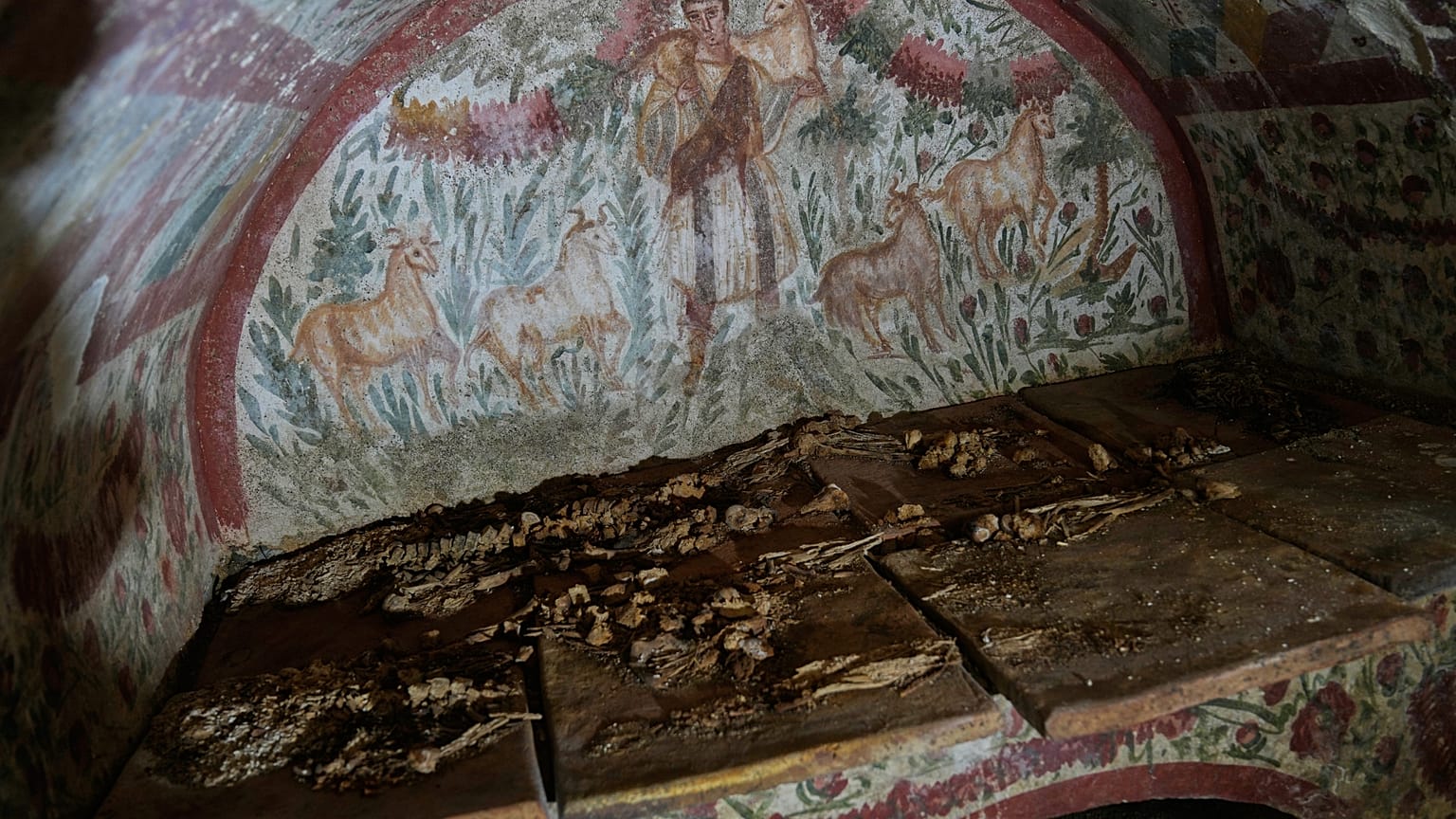














The 3rd-century fresco uncovered by Turkish archaeologists is the best-preserved of its kind to date.
A fresco depicting a Roman-looking Jesus as the “Good Shepherd” has been uncovered by Turkish archaeologists, one of the most important finds from Anatolia’s early Christian era.
 ADVERTISEMENT
ADVERTISEMENT
ADVERTISEMENT
The painting was discovered in August in an underground tomb near Iznik, where Pope Leo XIV recently visited as part of his first overseas trip. The town is known in Christian history as the site where the Nicene Creed was adopted in AD 325.
The tomb in the village of Hisardere is believed to date to the 3rd century, a time when Christians still faced widespread persecution in the Roman Empire.
The Good Shepherd fresco depicts a youthful, clean-shaven Jesus in a toga, carrying a goat on his shoulders. Researchers argue that it is one of the rare instances in Anatolia in which Jesus is portrayed with distinctly Roman attributes.
Before the cross was widely adopted as Christianity’s universal symbol, the Good Shepherd motif played a key role in expressing faith, indicating protection, salvation and divine guidance. However, only a few examples of the 'Good Shepherd' have been found in Anatolia, and the one in Hisardere is the best preserved.
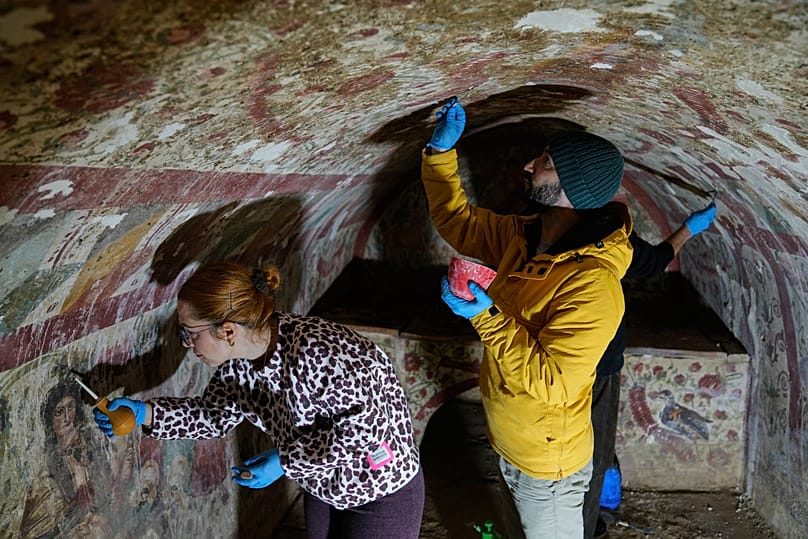
Lead archaeologist Gulsen Kutbay described the artwork as possibly the “only example of its kind in the region.”
The walls and ceiling of the cramped tomb also feature bird and plant motifs. Portraits of noble men and women, accompanied by slave attendants, also decorate the tomb walls.
Eren Erten Ertem, an archaeologist from Iznik Museum, said the frescoes showed “a transition from late paganism to early Christianity, depicting the deceased being sent off to the afterlife in a positive and fitting manner.”
The excavation also uncovered the skeletons of five individuals, three of whom were identified as two young adults and a six-month-old infant.
Turkish President Recep Tayyip Erdogan, presented a tile painting of the Good Shepherd discovery to Pope Leo XIV during his last month's visit to mark the 1,700th anniversary of the Council of Nicaea.
Anatolia witnessed pivotal moments in Christian history: St. Paul was born in Tarsus, St. John spent his final years in Ephesus and the Virgin Mary may have lived her last days near the same city.