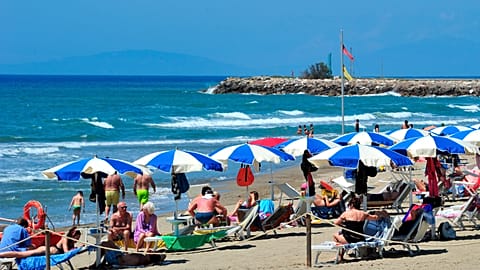






























More Europeans can afford a week-long holiday, but the trend is not universal. Five countries have seen the share unable to afford a holiday increase, including Germany and three Nordic countries.
Summer is holiday season across Europe, yet millions of people still cannot afford to take a week away from home. However, the share of Europeans unable to afford a holiday has fallen significantly.
 ADVERTISEMENT
ADVERTISEMENT
ADVERTISEMENT
In 2025, 27.5% of the EU's population aged 16 or older were unable to afford one week of annual holiday away from home. This was 35.2% in 2015, representing a decline of 7.7 percentage points and a significant improvement in holiday affordability.
In five countries, the share of people unable to afford a holiday increased over the past decade, although the rise was marginal in some cases. These were Norway, Sweden, Finland, Germany and Austria. The three Nordic countries saw the largest increases, but their rates remained among the lowest in Europe.
Germany and Austria also bucked the broader trend, with around one in five people unable to afford a week-long holiday in 2025. The share increased by 1.2 percentage points in Germany and 0.3 points in Austria over the decade.
Holiday economics
So, which European countries have the highest share of people unable to afford one week of annual holiday away from home? Which countries saw the biggest improvements in holiday affordability over the last ten years? What factors affect holiday affordability?
As of 2025, the share of people who are unable to afford one week's holiday varies widely across Europe. It ranges from 9% in Switzerland and Norway to 61% in Romania.
More than half the population was also unable to afford a holiday in Montenegro (58%), Albania (53%) and Turkey (51%). North Macedonia (48%) and Greece (47%) were also close to that level.
It is also above one in three in Bulgaria (39%), Hungary (39%), Serbia (36%) and Italy (36%).
The share unable to afford a holiday was below the EU average in Portugal (33%), Croatia (33%), Spain (32%), Lithuania (31%), Slovakia (29%), Latvia (29%), Cyprus (28%) and Malta (28%).
At the other end of the scale, the share was 15% or below in Luxembourg, Sweden, the Netherlands, Denmark, Finland and Slovenia, in addition to Switzerland and Norway, where it was 9%.
This share was 21% in Germany and 23% in France.
Southern and Southeastern Europe have the highest levels of holiday deprivation. This includes EU candidate countries. Northern Europe, in particular the Nordic countries, and Western Europe record the lowest levels. Central and Eastern Europe generally fall between these two regions, but with considerable variation between countries.
Role of GDP and economic disparities
Explaining the 2023 figures, experts emphasised the role of income levels.
Professor C. Michael Hall from Canterbury University pointed out that the level of disposable income is clearly important, as this allows people to spend money on holidays. "Disparities with holiday taking and expenditure reflect some of the broader economic disparities within the EU," he said.
Professor Lynn Minnaert from Metropolitan State University of Denver stated that the differences between nations are typically related to the strength of a country's economy. She noted that countries at the higher end of holiday deprivation have lower GDPs than those at the lower end.
The chart above shows this trend, presenting the share of people who are unable to afford a holiday alongside annual net earnings for a single person without children earning the average wage.
Fifteen years ago, almost 2 in 5 people (38.8%) in the EU were unable to afford a week-long holiday. This gradually declined after peaking in 2012 at 40.5%, reaching 28% in 2019. Since then, it has remained relatively stable at around 27-28%.
Comparing 2015 and 2025 figures, 25 of the 30 countries recorded a decline in the share of people unable to afford a holiday, while five recorded an increase. Three Nordic countries showed the highest increases in percentage-point terms, with Norway up 3.8 points, Sweden up 3.2 and Finland up 1.5.
However, these countries started from relatively low levels in 2015. For example, the share unable to afford a holiday was just 5.3% in Norway and 9.2% in Sweden. These increased to 9.1% and 12.4% respectively in 2025.
In Germany and Austria, where around one in five people are unable to afford a holiday, this rate rose by 1.2 points and 0.3 points respectively.
On the other hand, the share of people who are unable to afford one week's holiday away from home fell by 33 and 32 points in Croatia and Serbia.
The decline was 26 points in Cyprus, 22 in Ireland, and 21 points in Bulgaria and Turkey. Poland, Portugal, Slovakia, Malta and Hungary also recorded significant declines, of more than 15 points.