













Morgan Stanley is diving into crypto waters after filing to launch Bitcoin and Solana ETFs on Tuesday. The move signals major US banks are no longer sitting on the sidelines.
Morgan Stanley plans to launch ETFs tied to the price of Bitcoin and Solana, the first and sixth-largest crypto assets by market capitalisation respectively, according to a Form S-1 filed with the US Securities and Exchange Commission (SEC).
 ADVERTISEMENT
ADVERTISEMENT
ADVERTISEMENT
This is the first time one of the ten largest US banks by total assets has formally moved to offer crypto ETFs.
An exchange-traded fund (ETF) is a basket of assets that trades on a stock exchange like a share, giving investors easy exposure to an index, sector or commodity without owning it directly.
Many investors favour gaining crypto exposure via ETFs because they are low-cost and convenient. They can also offer greater liquidity while removing the regulatory and logistical complications of holding and safeguarding the underlying assets directly.
However, in the two years since the SEC approved the first US-listed Bitcoin ETF, it has largely been asset managers rather than banks that have launched these products.
BlackRock, the world’s largest asset manager, said last December that its Bitcoin ETF suite had become the firm’s top revenue source, with allocations nearing $100 billion (€85bn) and generating more than $245 million (€210mn) in annual fees.
US banks, which have only acted as custodians of client funds until now, seem ready and eager to evolve as providers of crypto services in 2026.
Regulatory push under Trump
The current US administration has been notably favourable towards the crypto asset industry. President Donald Trump's family launched a crypto platform, World Liberty Financial, just 50 days before the 2024 presidential election.
The company is managed by Trump’s two eldest sons, Donald Jr and Eric Trump, and alongside another firm, Trump Media and Technology Group, it has expanded the US President’s personal crypto ventures.
In parallel to these private interests, the current US administration has made a major regulatory push encouraging Wall Street to fully embrace crypto assets.
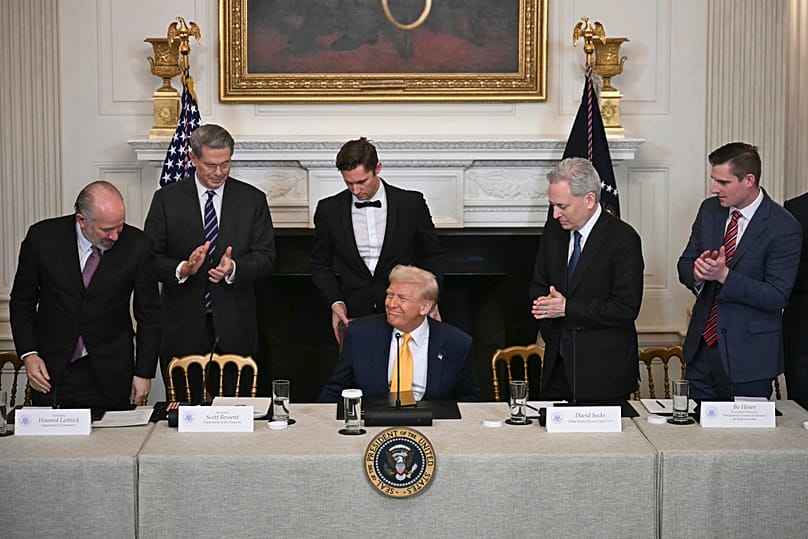
In July 2025, Trump signed the Guiding and Establishing National Innovation for US Stablecoins Act (GENIUS Act) into law, creating a comprehensive regulatory framework for stablecoins. These are crypto assets designed to maintain a stable value by pegging their worth to a real-world asset, typically a fiat currency such as the US dollar.
That same month, the Crypto Legal Accountability, Registration and Transparency for Investors Act (CLARITY Act) was approved in the US Congress. It is now moving through the US Senate and is expected to pass on 15 January 2026.
The CLARITY Act is a landmark legislation intended to end the long-standing era of “regulation by enforcement” that has weighed on US crypto firms for years.
In September 2025, the SEC also revamped listing rules for new commodities ETFs, including those tied to crypto assets, clearing the way for firms to bring more financial products to market.
The shift helped spur Morgan Stanley to broaden client access to crypto investments in October 2025, and it has now filed with the SEC to offer crypto ETFs directly.
At the start of 2026, Bank of America also began allowing its wealth advisers to recommend crypto allocations in client portfolios, another sign of growing adoption of crypto assets among major US banks.
What this means for the EU
This development in the US banking sector and the crypto industry is not only significant for Wall Street, but also has direct implications for European investors.
US-listed ETFs are typically not available to European retail investors because they do not meet EU requirements under the Undertakings for Collective Investment in Transferable Securities (UCITS) regime.
Morgan Stanley has been expanding its footprint in the European ETF market since entering the space in 2023, and has been building the infrastructure needed to launch EU-compliant versions of these funds.
While Europe has yet to see a UCITS-compliant spot crypto ETF, major platforms such as Coinbase, one of the world’s largest crypto asset exchanges, are partnering with financial institutions, including Morgan Stanley, to enable crypto ETF trading in Europe this year.
Together, they aim to comply not only with UCITS, but also with the EU’s Markets in Crypto-Assets (MiCA) rules, which require firms to hold a Crypto-Asset Service Provider (CASP) licence.
Morgan Stanley’s leap indicates that for Wall Street, crypto is no longer a reputational risk to avoid, but a revenue stream they can no longer afford to ignore.