












Montenegro aims to become the EU's 28th member by 2028, while Moldova is striving to move forward on its European path despite the challenges posed by the Transnistria conflict.
The new geopolitical reality has put EU enlargement back at the centre of the debate. From the Western Balkans to Eastern Europe, the accession of new members is no longer just a matter of institutional and economic convergence.
 ADVERTISEMENT
It is also a question of security, influence and Europe's strategic direction. Montenegro is aiming to become the EU's 28th member by 2028, while Moldova is trying to advance on its European path despite the challenges posed by the conflict in Transnistria.
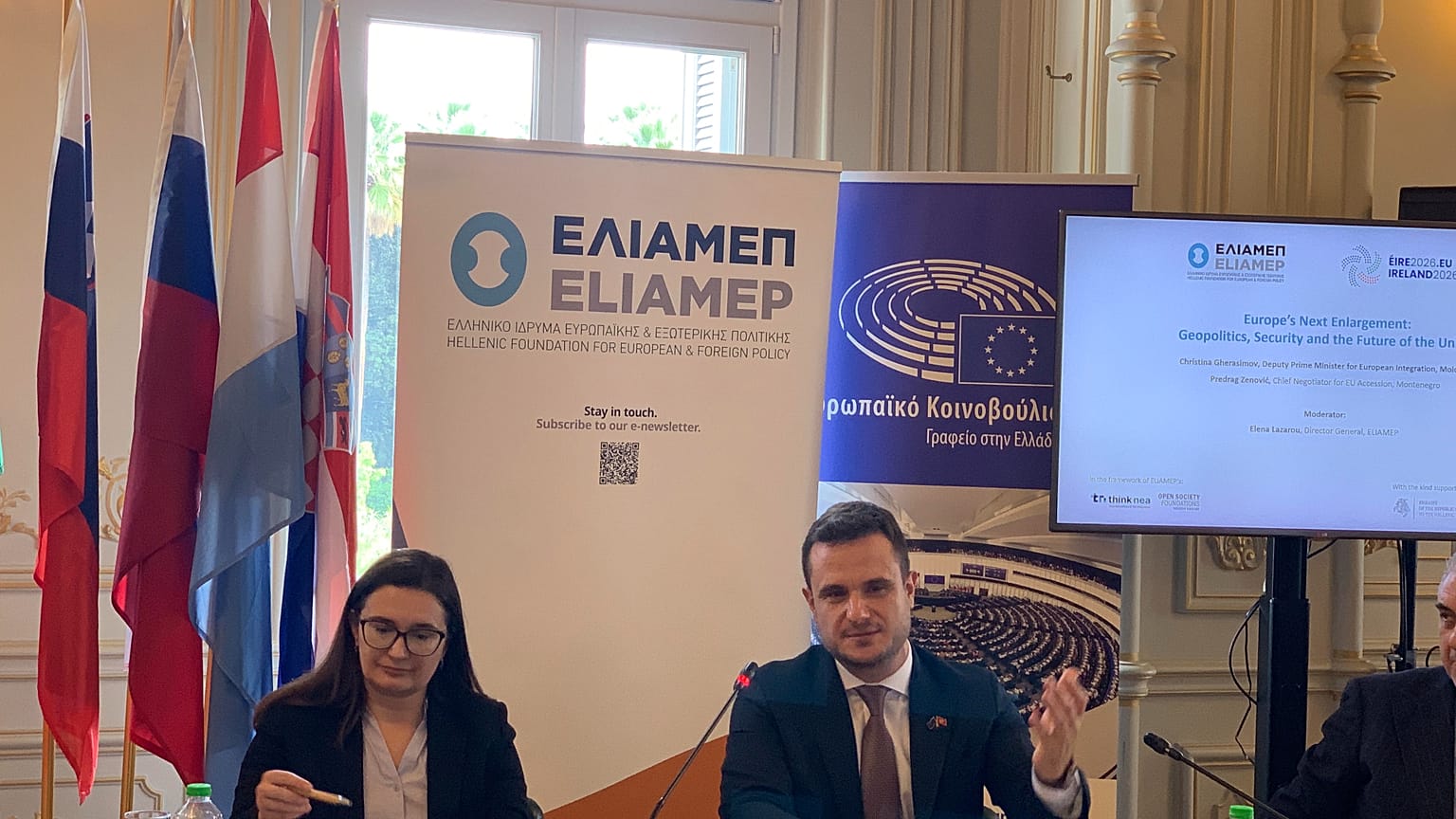
Enlargement's return to the agenda is directly linked to the war in Ukraine and growing concern over Russian influence in the wider region. For Brussels, integrating candidate countries now has a broader strategic dimension: it will determine where the limits of Europe's political and economic influence lie in the years ahead. These issues were discussed at a conference in Athens, co-organised by the Irish presidency and the think tank ELIAMEP.
Montenegro: the 2028 goal and unresolved issues with Croatia
Montenegro is the most advanced of the Western Balkan candidate countries. It aims to complete accession negotiations and become the EU's 28th member state in 2028.
Predrag Zenović, Montenegro's chief negotiator for EU accession since December 2023, was optimistic about the timetable. "We see Montenegro as the EU's 28th member state by 2028," he told Euronews.
Podgorica's timetable foresees closing all negotiating chapters in 2026, signing the Accession Treaty in 2027 and joining in 2028.
However, unresolved bilateral issues with Croatia remain a significant obstacle. Asked whether the dispute could go to international arbitration, Zenović said the two sides are examining various proposals to settle their differences. He expressed confidence that the need to maintain accession momentum would prevail.
"There has to be some kind of mutual understanding on both sides," he said, arguing that both Zagreb and Podgorica recognise the importance of enlargement and the limited time available.
Moldova: the European perspective and the Transnistria question
For Moldova, too, the European path has a clear security dimension. The presence of Russian troops in the breakaway region of Transnistria is one of the main threats to the country's territorial integrity.
The Moldovan government is seeking the peaceful reintegration of the region, starting with economic integration. Cristina Gherasimov, Moldova's Deputy Prime Minister for European Integration, told Euronews that the region now follows the same customs code as the rest of the country. Since September, it has also begun gradually introducing VAT and excise duties on certain categories of goods.
"Moldova will always continue to pursue the peaceful reunification of the country," she said, stressing that on security issues the country needs the support of its European partners.
The key question is how far the presence of Russian troops could affect Moldova's EU accession. Gherasimov argued that the Transnistria conflict should not become an obstacle to the process, since the decision on the country's European future belongs to its citizens.
"Whether Moldovans join the European Union or not is their choice, not Russia's choice," she said.
She also described Moldova's efforts to counter disinformation and pro-Russian narratives, which, she said, foster fear and mistrust of the European perspective. Despite this pressure, she maintained that support for EU accession remains strong in Moldovan society.
Greece and the challenge of the 2027 presidency
In this new geopolitical environment, Greece wants to play an active role in speeding up enlargement, as it is due to hold the Presidency of the Council of the EU in the second half of 2027.
Athens has considerable diplomatic capital in this area. A key reference point is the 2003 Thessaloniki Summit, which reaffirmed the European perspective of the Western Balkans.
According to Dr Ioannis Armakolas, senior researcher and programme director at ELIAMEP and Associate Professor of Comparative Politics of South-East Europe at the University of Macedonia, enlargement is expected to be a key priority of the Greek Presidency. Expectations are high, he notes, both in the Western Balkans and in candidate countries such as Moldova and Ukraine.
"Greece has this symbolic diplomatic capital because of the famous Thessaloniki Summit of 2003. Therefore, there is an expectation that something important will happen during the Greek Presidency," he says.
One of the most ambitious goals is to complete Montenegro's accession process during the Greek Presidency. Armakolas believes this is achievable, provided the country closes its negotiating chapters on time and resolves its outstanding issues with Croatia. Athens could also help advance other enlargement files, from Albania and Serbia to Moldova and Ukraine.
The question, then, is not only how many countries will manage to walk through the door of the European Union, but also whether the Union itself can turn the geopolitical need for enlargement into a credible, concrete political plan.