












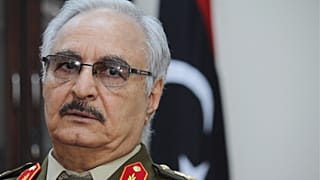
Eastern Libya's commander, accompanied by his son Saddam, met Turkey's defence and foreign ministers and its intelligence chief, days after Ukrainian naval drones sank the Russian warship Merkury at Benghazi's naval base.
Khalifa Haftar, commander of the Libyan National Army (LNA) controlling eastern Libya, arrived in Ankara on Tuesday, meeting senior officials days after Ukrainian naval drones sank a Russian warship at Benghazi's naval base.
 ADVERTISEMENT
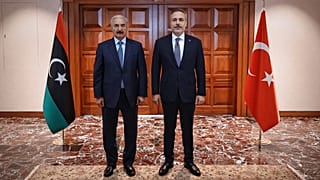
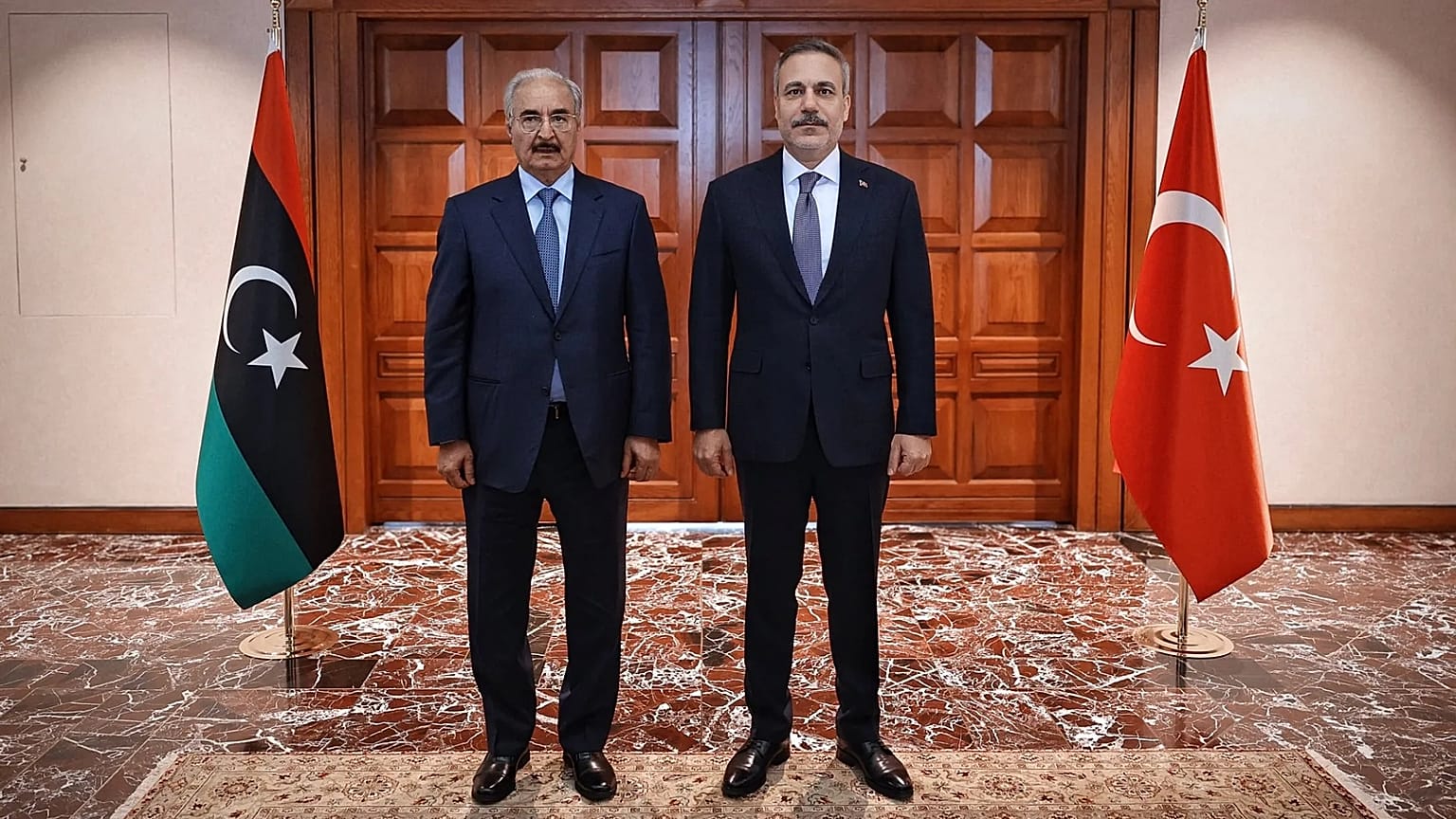
Haftar and his delegation, which included his son Saddam Haftar, met Defence Minister Yaşar Güler and Foreign Minister Hakan Fidan on Tuesday.
On Wednesday, Foreign Ministry footage showed Haftar meeting Fidan again alongside Energy Minister Alparslan Bayraktar, National Intelligence Organisation (MIT) chief İbrahim Kalın and military officials.
Turkey's Chief of General Staff Selçuk Bayraktaroğlu received Haftar on arrival, LNA footage showed.
No official statement on the content of the talks had been issued as of Wednesday. No meeting between President Recep Tayyip Erdoğan and Haftar appeared on the presidency's official schedule.
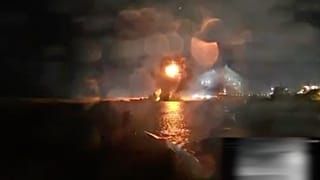
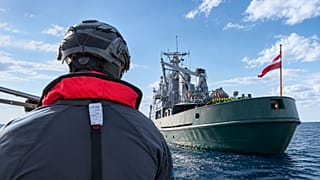
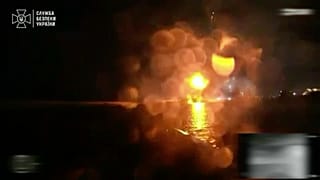
Ukrainian naval drones sank the Russian warship Merkury at Benghazi's naval base on Saturday in an operation Ukrainian President Volodymyr Zelenskyy confirmed, praising it as exemplary. A cargo vessel was also damaged in the strike.
The internationally-recognised Tripoli-based government requested an explanation from Ukraine, while eastern Libyan authorities called for an international investigation into what they described as a Ukrainian military presence in the country.
Haftar's Russian connection
Russia has backed Haftar since at least 2019, when Wagner Group mercenaries supported the LNA's offensive on Tripoli.
Wagner has since been reconstituted as Africa Corps, which maintains logistics bases in southern and eastern Libya and has announced plans for a naval facility in Tobruk.
Moscow sees eastern Libya as a bridgehead for its operations across the Sahel and as a potential foothold in the southern Mediterranean, particularly after the fall of Russia's ally Bashar al-Assad in Syria.
Libya has been politically divided since Gaddafi's overthrow in 2011 and the resumption of fighting in 2014.
The Tripoli-based Government of National Unity, led by Prime Minister Abdulhamid Dbeibah, controls the west, while a rival administration backed by Haftar operates in the east.
Turkey is one of the few countries that maintains active relations with both sides. Between 2019 and 2020 Ankara backed the western government with military support that played a critical role in repelling an LNA offensive on Tripoli.
Relations with the Haftar camp have since improved steadily, with Turkish officials making regular visits to Benghazi and Turkish companies investing in the region, primarily in construction.
In October, the eastern-based House of Representatives endorsed the 2019 memorandum on maritime jurisdiction areas signed between Ankara and the former Tripoli-based Government of National Accord — an agreement that drew sharp reactions from Greece, Cyprus and the EU.
Diplomatic contacts have intensified ahead of the December summit. Fidan and MIT chief Kalın met Prime Minister Dbeibah in Istanbul on 21 November.
Turkey also hosted Khalid Haftar, LNA chief of staff, earlier in November, and in October military representatives from eastern and western Libya held talks in Ankara to unify the country's armed forces.
Saddam Haftar, considered a possible successor to his father, separately announced on social media that he had visited Qatar, which also plays a mediating role in international disputes.
Erdoğan's first visit to Libya in 15 years
Haftar's Ankara visit comes ahead of Erdoğan's planned trip to Tripoli on 8-9 December for the Turkey-Africa Partnership Summit, expected to be his first visit to Libya in 15 years.
Erdoğan last visited Libya on 16 September 2011, when he was Turkey's prime minister and late leader Muammar Gaddafi had just been overthrown.
Travelling to Tripoli and Benghazi, he met Mustafa Abdul Jalil, then head of the National Transitional Council, and Executive Board chairman Mahmoud Jibril, and signed cooperation agreements between the two countries.
Foreign Minister Fidan confirmed the December trip, saying its importance extends beyond the summit itself. Erdoğan is expected to meet representatives of both eastern and western Libyan authorities during the visit.