












Serbia's new Student List leadership will skip Wednesday's EU-Western Balkans summit in Brussels and is not expected to sign its declaration, delaying clarity on whether Belgrade will align with EU foreign policy. Russia sanctions and Kosovo are the main sticking points.
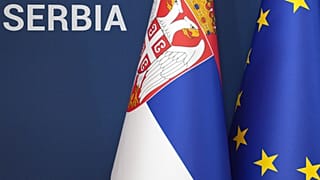
Serbia's new political leadership will be conspicuously absent from Wednesday's summit between Western Balkan leaders and the EU institutions, leaving open whether the incoming government in Belgrade will align more closely with the bloc's foreign policy.
 ADVERTISEMENT
Importantly, given its absence, Brussels also does not expect Serbia to subscribe to the summit's declaration, which reiterates commitments to EU values and rejects historical revisionism and the glorification of war crimes.
In September, the mass funeral attended by senior Serbian government officials for convicted war criminal Ratko Mladić, known as the Butcher of Bosnia, attracted strong criticism from the EU and several member states.
The non-appearance of the region's largest and most influential country casts a shadow on the Brussels summit, as the EU seeks to capitalise on renewed enlargement momentum and deepen its ties with the Western Balkans.
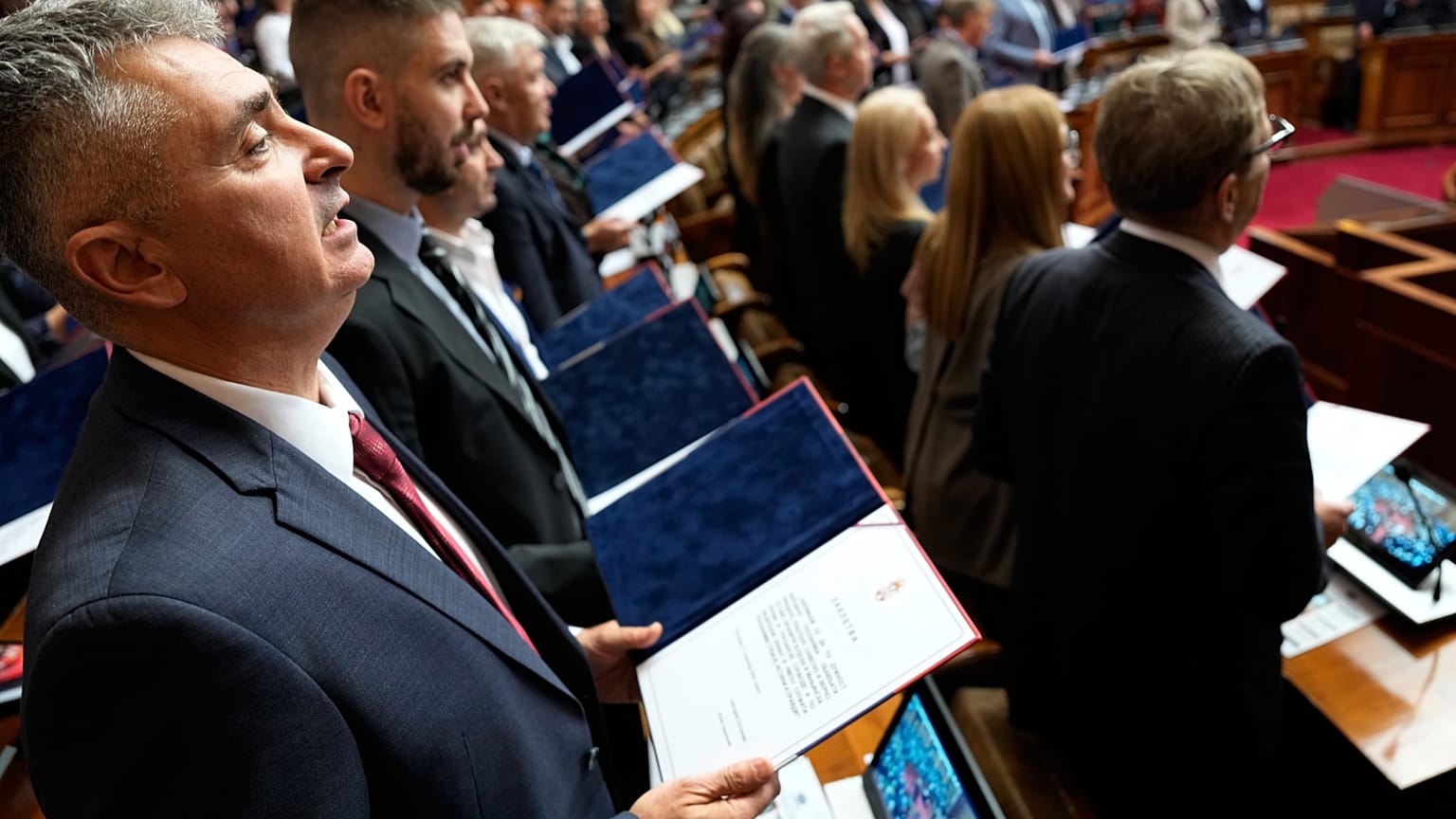
Aleksandar Čupić, Serbia's newly elected parliamentary speaker and acting president, was invited but was unavailable due to parliamentary business, including setting up committees and preparing to call presidential elections.
"Today we have to finish a constitutive session, and that is our priority right now," Sarah El Sarag, a Student List MP, told Euronews. "It's nothing personal. We have to do this kind of thing first."
The absence is all the more significant because Serbia is in political transition after Aleksandar Vučić's ruling party lost power after 14 years.
The Student List, the protest movement's electoral vehicle, now holds a parliamentary majority and is expected to form the next government.
But skipping the summit means Brussels must wait longer to learn how the new leadership intends to position Serbia on the bloc's most sensitive foreign-policy issues, above all Russia.
Serbia's absence has also become somewhat of a common feature at these summits. In December 2025, Vučić announced that neither he nor any other Serbian official would attend the EU-Western Balkans summit in Brussels, protesting EU member states' failure to agree to open Cluster 3 of Serbia's accession talks.
"The alignment with the EU's common foreign and security policy really remains a number one pressing issue. In the current geopolitical context, our member states expect a clear strategic orientation from partners who aspire to join the European Union, both in words and in deeds," an EU official told reporters ahead of Wednesday's summit.
In other words, Brussels has been tightening the screws on how far candidate countries must align with the bloc's foreign policy, as Euronews has previously reported.
The European External Action Service, the EU's diplomatic arm, has instructed EU delegations to closely monitor the implementation of sanctions against Russia and possible circumvention in candidate countries.
Joining the EU's sanctions regime against Moscow would be a particularly difficult decision for Serbia. Student List representatives have voiced support for speeding up accession, notably through reforms of the rule of law, judicial independence and media freedom, but have so far avoided committing to any shift in foreign policy.
At a meeting with senior EU officials in Brussels, representatives of the new parliamentary majority said their commitment to internal reforms was driven primarily by the interests of Serbian citizens rather than by the goal of European integration, as the movement campaigned on an anti-corruption platform.
Sanctions on Russia are likely to become a major source of friction between the future government and Brussels. A Eurobarometer survey published in May found that 67% of Serbian respondents opposed sanctions against the Russian government, individuals and companies.
Opposition has deep historical roots. UN sanctions on the Federal Republic of Yugoslavia in the 1990s, during the wars in the former Yugoslavia, contributed to economic hardship, hyperinflation and international isolation.
NATO's 1999 bombing campaign and Russia's later diplomatic backing for Belgrade, particularly over Kosovo, further shaped public attitudes towards Western foreign policy.
In an interview with Radio Free Europe last month, Ilija Srdanović, who has emerged as the Student List's main international interlocutor, said Serbian citizens should ultimately decide the country's position on sanctions against Russia through an open public debate.
Another potential source of friction is the widespread perception within the protest movement that EU institutions and several European leaders accommodated Vučić despite the repression of demonstrations, corruption and curbs on media freedom.
As recently as July 2026, the Commission renewed its push to open Cluster 3 for EU accession, but eight member states blocked it, largely over Belgrade's ambiguous position on Russia and its domestic reform record.
Kosovo could further complicate relations with the new leadership. Serbia's refusal to recognise its independence, and its reliance on Russian diplomatic support to keep Kosovo from wider international recognition, remain significant obstacles to normalisation.
Here, too, Srdanović has sought a balance. He has said the Student List is committed to continuing the EU-facilitated dialogue between Belgrade and Pristina, while arguing that agreements reached by previous Serbian governments should be reviewed for compliance with the constitution.
That raises questions about the movement's willingness to implement the 2023 Ohrid Agreement, under which Serbia committed not to oppose Kosovo's membership of international organisations.
"Our expectation remains that Serbia, like all the other partners in the region, aligns with the EU common foreign and security policy," a second EU official said.
For Brussels, the challenge is to establish whether the new leadership's commitment to democratic reform can translate into a broader strategic reorientation, or whether Serbia's foreign policy will stay largely unchanged despite the upheaval in Belgrade.