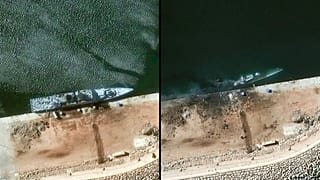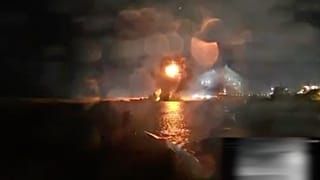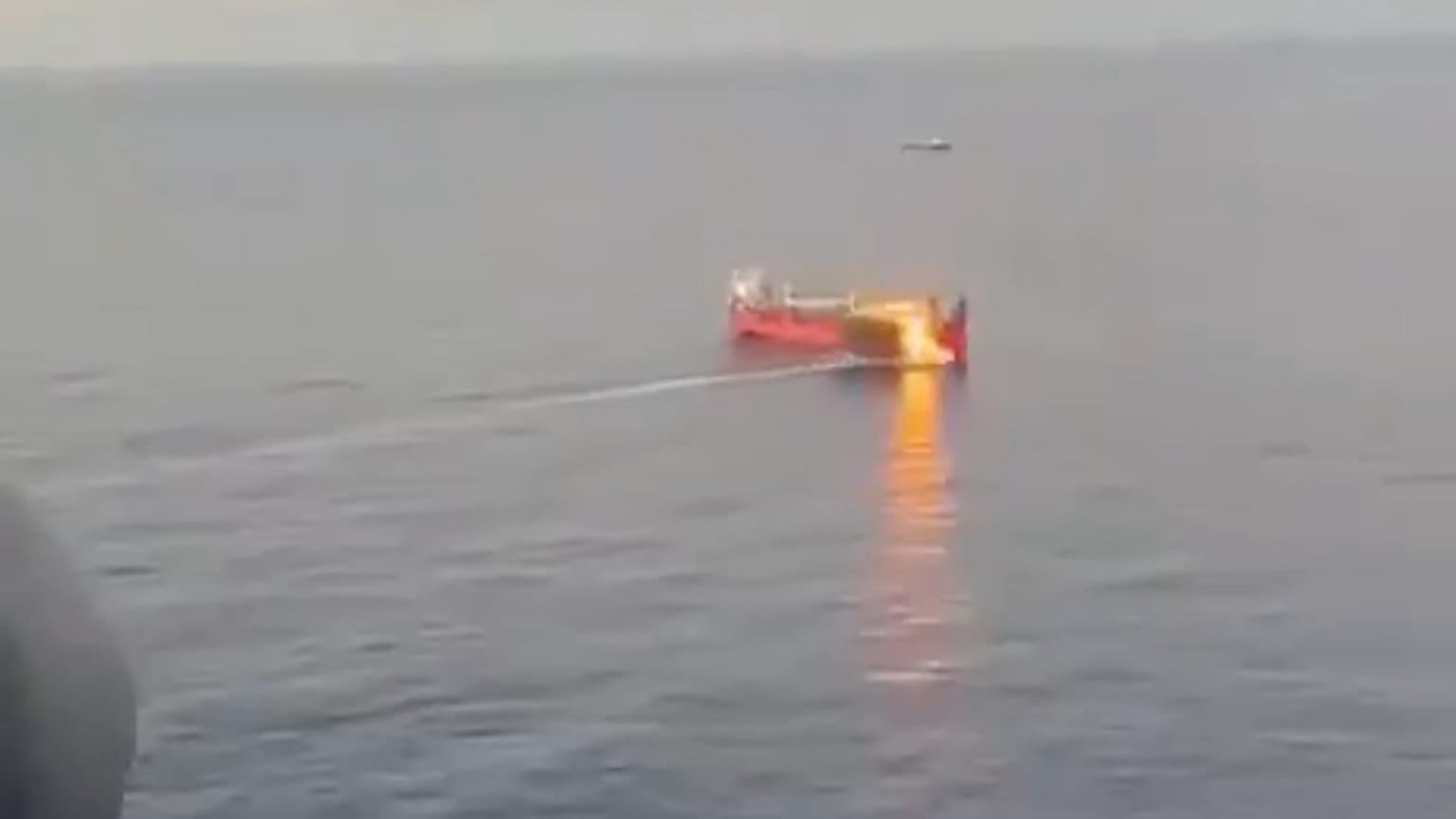













Ukraine's naval drone strikes on two Russian vessels in and off Benghazi have alarmed Italy, amid fears that the attacks could reignite Libya's civil war.
Kyiv has stepped up long-range drone attacks on Russian ships in the Mediterranean Sea, but Italy fears the strikes could escalate into renewed fighting in Libya, destabilising its southern neighbour in one of Rome's worst nightmares.
 ADVERTISEMENT
Italian Foreign Minister Antonio Tajani voiced his concern over Ukraine's operations in Libya to his Ukrainian counterpart Andrii Sybiha on Tuesday, according to a readout of the phone call.
On Sunday, Ukrainian naval drones hit two Russian vessels, one docked at the Benghazi naval base and the other just off the Libyan city. Ukrainian President Volodymyr Zelenskyy called it an "exemplary Ukrainian operation."
The attacks appear to be part of a broader maritime campaign against Russian vessels beyond the Black Sea. On Saturday, a Ukrainian drone hit another Russian ship near Finland's territorial waters.
But the strikes in Libya have rung alarm bells in Rome, where even the prospect of civil war reopening across the Mediterranean is enough to send a shiver down officials' spines.
Italian Prime Minister Giorgia Meloni has so far refrained from commenting on the episode publicly to avoid escalating the situation, but according to the Italian daily la Repubblica, she privately slammed the attacks as "unacceptable".
"We were not informed of absolutely anything; we did not provide any kind of support to the Ukrainians, they did everything without informing us," Tajani told reporters on the sidelines of a visit to Baku.
Tajani pledged to work to stop the conflict with Russia spreading across the Mediterranean basin, while respecting Libya's sovereignty and avoiding its destabilisation.
Libya has been split since the civil war that followed the fall of Muammar Gaddafi in 2011. A UN-recognised government in Tripoli controls much of the west, while the east is dominated by military strongman Khalifa Haftar and his Libyan National Army, which is backed by the rival administration in Benghazi.
Russia backs Haftar, while Italy supports the Tripoli government. Turkey has also been increasing its military presence in the region since it intervened in 2019 to stop Haftar capturing Tripoli.
For Rome, a renewed explosion of fighting in Libya, sparked by possible Russian retaliation in the country, is a nightmare scenario that evokes the chaos following Gaddafi's death.
Italy can do little but hope the strikes do not trigger renewed fighting between Libya's rival factions. Domestically, the Italian government also sees the risk that the attacks might undermine political support for the aid to Ukraine.
"We all know that Libya and the Mediterranean Sea have been a zone of Russian intervention for a long time. Italian politics prefers to ignore international developments rather than taking responsibility to try to prevent an escalation," MEP Lucia Annunziata (Italy/S&D) told Euronews.
Annunziata argued that Kyiv should have notified Rome of the attacks, but stressed that the Italian government cannot simultaneously recognise Ukraine's right to self-defence while imposing geographical limits on how it exercises that right.
Italy is not alone in its concern over the new flurry of Ukrainian attacks on Russian vessels. On Tuesday, a German government spokesperson warned against escalation in the Baltic Sea region.
In May, Greek fishermen found an unexploded Ukrainian naval drone in the Ionian Sea, prompting a strong reaction from Athens, which wants to keep the Mediterranean from becoming a theatre of military operations.
"Ukraine's right to self-defence cannot justify such actions," Foreign Ministry spokesperson Lana Zochiou said when Athens lodged a formal protest in June.
According to an EU official who spoke with Euronews on condition of anonymity, Ukraine intended to send a clear signal that Russian vessels in the Mediterranean are within arm's reach, forcing them to reroute and raising the costs for Moscow.
"No member state wants to see the war in its backyard," the official said. "But the spillover didn't start two days ago. Russia is violating EU territory every day of the week. Russian vessels are a legitimate military target."
Read more