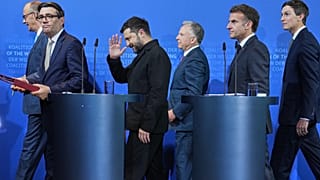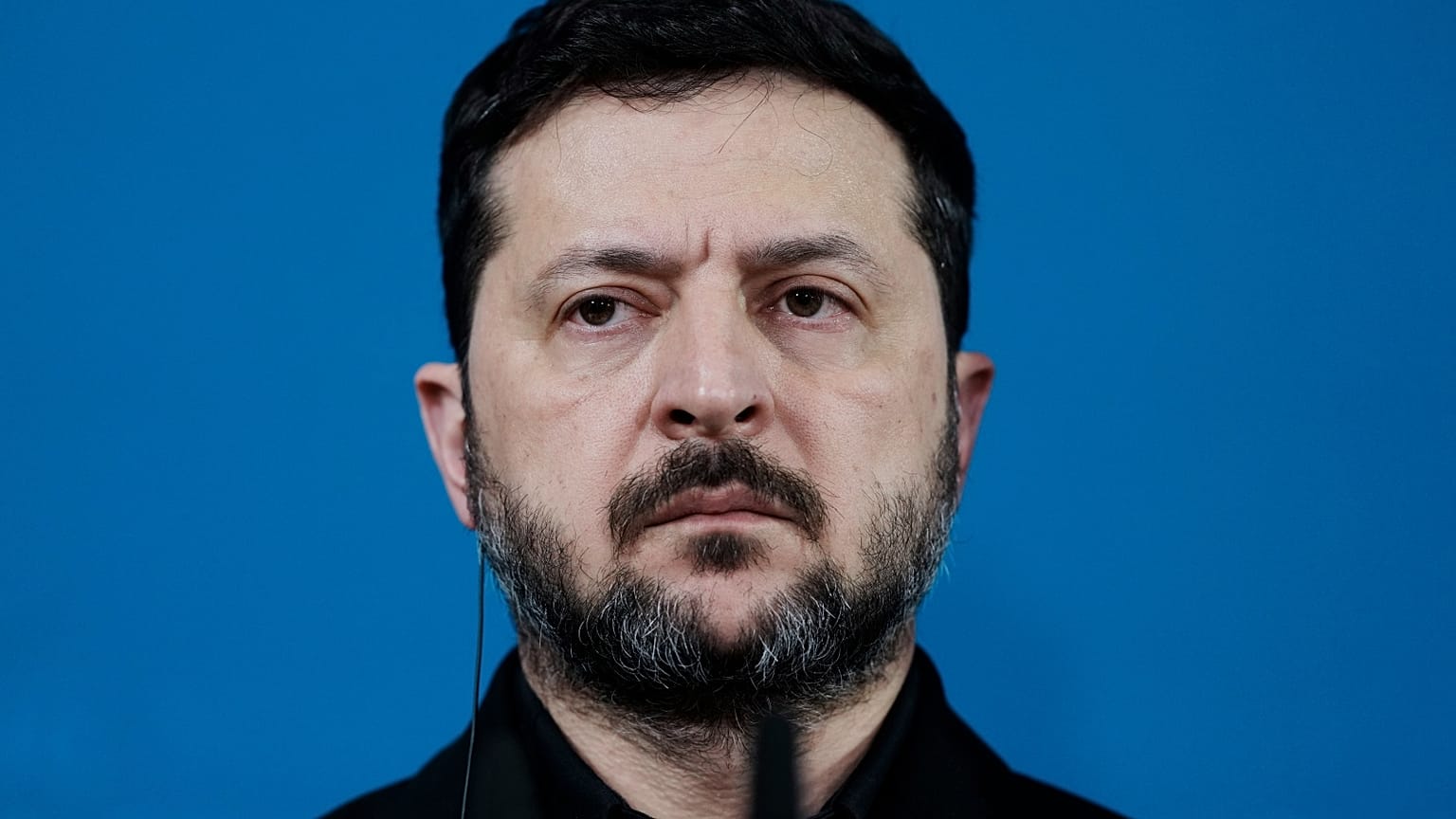













The promise to provide Ukraine with an Article 5-like security guarantee has sown confusion. Volodymyr Zelenskyy wants the US and Europe to clarify how they would respond in the event of a new Russian attack.
Ukrainian President Volodymyr Zelenskyy has asked the United States to clarify what an Article 5-like security guarantee would mean for his country in a post-war scenario, warning that a new Russian attack is not a matter of "if" but of "when".
 ADVERTISEMENT
"I'm not sure we have a common acceptance of Article 5," Zelenskyy said on Thursday evening after a meeting of the Coalition of the Willing in Berlin.
"What does it mean?"
The idea of developing a security guarantee for Ukraine modelled under NATO's collective defence, which states that an armed attack against one ally shall be considered an attack against all of them, was first raised in December of last year. However, the proposal was never fully developed as peace negotiations subsequently stalled.
It came back into focus on Thursday, as European leaders gathered in Berlin.
US special envoy Jared Kushner, who took part in the meeting, said President Donald Trump was "open" to providing such a commitment to a post-war Ukraine.
"From an American perspective, giving an Article 5-like security guarantee is a really, really big deal," Kushner said, speaking next to Zelenskyy.
"Obviously, it has to be in America's interest to do that. And we also have to make sure that it's part of a broader security package."
Kushner claimed that Russia has become "comfortable" with the concept, though he admitted "there's a lot of scepticism and disbelief" about it in Moscow. Kushner also said the Russian intention is "to not have another war in the future".
"That's why it's important to restart the dialogue between Europe and Russia," he said.
"We have to work on a system of incentives and interests to make sure that whatever agreement we come to is something that will be kept, it will be monitored, there'll be huge deterrence, and there'll be massive consequences if it's ever violated."
But in a subsequent press conference, Zelenskyy challenged the vagueness of Kushner's response, asking for specific details such as the possible deployment of US troops or the establishment of US bases on Ukrainian soil.
"What about American soldiers?" he said. "Do you have an answer on it? Me not. For today. I don't know the answer."
For an Article 5-like guarantee to work in practice, he said, the US and Europe have to properly spell out how they would react to a new Russian assault.
"What will partners do?" he said. "What happens if – sorry to be sceptical – not if, but when (Russians) will try to do it again? What will they do?"
"It has to be clear not only to partners (but also) to people, societies, investors" who will come to Ukraine after the war, he went on.
"All these people, they need clear answers."
Zelenskyy said that full-time NATO membership, a long-held goal for Kyiv and a red line for Moscow, would make it clearer, as his country would automatically benefit from the real Article 5 provision, the linchpin of the alliance's deterrence.
Ukraine's NATO dream has split allies, with some arguing it would be the easiest way to avoid a new invasion and others warning it would unnecessarily provoke Russia.
French President Emmanuel Macron said on Thursday that Russia's "maximalist" demands warranted revisiting "the question of Ukraine's NATO accession".
The meeting in Berlin ended with a declaration signed by Germany, France and the UK that featured a subtle reference to a potential Article 5-like security guarantee.
The text did not describe it as such, but as "a legally binding commitment, subject to national procedures, to take measures to restore peace and security in the case of a future armed attack by Russia".