












Idealista's analysis shows rising pressure on households. Faro demands most effort to rent, Funchal to buy, and Lisbon's burden is very high for both.
In a context of major social and political unrest in Portugal, largely due to successive demonstrations for the right to housing and the high cost of living, the conclusions of a new analysis by southern Europe's largest property portal, Idealista, are blunt: Portuguese families spend on average 83% of their net annual income on rent. The figure falls to 70% in the case of buying a home.
 ADVERTISEMENT
"Renting or buying a home consumes a large part of household income, reflecting the difficulties that many families face in accessing adequate housing," can be read in the study's conclusions.
This reality is widespread across the country, but in some places the financial burden of housing on families is even greater.
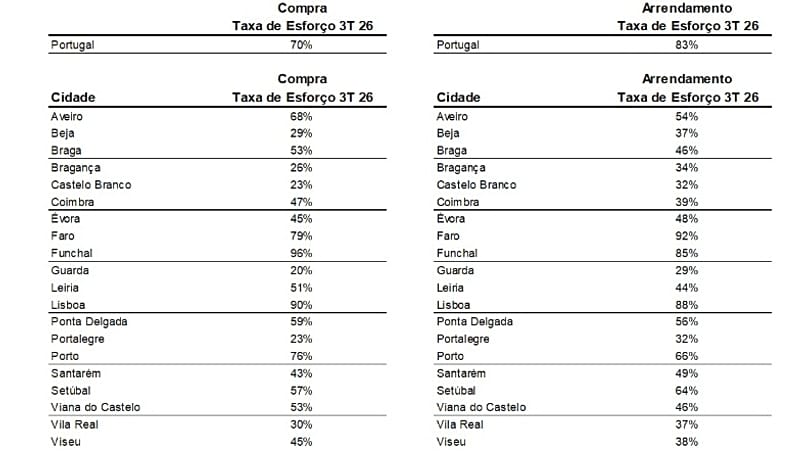
The analysis covered 20 cities: the 18 district capitals in mainland Portugal and the two capitals of the autonomous regions of Madeira and the Azores. Faro is where families spend the highest share of their annual salary on renting, with the effort rate reaching 92% of household income.
Next comes Lisbon, where families spend 88% of their salary on rent, and Funchal, with 85%.
Also in the top five cities where families devote the largest share of their income to rent are Porto (66%) and Setúbal (64%). Coimbra, Viseu, Beja, Vila Real and Bragança appear as the cities where rents weigh least on household income. Only in three cities does the effort rate not exceed the recommended limit of 33%: Castelo Branco and Portalegre, with an effort rate of 32%, and Guarda, with 29%.
Effort rate for buying a home
The idea of buying a home is increasingly utopian for many Portuguese people, even for young people who have seen some government measures targeted at them, notably the controversial public state guarantee.
And those who do manage to buy a home in Portugal are facing an effort rate that is increasingly high.
According to Idealista, Funchal is the city where "buying a home represents the greatest financial effort", with a rate of 96%, followed by Lisbon, with 90%, and Faro, with 79%. This means that almost all of families' net annual income goes on repaying a housing loan.
The recommended effort rate for buying a home, equal to or below 33%, is clearly exceeded in most cities: Porto (76%), Aveiro (68%), Ponta Delgada (59%), Setúbal (57%), Braga (53%), Viana do Castelo (53%), Leiria (51%), Coimbra (47%), Évora (45%), Viseu (45%) and Santarém (43%).
Only in six district capitals does the effort rate for buying a home remain within the recommended level, such as Guarda (20%), Castelo Branco (23%), Portalegre (23%), Bragança (26%), Beja (29%) and Vila Real (30%).

The rise in interest rates has pushed up mortgage repayments, leaving families with ever higher bills to pay. In 2026, in Portugal, three, six and 12 month Euribor rates began to register sharper increases from March 2026.
The Bank of Portugal this year reduced the maximum recommended effort rate from 50% to 45% of net monthly income. This is a maximum threshold and is still above many perceptions of sustainable effort rates.