




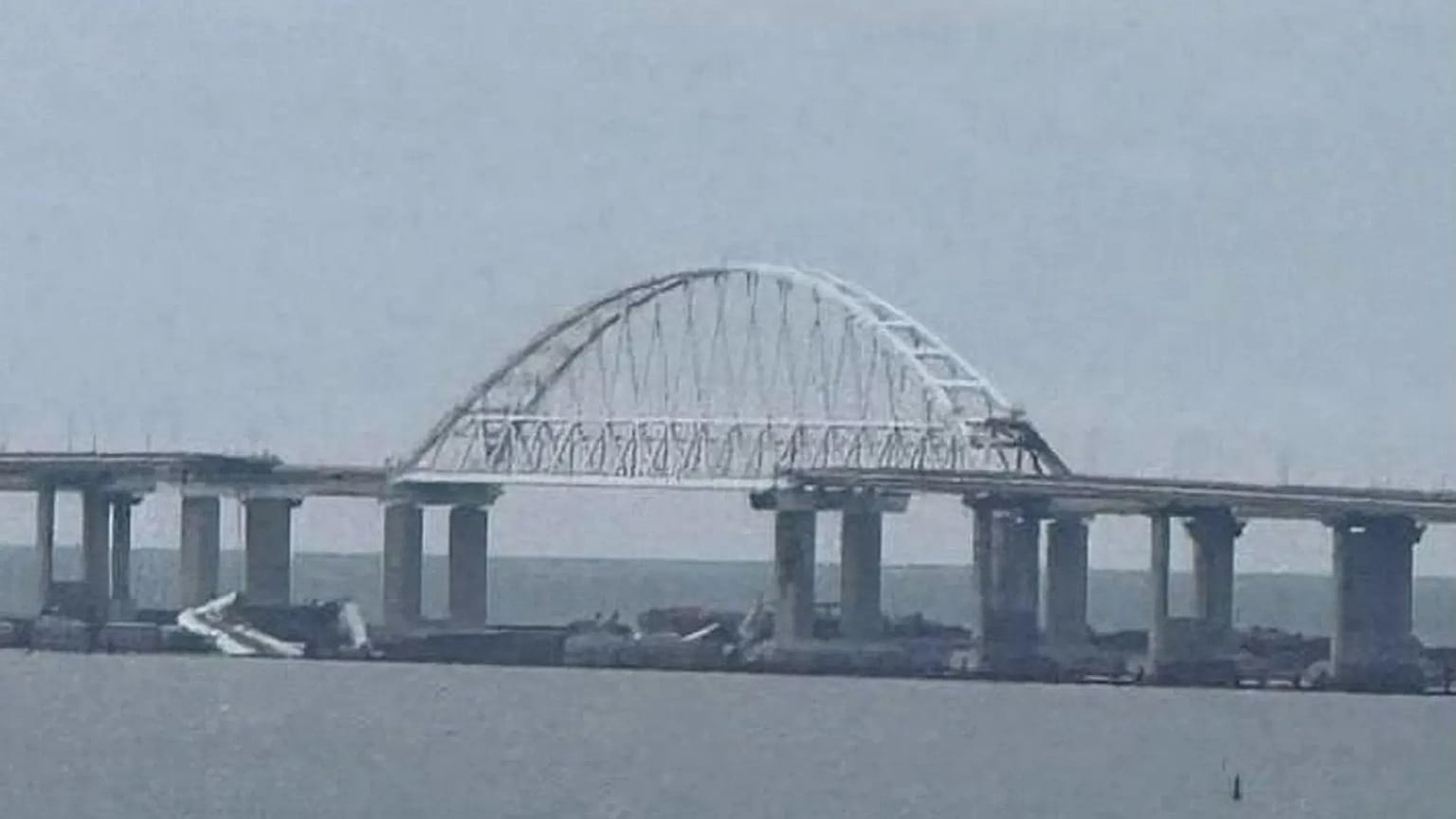













Ukraine's unprecedented seven-stage operation reportedly partially destroyed one of Russia's most heavily defended infrastructure sites, a vital military supply route to occupied Crimea and the crown jewel of Vladimir Putin's occupation of the peninsula.
Ukrainian forces used a combination of drones and missiles to strike the road and railway sections of the Crimean Bridge overnight into Tuesday, following weeks of coordinated attacks aimed at dismantling Russian air defences protecting the crossing.
 ADVERTISEMENT
Ukrainian President Volodymyr Zelenskyy revealed details of the strike, which marked the culmination of a seven-stage operation developed and coordinated by Ukraine's Security Service (SBU) and the General Staff of the Armed Forces, involving 11 different weapons systems.
Images circulating after the attack appeared to show one of the bridge's main arches and part of its roadway collapsed into the sea, potentially dealing a major blow to the crossing linking Russia with occupied Crimea.
Russia's Transport Ministry confirmed that both road and rail traffic had been suspended following a second consecutive day of attacks, but did not confirm the reported collapse.
How Ukraine carried out the operation
In a detailed statement published on X, Zelenskyy said Ukrainian forces had spent several weeks systematically targeting Russian military systems protecting the crossing.
"Our warriors gradually destroyed air defense systems, radars, electronic warfare equipment, and other designated targets on the way to the final objective," Zelenskyy said.
He identified eleven weapons systems used throughout the operation: Dovbush, Vendetta, Da Vinci, Sichen, Mich-2000, Ruta, Palianytsia, An-197, FP-1, FP-5 Flamingo and R-360 Neptune.
At the final stage, Ukrainian forces used different weapons to target the bridge's two transport sections.
"Today, at the key stage, the 'Palianytsia' drones performed exceptionally well, striking the road section of the bridge, while 'Neptune' missiles, 'Ruta' drones, and FP-5 drones struck the railway section," Zelenskyy said.
The Ukrainian president also highlighted the use of the FP-5 Flamingo cruise missile in a precision-guided strike.
"Using 'Flamingo,' our warriors carried out a precision-guided strike – and the communications uplink worked flawlessly until the very last seconds."
Robert Brovdi, known by his callsign "Magyar", commander of Ukraine's Unmanned Systems Forces, also commented on the attack, identifying several Ukrainian military units involved in the operation.
According to Brovdi, the strike was a joint operation involving deep-strike units of the Ukrainian Navy, the Rocket Forces and Artillery, the newly formed 7th Centre of the 414th "Magyar's Birds" Brigade, the 1st Centre of the Unmanned Systems Forces and Ukraine's Security Service (SBU).
"The sacred bridge is tired. It's time for rubber dinghies," Brovdi wrote.
He also suggested that the attack would have lasting consequences for Russian transport connections to the peninsula.
Fire Point, the Ukrainian manufacturer of the Flamingo cruise missile, reacted to the attack on X, posting a brief message: "Crimea is Ukraine btw."
"Crimean Bridge. Sanctioned," Ukraine's Presidential Sanctions Commissioner Vladyslav Vlasiuk wrote in a separate post on X.
Zelenskyy did not specify how many drones or missiles were launched, how many reached their targets, or which weapons were responsible for the reported collapse.
What happened to the bridge?
Images published by Russian and Ukrainian Telegram channels, appear to show only one of the bridge's two arches remaining.
The channels reported that the other arch and part of the roadway had collapsed into the sea following the overnight attack.
Russia's Transport Ministry said the damage was being assessed but did not confirm the reported collapse.
The extent of the structural damage has not been independently verified.
Why the Crimean Bridge matters
The 19-kilometre Crimean Bridge connects Russia's Krasnodar Krai region with the Russian-occupied Crimean peninsula across the Kerch Strait.
Constructed after Russia's illegal annexation of Crimea in 2014, the $4 billion project opened to road traffic in 2018, with passenger rail services beginning in 2019.
The bridge serves as a critical military supply and transport route for Russian forces operating in occupied territories in southern Ukraine, facilitating the movement of military equipment, supplies and personnel.
It also holds enormous symbolic significance for Vladimir Putin, who championed its construction as a way of cementing Russia's control over Crimea following the annexation, one of the defining moments of his presidency.
The bridge has repeatedly been targeted by Ukrainian forces, suffering significant damage in October 2022 and July 2023, although neither attack permanently put it out of commission.
Zelenskyy described the latest operation as a response to Russia's continued attacks on Ukrainian infrastructure, including bridges in Kyiv, Zaporizhzhia, Dnipro and the Odesa region.
"We have repeatedly offered Russia steps toward de-escalation – and every proposal has been met with loud rejection," he said.
"Ukraine’s defensive capabilities are strong and will remain so, and we will never leave terror against our cities and people unanswered."