




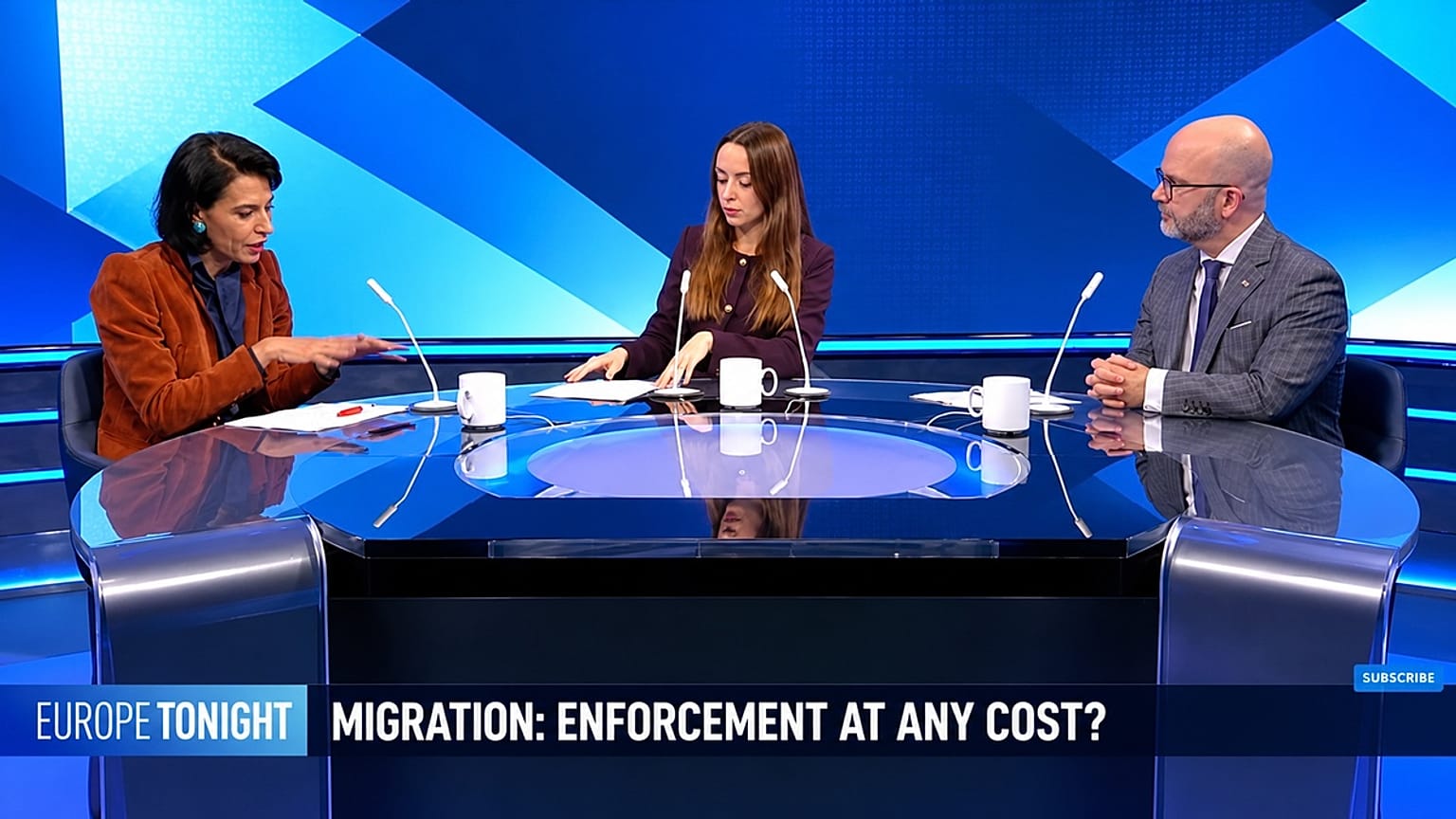













On Euronews' first edition of Europe Tonight, presenter Mared Gwyn Jones led a debate on Europe's latest migration crackdown, after five EU countries announced a partnership with Rwanda to establish deportation hubs for irregular migrants.
In the first edition of Euronews' new flagship show, Europe Tonight, presenter Mared Gwyn Jones brought viewers the latest analysis of the stories making headlines over the weekend and on Monday.
 ADVERTISEMENT
Jones opened the programme with the latest EU developments on migration, as five countries - Greece, Denmark, Germany, Austria and the Netherlands - announced a partnership with Rwanda to establish deportation hubs for irregular migrants, with the first pilot centres expected to be operational by mid-2027.
Our correspondent Vincenzo Genovese, reporting from Vienna, said it marked an unprecedented move in EU migration policy, with the bloc sending irregular migrants to a country with which they have no previous connection - a move compared to Donald Trump's approach in the US.
Danish Prime Minister Mette Frederiksen called the agreement a "game changer," saying it would help European countries regain control and remove incentives for illegal migrants.
According to people familiar with the negotiations, the first facility will accommodate around 100 people. The hub would consist of open facilities rather than closed deportation centres, and migrants would be free to move around the country. The goal is to give them the chance to integrate into local society and the labour market.
The EU law enabling return hubs outside the bloc states that only non-EU countries “where international human rights standards are respected” are eligible.
Rwanda has a questionable track record on human rights. However, Rwanda's minister of the interior, Vincent Biruta, said the country was ready, had good experience in dealing with migrants and would respect fundamental rights.
Legal challenges could emerge when deportations begin next year, as happened with the UK-Rwanda agreement.
On Monday, Frederiksen added that she had a strong feeling that other countries would join the scheme.
Nineteen of the twenty-seven EU governments support the deportation plan. Only France and Spain have made clear their opposition to it. Italy already has its own agreement with Albania.
THE DEBATE
MEPs Charlie Weimers and Abir Al-Sahlani discuss Rwanda
Jones hosted Swedish MEP Charlie Weimers, a Member of the European Parliament since 2019 and part of the European Conservatives and Reformists group, and Iraqi-born Swedish MEP Abir Al-Sahlani of the Renew Europe Group, who has also been an MEP since 2019, to debate the Rwanda "Return Hub."
Weimers said he agreed with Frederiksen, adding that he thought the policy was a "game changer." Noting that "every system" starts small, he said it would be successful if it led to further steps in the future to address migration policy in the EU.
Al-Sahlani pondered the feasibility of Rwanda returning migrants to their countries of origin, questioning how Rwanda would be able to carry out such returns when European countries themselves had struggled to do so.
“If we in Europe were not able to send them back to their countries, what makes us believe Rwanda will be able to?” Al-Sahlani asked, citing concerns over Rwanda's dependence on development aid and security concerns, as well as other unanswered questions.
Weimers calls deal a 'deterrent'
Meanwhile, Jones challenged Weimers over the cost-effectiveness of the proposed centres, citing Italy’s Albania scheme, which is costing Italian taxpayers €670 million over five years while handling only 0.3% of illegal arrivals into Italy. But Weimers described the new deal as being intended as a "deterrent" to those considering illegally migrating to Europe.
Al-Sahlani also criticised the growing influence of far-right narratives on European migration policy, arguing that governments were failing to use existing legislation and tools effectively.
The Renew Europe Group MEP further accused political leaders of portraying refugees as a threat and making them scapegoats for wider societal problems. She also warned that migration debates were increasingly driven by emotion rather than facts, fuelled by the misuse of statistics, selective truths and fabricated stories that vilify people seeking refuge.
Don't forget to join us tomorrow at 6 p.m. for the latest analysis of Europe's top headlines.