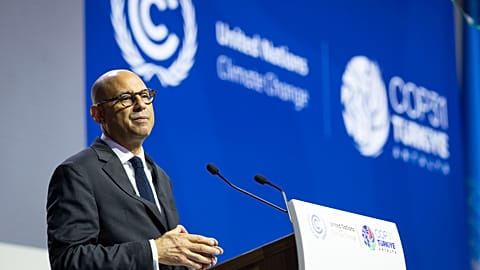













As the health impacts of climate change become increasingly difficult to ignore, COP31 is putting healthcare systems and their ability to adapt at the centre of discussions on the first day of the UN climate conference.
Just a fraction of global climate finance is reaching healthcare, leaving health systems struggling to prepare for the growing impact of extreme heat, floods and droughts, researchers warned on Monday at COP31.
 ADVERTISEMENT
"Health financing is only a very, very minor part, with 1% of overall climate finance spending," said Dennis Tänzler, executive director at Adelphi Research, an independent think tank specialising in environmental and development policy.
The funding shortfall comes as rising temperatures increase demand for medical services, threaten healthcare infrastructure and expose millions of workers to heat-related illnesses.
In 2023, heat was associated with an estimated 710,000 deaths worldwide, with around 71% attributed to human-caused climate change, according to the 2026 Lancet Countdown report on climate change and health.
"And that has not been the hottest year," said Stella Hartinger, regional director of the Lancet Countdown for Latin America. "Since then, 2024 was an even harder year, 2025, and now 2026. So these values are going to continue to increase."
This year in Europe alone, provisional estimates of excess mortality across Europe exceeded 30,000 people over the summer, with approximately 16,000 excess deaths estimated during the 22–28 June heatwave alone, according to the UN.
Preparing healthcare systems
Brazil illustrates the challenge facing countries trying to adapt their healthcare systems to a warming climate. The country has a universal, publicly funded healthcare system, but growing climate risks and deep social inequalities are putting pressure on its ability to protect vulnerable communities.
Daniel Porcel, from Brazil's Talanoa Institute, said financing remained a major obstacle to preparing the country's healthcare system, particularly when it came to protecting vulnerable communities far from major cities and ensuring hospitals and other healthcare facilities could withstand increasingly extreme weather.
"How do we make SUS ready for the new climate reality?" Porcel said, referring to Brazil's Sistema Único de Saúde (SUS), which provides free healthcare to the population.
Brazil approved a national climate adaptation plan last year, including 16 sectoral plans, one specifically dedicated to health. But Porcel said more investment was needed to strengthen healthcare infrastructure, train medical professionals and protect communities most exposed to climate risks.
The funding gap is part of a wider problem facing countries worldwide. While governments are increasingly recognising the health consequences of climate change, investment in preparing healthcare systems has not kept pace with the risks.
Rising temperatures are also taking an economic toll on households, according to a separate analysis by Adelphi Research covering eight countries: Bangladesh, Brazil, France, India, Indonesia, Italy, Nigeria and South Africa.
Heat stress forces workers to reduce their hours, take additional breaks or stop working altogether, while heat-related illnesses increase out-of-pocket medical expenses, particularly in countries where access to health insurance and paid sick leave is limited.
Workers in agriculture and construction are particularly exposed. In Bangladesh, India, Indonesia and Nigeria, workers in these sectors are already losing the equivalent of around 20 working days or more annually because of heat stress, according to Tänzler.