

















Good morning. This is Luca Bertuzzi, steering the newsletter this week. In this edition: Europe fights for a seat at the Ukraine peace table, Israeli opposition leader Gadi Eisenkot was tasked with forming a government, Poland mourns the deadly Kraków attack and von der Leyen heads to the Black Sea.
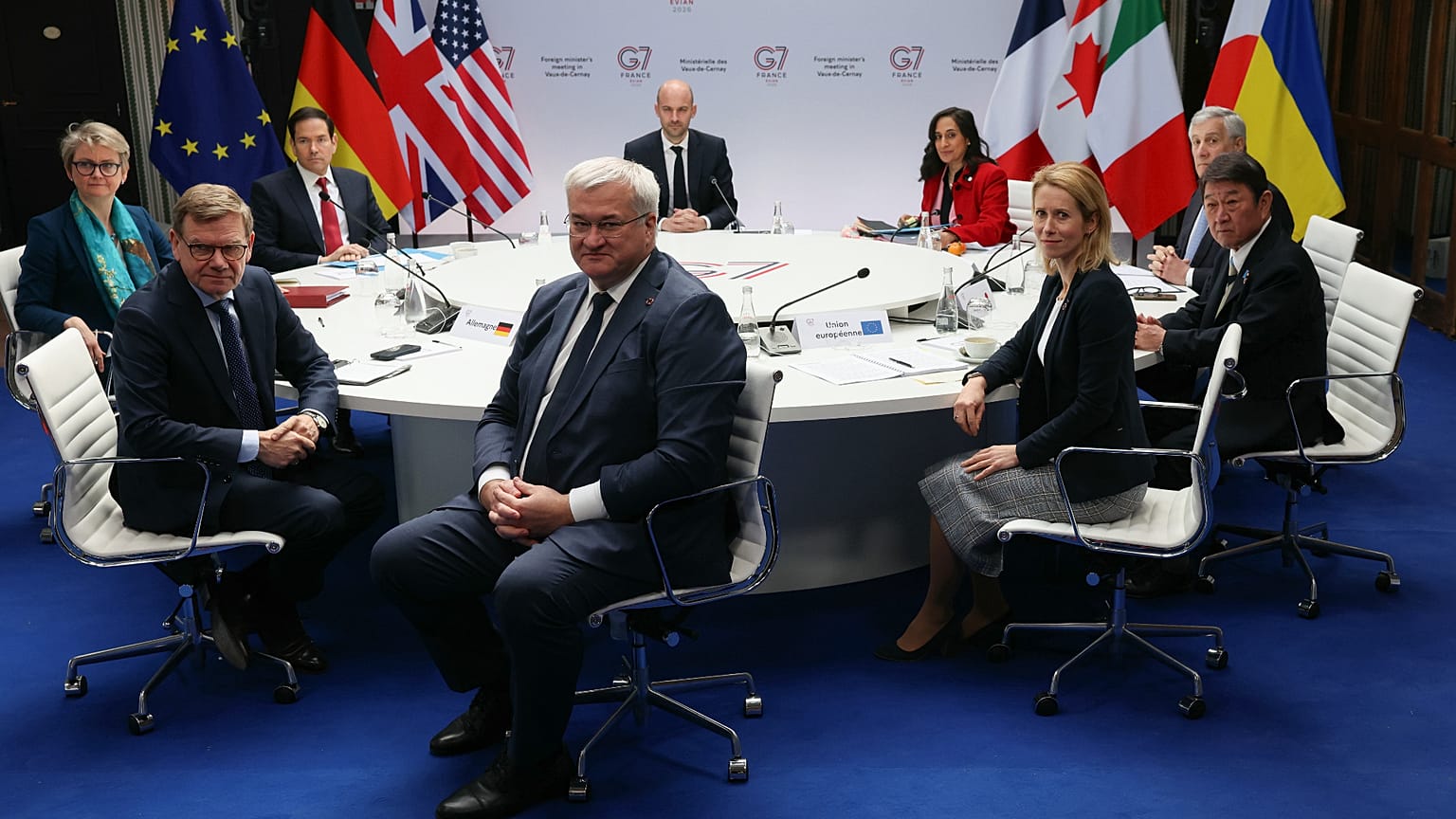
Save me a seat. Europeans want to make sure they have a say in ending Russia’s war against Ukraine, and the clock is ticking. Foreign ministers gather in Paris on Monday and Tuesday for a G7 meeting, just days before US-mediated talks between Moscow and Kyiv open in Abu Dhabi.
 ADVERTISEMENT
French Foreign Minister Jean-Noël Barrot said on Sunday that Europeans would be “well represented” at the Abu Dhabi discussions and that France would take part, though he did not say who would go or in what capacity.
The talks, scheduled for 10–11 November, are expected to bring together Russian, Ukrainian and US delegations to discuss a potential ceasefire and the security arrangements that could accompany an end to the war.
The G7 ministers meet under France’s presidency, with support for Ukraine high on the agenda: military capabilities, financial assistance and energy support, alongside the Middle East and other crises.
Ukraine’s Foreign Minister Andrii Sybiha is expected to join on Tuesday for a dedicated session on support for Kyiv and in preparation for the Abu Dhabi talks.
For the Europeans, the central aspect is to defend not only Ukraine but also European security in the negotiations, after US President Donald Trump has touted a major agreement involving Ukraine and potentially all of Europe, without offering details.
From today until 22 November, the Franco-British-led coalition of the willing is conducting a military exercise in Poland, involving 2,800 troops from 11 countries, a crucial test to showcase its credibility and preparation to put in place security guarantees in a post-War Ukraine.
On Monday, France will also host a donor conference with the European Bank for Reconstruction and Development and Ukrainian authorities to raise funds to repair the damaged Chernobyl containment structure.
Behind the diplomatic flurry lies a growing fear in European capitals that decisions on the continent’s security could be taken without them. Last week, Italian Prime Minister Giorgia Meloni called for a more coordinated European approach and a clear mandate for who will represent the EU in the talks.
European Council President António Costa has agreed to put EU representation in the peace talks on the agenda of the informal EU leaders’ meeting in Dublin on Friday.
An anti-Bibi coalition. Netanyahu's grip on power is being tested as Eisenkot gets his first chance to form government, Sasha Vakulina reports.
Israeli President Isaac Herzog on Sunday tasked opposition leader Gadi Eisenkot with forming the country's next government, giving the former military chief the first opportunity to replace Benjamin Netanyahu as prime minister.
The decision follows the 27 October election, which left neither bloc with a parliamentary majority. Eisenkot has 28 days to assemble a coalition, with a possible two-week extension, Sasha writes.
Arab-led parties, which secured a record 19 seats amid high voter turnout, could prove decisive. Ra'am has backed Eisenkot, while the Joint List has offered to support him from outside the coalition in an effort to end Netanyahu's long hold on power.
But negotiations are expected to be difficult, with some of Eisenkot's potential coalition partners opposed to relying on Arab-led parties, and deep disagreements remaining over Israel's wars and settlement expansion in the occupied West Bank.
Poland mourns deadly Kraków shooting. European leaders have voiced solidarity with Poland after a shooting in the southern city of Kraków left six people dead and 16 injured, with EU flags flown at half-mast in tribute to the victims.
A gunman opened fire in Kraków’s historic Main Market Square on Saturday, killing six people and injuring 16, including two police officers. The suspect, a 24-year-old Polish man, was shot by police and arrested. He remains in critical condition.
Polish authorities said preliminary findings suggested far-right ideology may have driven the suspect, though investigators have yet to establish the precise motive. Prime Minister Donald Tusk has called the shooting a terrorist attack, and investigations are ongoing.
Jacek Siewiera, the former head of Poland's National Security Council, told Euronews that it was a huge success that the country managed to avoid terrorist attacks for the past three decades, but the security apparatus fell short in this case.
The attack has drawn messages of solidarity from European leaders including French President Emmanuel Macron, German Chancellor Friedrich Merz and Meloni.
Poland has declared two days of national mourning, on Sunday and Monday.
Europe's bleak sea security. Commission President Ursula von der Leyen travels to Romania and Bulgaria to discuss Black Sea security, as Russian drone attacks on commercial shipping raise fears for the safety of maritime traffic and critical infrastructure.
She will meet Romanian President Nicușor Dan and Prime Minister Luca Niculescu in Bucharest on Monday, then head to Bulgaria on Tuesday for talks with Prime Minister Rumen Radev and a visit to the Nikola Vaptsarov Naval Academy in Varna.
The trip comes as Russia’s war spills into the Black Sea. Recent drone attacks have exposed how vulnerable maritime infrastructure and shipping routes are close to EU and NATO territory.
One proposal on the table is a Black Sea maritime security hub to improve surveillance, information-sharing and the protection of critical infrastructure. Romania and the Commission have already discussed phasing it in, with the aim of complementing NATO’s military activities in the region.
Russian strikes on Ukraine leave 850,000 without power as Zelenskyy reports drone attack on Komyshuvakha
Zelenskyy said Russia had launched a drone strike on the site of a recent attack on Komyshuvakha, where rescuers have been carrying out search operations following a bombing that killed at least 55 people on Monday.
Russian strikes on Ukraine overnight reportedly left more than 850,000 people without power across the country.
Ukrainian energy firm DTEK said Russian forces had launched a "massive attack" on Ukraine's energy sector, targeting key facilities in the eastern Dnipropetrovsk region.
"Over 600,000 residents of the region in the Pavlohrad, Samar, Kamianske and Dnipro districts, as well as in the city of Dnipro itself, have been left without power," the company said. Power is gradually being restored in the region, authorities later announced.
Ukrainian President Volodymyr Zelenskyy added that there were widespread power outages across the nation, including in Kharkiv Oblast in the northeast and the Zhytomyr region in the northwest, where he said 140 apartment buildings were without heating following a Russian strike.
Nathan Rennolds has the story.
More from our newsrooms
Canary Islands demand urgent government action amid surge in migrant arrivals
The president of the Canary Islands has announced that Spanish Prime Minister Pedro Sánchez has agreed to convene an emergency meeting of the Interministerial Commission on Immigration on Tuesday to address the growing pressure facing the island of El Hierro following a recent surge in migrant arrivals. Christina Thykjaer has the report.
‘We need to change everything’: Mélenchon uses Le Bourget rally to press home his programme
The right to vote at 16, a Sixth Republic as a “new ecological state”: the four-time Élysée candidate outlined his presidential programme to more than 20,000 supporters. A further show of strength against a backdrop of social unrest in the country. My colleagues Alexander Kazakevich and Valérie Gauriat have more.
Europe needs Cold War-like deterrence for AI warfare, Poland says
The rise in AI-powered cyberattacks requires Europe to build a deterrence system similar to the one that prevented mutual destruction during the Cold War, Polish Deputy Prime Minister Krzysztof Gawkowski has said. Jorge Liboreiro has the details.
We’re also keeping an eye on
- European Commission President Ursula von der Leyen is in Bucharest.
- The Economic and Financial Affairs Council is taking place in Brussels.
- Commission Executive Vice-President Teresa Ribera will be in Lisbon for the public presentation of the "Centre for Climate Security and Resilience".
- High-Representative Kaja Kallas attends the G7 Foreign Ministers meeting in Paris.
That’s it for today.