




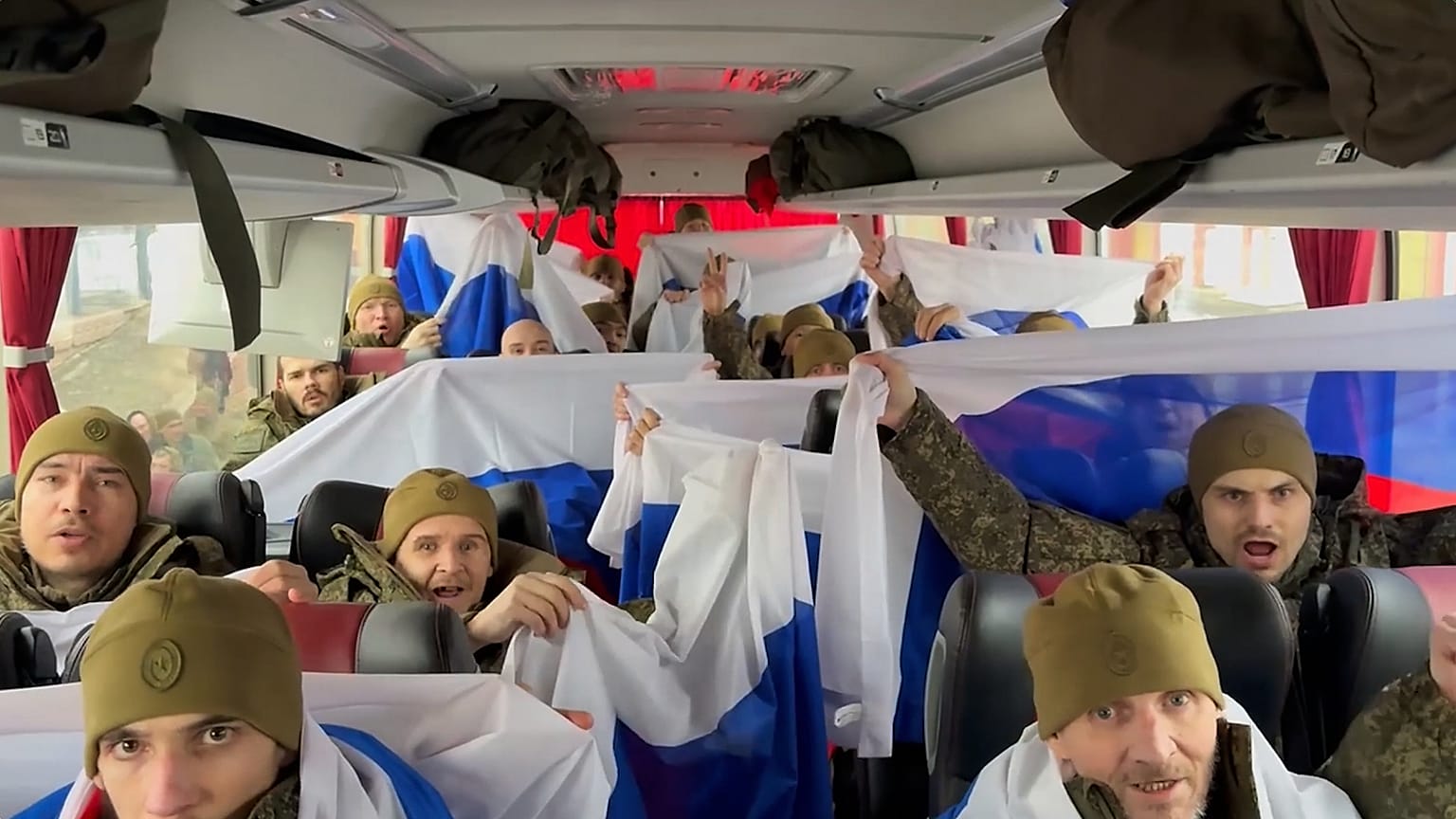













Ukraine has shared the names of more than half a million Russian soldiers, but fewer than 1% have been added to the EU’s Schengen security database. Brussels is now exploring ways to overcome the legal hurdles amid growing concerns over Russian security threats.
EU countries are struggling to keep Russian soldiers and war veterans out of Europe because of legal and bureaucratic obstacles that have prevented them from adding hundreds of thousands of names to the bloc's shared security database.
 ADVERTISEMENT
Ukraine has supplied European authorities with the identities of more than half a million Russian soldiers, amid growing fears that combatants returning from the frontline could pose a security threat.
But after almost a year of work, EU countries have managed to enter fewer than 1% of those names into the Schengen Information System (SIS), which border guards use to identify people who should be refused entry.
Ukraine has been compiling a database of Russian soldiers identified on the frontline and systematically sharing it with Estonia. Tallinn, in turn, passes the information to countries including Germany, Lithuania, Poland and Czechia.
In recent months, officials in these countries have been painstakingly entering the names into SIS, the EU's main shared database for security, border management and law enforcement.
Border guards routinely consult it when checking travellers at the external borders, and police can use it for law-enforcement purposes.
Originally conceived as a security measure to compensate for the abolition of internal border controls within the Schengen area, the system has gradually expanded to cover a much broader range of security and migration alerts.
There is, however, a practical and legal obstacle. SIS was not designed as a mass watchlist of foreign military personnel who have never set foot in Europe. Its legal framework requires authorities to establish specific grounds for each alert, including an individual assessment of the threat a person poses.
As a result, countries trying to keep Russian combatants out have had to work within a system built around individual alerts and decisions, not a blanket mechanism for flagging entire categories of foreign nationals.
Individual assessments
Kyiv typically shares information identifying Russian soldiers and their alleged involvement in the war, along with details such as their location on the frontline. That does not automatically meet the legal bar for an SIS entry.
Under EU rules on SIS alerts for refusal of entry and stay, national authorities must carry out an individual assessment and establish that the person’s presence would threaten public policy, public security or national security.
This means authorities cannot simply upload Ukraine’s database into SIS. They must gather and assess further information on each person, establish the legal grounds and take a formal decision before issuing an alert. The process is lengthy and resource-intensive, especially for a database of hundreds of thousands of names.
Given the high death toll among Russian troops on the frontline, some of those listed may already be dead. Despite these inefficiencies, national authorities have been left with no better option.
“At this stage, we have nothing better to do than put these people in the SIS; it’s the most effective system,” an EU diplomat told Euronews, noting that when one member state enters a name, the alert becomes binding on all the others.
It is not the first time national authorities have run into this problem. A very similar case arose with former ISIS members, but those numbered a few hundred, not hundreds of thousands.
Ban on combatants
EU institutions and governments have therefore spent recent months discussing technical ways to bar current and former Russian combatants from European soil.
The issue was a sticking point in negotiations on the latest sanctions package against Russia, adopted in July, and was watered down at the insistence of Italy and France.
Under the final compromise, the package does not apply the combatants ban directly but makes it conditional on implementing measures. The Commission is working on them and could present them as early as the next Foreign Affairs Council on 16 November.
Meanwhile, Russia’s hybrid threats have become increasingly physical. The most prominent case is the attempted drone attack on Leipzig airport in August, which Berlin formally attributed to Moscow in September.
Shifting security landscape
The episode has shifted perceptions of the Russian threat across Europe. Northern and eastern European countries are pushing to restrict tourist visas for Russians, while the likes of Italy, France and Spain issue them in large numbers.
At an informal ministerial meeting in early September, EU foreign policy chief Kaja Kallas said there was “broad support” for moving forward with a ban on tourist visas for Russian soldiers and war veterans.
“The moment you say it was Russia, you need to react, or you are inviting more attacks. France understands this and has moved; it is only Italy standing in the way now,” a second EU diplomat told Euronews on condition of anonymity.
While France’s position appears to have shifted, Italy remains sceptical, fearing its consular services would be overloaded identifying Russian ex-combatants among visa applicants, as well as potential legal challenges.
Rome, however, faces an awkward fact: one of the main suspects in the Leipzig attempted attack was a Belarusian citizen who entered the EU on a tourist visa issued by the Italian consulate in Minsk. The other was a Russian-born Latvian citizen.
Political opposition seems to be gradually giving way, but the question remains technical and, above all, legal. EU officials fear a flood of court challenges, which makes finding a solid solution all the more pressing.
Technical solutions
The EU delegation in Moscow initially held several rounds of consultations with member states' consulates on operational challenges. But consular procedures are not the main obstacle, and arrangements are expected to be put in place relatively quickly.
A Commission paper circulated during the last sanctions negotiations, seen by Euronews, proposed expanding the list of supporting documents Russians must submit for an EU visa to include military booklets for men of conscription age.
Officials also worry about circumvention: Russian authorities might systematically forge the booklets or even supply entirely false identities. That is why certain EU countries, like Czechia, only allow Russians with biometric passports to enter.
“The question is not so much whether we will respond or not but if the measure will be solid or not,” an EU official with direct knowledge of the matter told Euronews. “We need to put a system in place, but we also need to make sure it cannot be circumvented.”
A longer-term fix would be to amend the Schengen Borders Code, giving member states more flexibility in managing SIS and moving from individual listings to a new category covering people believed to pose a security threat.
This could be paired with a revision of the Visa Code, which the Commission is expected to propose in early 2027, giving the EU the power to adopt coordinated restrictions on specific categories of travellers, including combatants from an aggressor state.
Diplomatic restrictions
A separate track concerns further limits on the movement of Russian diplomatic and consular staff, also seen as a security liability amid escalating hybrid attacks.
The 19th sanctions package already restricted Russian diplomats’ movement by requiring them to notify authorities in a second member state before travelling to or transiting through it.
But while advance notification is mandatory, an optional mechanism requiring diplomats to obtain prior authorisation has largely gone unused.
Across these initiatives, the EU faces the same challenge: finding a practical, legally sound solution that preserves a coordinated European approach while delivering a firm response to Russia's hybrid threats.