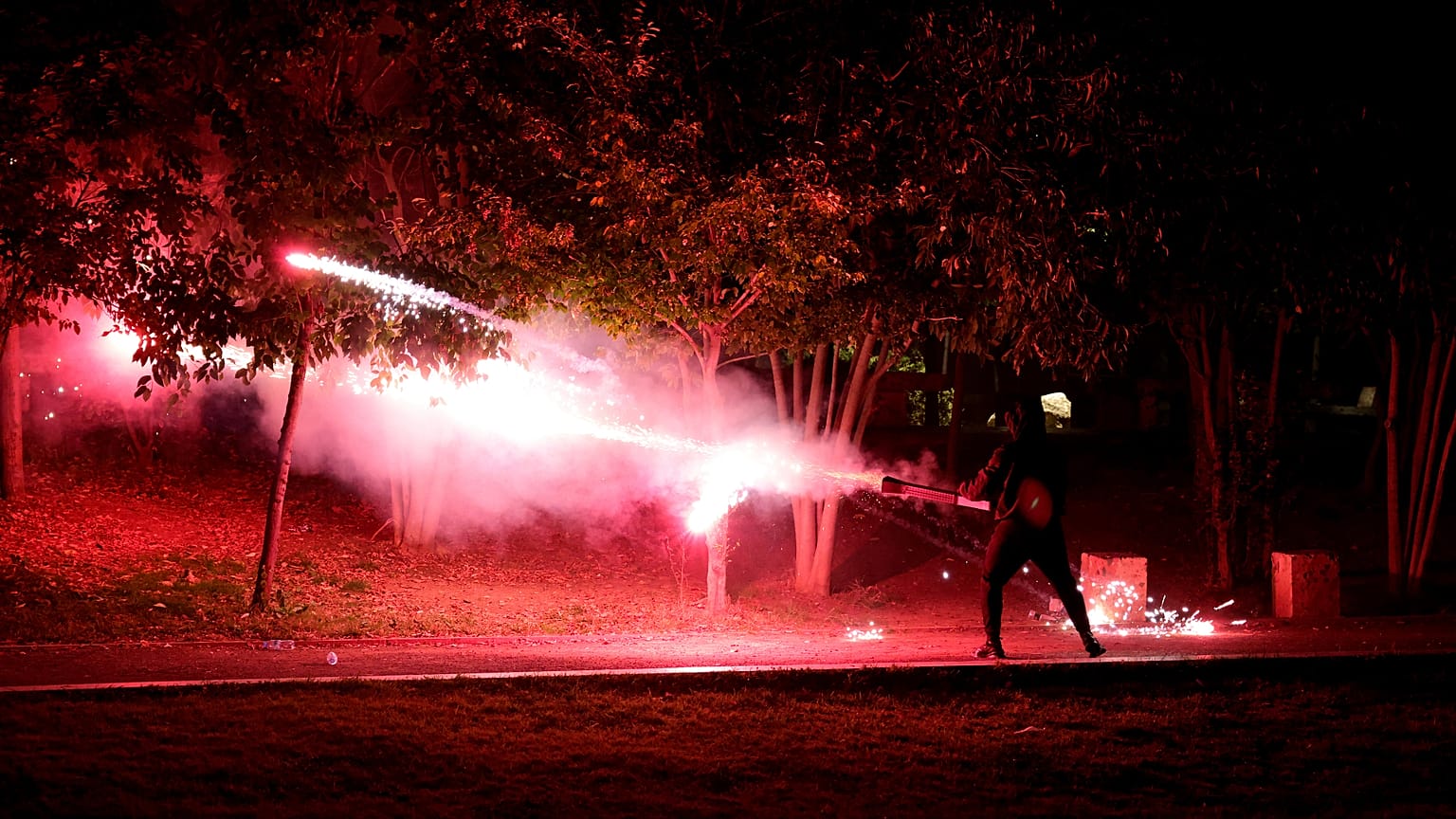













Fireworks may be a staple of celebrations, but their health risks are prompting experts to call for stricter regulations and greater public awareness.
New Year’s Eve, national days and election victories: fireworks light up European skies as people celebrate major occasions.
 ADVERTISEMENT
However, amid the joy and festivities, fireworks injure thousands of people every year, experts warn.
These products pose an underestimated danger to public health and require stronger regulation, according to experts from the University of California, Los Angeles (UCLA), who wrote an opinion piece in the scientific journal The BMJ.
Common medical emergencies include severe burns, blast injuries caused by shockwaves, traumatic brain injuries, finger amputations and permanent blindness. These injuries disproportionately affect children, young males, rural communities, people from lower socioeconomic groups and innocent bystanders, the authors wrote.
To reduce harm, the authors are calling for stronger regulations and sustained public education campaigns, both in the US and internationally.
They argue that medical organisations and public health bodies should encourage people to attend professional public displays rather than setting off fireworks at home, helping to counter social media messages that promote private use.
They also recommend school-based campaigns targeting primary and secondary school pupils, using real-life stories and images of people affected by firework injuries to highlight the consequences of mishandling them.
Finally, the authors suggest introducing graphic warning labels showing injuries on fireworks packaging, similar to those used on cigarette packets, to raise awareness of the risks.
Situation in Europe
Across Europe, thousands of people seek medical care after firework-related injuries every year.
The Netherlands is one of the countries that systematically collects data on firework-related injuries. During the 2025-2026 New Year’s celebrations, an estimated 1,239 people required emergency medical treatment at hospital emergency departments or out-of-hours general care, representing a 7% increase in injuries from the previous year.
In Italy, the Ministry of the Interior confirmed that 283 people were injured during New Year's Eve celebrations, 54 of whom required hospitalisation.
However, many countries do not maintain nationwide registers of such incidents.
Healthcare professionals stress that systematic national data collection is urgently needed to accurately measure the true scale of firework-related injuries.
Despite the immediate health risks, fireworks represent a significant and growing market in Europe.
The latest Eurostat data on fireworks imports, published in December 2025, showed that the EU imported 120,000 tonnes of fireworks from outside the bloc in 2024, worth €406.7 million. This represented a 9.5% increase in volume and a 21.5% increase in value compared with 2023.
The European Commission’s 2025 staff working document also states that EU pyrotechnic imports have increased in recent years, reaching a record €452 million in 2024, with fireworks accounting for the largest share.
The Netherlands and Germany dominate EU imports. In 2024, the Netherlands received 37.0% of extra-EU fireworks imports and Germany 35.6%, followed by Poland at 7.4%
How are they regulated in Europe?
Across the EU, a European directive governs consumer fireworks, harmonising product safety requirements but allowing each member state to impose further restrictions on sale, possession, and use.
The EU framework divides fireworks into four categories, based on their level of hazard and intended use:
For very low-hazard, indoor and close-range items such as some sparklers and party poppers, the minimum age is 12. The age limit is higher in Germany and France, where
low-hazard outdoor fireworks for use in a confined area require a minimum age of 16 and 18, respectively.
Medium-hazard fireworks, intended for outdoor use in large open spaces and use only by people with specialist knowledge, have an EU minimum age of 18.
Some countries, including the Netherlands, Germany, France and Italy, have introduced more restrictive national rules.